Lion's Mane Mushroom: The Guide to Species, Part and Dose
Scientifically reviewed by Dr. Danielle Oncer, PharmD (pharmacology, dosing & safety) and Jon Klipstein (supplement formulation expert, Die Tryin Co.).
Short answer
Lion's mane mushroom (Hericium erinaceus) is studied for focus and memory, and which compounds you get depends on the part: erinacines concentrate in the mycelium, hericenones in the fruiting body. Trials used 3,000 mg/day of fruiting-body powder and 1.8 g/day taken solo. Our scoop holds 1,000 mg.
Two products can both say "lion's mane" on the front, both be telling the truth, and share almost none of the same active molecules. That isn't a scandal, it's botany — the compounds this mushroom is known for split along the part it grew from, and most pages selling you one version or the other never bring it up.
I'm Onur, a physiologist and chemist by training and the person who formulated the blend this site sells, so take that as a disclosure and a qualification at the same time.
This page is the map, not the deep dive. Four of our posts go further on lion's mane than this one will, and I'll hand you to each by name. What I want to keep here is the part almost nobody prints: which compounds live where, what that does to the research you're being shown, and where our own 1,000 mg sits against the doses the trials actually used.
What exactly is lion's mane mushroom?
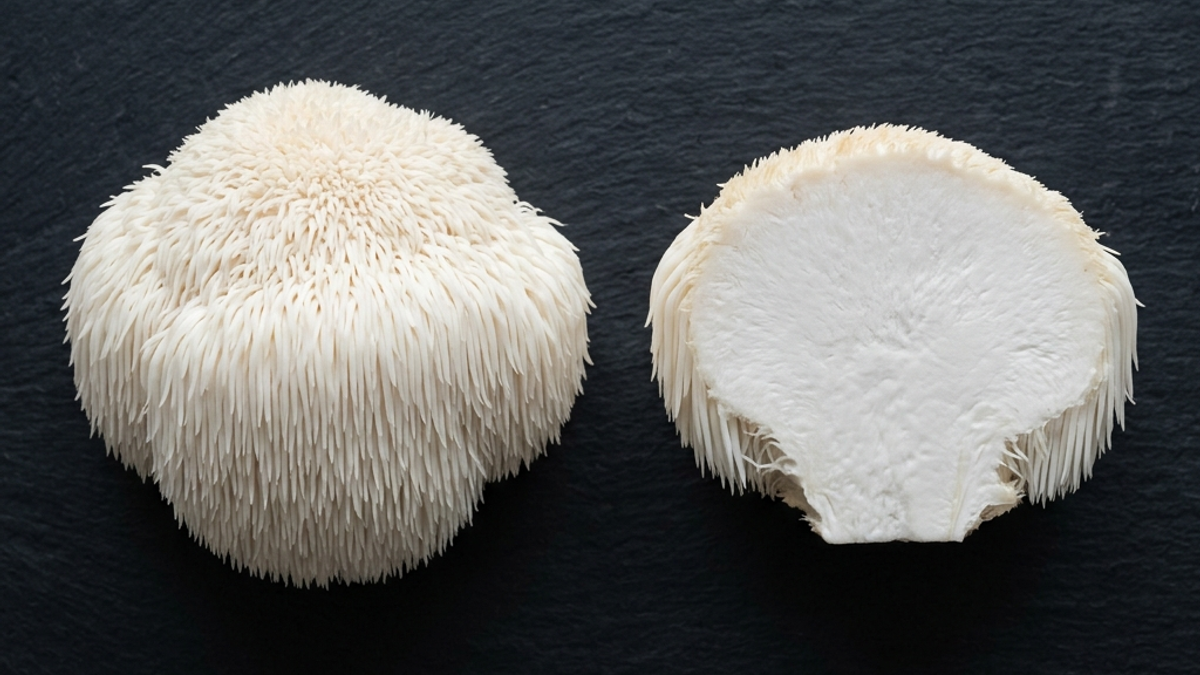
Hericium erinaceus — one species, no ambiguity. It's the white mushroom that grows in cascading spines rather than a cap and stem, and you'll meet it under a handful of other names: yamabushitake in Japanese, hóu tóu gū in Chinese, bearded tooth, monkey head. All the same organism.
That sounds like a boring paragraph. It is the most reassuring one in this category. Elsewhere on the same shelf, two mushrooms from entirely different genera are both sold in English as "tiger milk mushroom," and we had the wrong one named on our own pages until this August. Correcting it meant rewriting several. Lion's mane has none of that. Species named, question closed, and you get to spend your attention on the two things that actually vary between products.
Erinacines or hericenones — which one is in the jar you're holding?
The part decides, and this is the single most decision-relevant fact about buying lion's mane.
Hericenones concentrate in the fruiting body — the visible mushroom, the thing in the photograph. Erinacines concentrate in the mycelium — the root-like network that grows through the substrate before any mushroom forms. Two different chemical families, both studied in connection with the same neurotrophic signaling story, living in two different parts of the same organism. A product built from one is not a slightly weaker version of a product built from the other. It's a different set of molecules.
Now the consequence, which is where this gets useful.
The most exciting-sounding literature on this mushroom is erinacine literature. A 2025 PRISMA systematic review of erinacines, pooling cellular and rodent models, reports dose-dependent effects on cognitive and behavioral outcomes and activation of pro-survival signaling (PMID 40626304 (opens in new tab)) — and every study in it is cells or animals. Meanwhile the human cognition trial everyone cites, the 16-week double-blind one, used fruiting-body powder (PMID 18844328 (opens in new tab)).
So a mycelium product can gesture at a genuinely interesting shelf of mechanism papers. A fruiting-body product can gesture at the human trials. Neither gets a trump card: the erinacine work is preclinical and can't be extrapolated to people, and the human trials are small.
Ours is dual-extracted fruiting body, so hericenones are the family we're working with, and I'll say plainly why I made that call. It wasn't glamour. It was that I wanted our ingredient to be the same material as the trials I'd want us judged against.
One number I'm not going to give you: how much of either compound is in a scoop. We hold no hericenone assay, and the supplier's certificate of analysis for this ingredient does not measure hericenones, so a figure from me would be invention. Our manufacturer runs its own testing, which is not the same thing as independent third-party testing, and I won't call it that. The independent reports we have published, pesticides and heavy metals on one lot of the finished blend, are on our lab results page; none of them measures hericenones. The mechanism deep-dive, written by Danielle, is in lion's mane pharmacology; the part-versus-part manufacturing question lives in fruiting body vs mycelium.
Is 1,000 mg of lion's mane a real dose?
Here is our number and the studied numbers in one place, which is the only honest way to show them.
One scoop is 1,000 mg of dual-extracted fruiting-body lion's mane, listed on the label as its own line. The 16-week double-blind trial in 30 adults aged 50 to 80 used 3,000 mg a day (18844328 (opens in new tab)), and the cleanest solo-ingredient trial, 41 healthy adults over 28 days, used 1.8 g a day (38004235 (opens in new tab)).
So: our 1,000 mg sits at the bottom of the studied range, not the middle of it.
Two things sit on the other side of the scale, and both are arithmetic rather than argument. Our serving note is built so two scoops is a comfortable daily amount rather than an overdose, which puts lion's mane at 2,000 mg and well inside the range. And 1,000 mg of one named mushroom is more of that mushroom than a 2,000 mg six-species blend can give any single species — 2,000 split six ways averages about 333 mg each, and that's assuming an even split nobody has shown you. A disclosed number at the bottom of a range beats an undisclosed one anywhere in it.
Timing, consistency, and whether you can take too much are their own questions, and Danielle answers them properly in how much lion's mane per day.
Does lion's mane actually do anything?
Early evidence for cognition. Nothing louder than that, and anything louder you read is somebody's marketing.
The 16-week trial found higher cognitive-scale scores on 3,000 mg a day than placebo, but it ran in 30 adults aged 50 to 80 with mild cognitive impairment, so it gives you dose and direction and tells you nothing about what happens to a healthy 34-year-old. The 2023 placebo-controlled pilot gave lion's mane on its own to 41 healthy adults and found significantly faster performance on an attention task (p=0.005), but its subjective-stress result moved only as a non-significant trend (p=0.051), which is why you will never see us make a stress claim from it. Pooling the trials, a 2025 systematic review reported a combined weighted mean improvement of 1.17 points on a standard cognitive screen (40959699 (opens in new tab)) — real, and small.
Two citations get misused constantly, so I'll name them. The same-session study people quote for "you'll feel it in two hours" gave lion's mane combined with guayusa (38140277 (opens in new tab)), so it cannot tell you what lion's mane does alone. And the NGF and BDNF review that turns up under lion's mane headlines (40572619 (opens in new tab)) is about neurotrophins in general — useful background on why brain plasticity matters, not evidence about this mushroom.
Danielle takes that evidence apart study by study in lion's mane for focus and memory.
Which lion's mane page should you read next?
Five pages, and they don't overlap. Pick by the question you actually came in with.
- Lion's mane pharmacology — the mechanism. NGF, BDNF, which of its compounds are fat-soluble, and why your gut has a say in absorption. Read this if you want to understand it rather than just use it.
- Lion's mane for focus and memory — the evidence audit. Every human trial, what it measured, and what it can't support. Read this if you're deciding whether it's worth your money.
- Lion's mane for focus at work — the practical one. Fitting a non-stimulant into a real working day, and what "for focus" honestly does and doesn't mean at 3 p.m.
- How much lion's mane per day — dose, timing, consistency, tolerability, and when to ask a clinician.
- Reishi vs lion's mane — the comparison. Lion's mane is the one with cognitive trials; reishi is studied for immune modulation. Read this if you're choosing between them or wondering whether to take both.
Above all of them sits our complete guide to functional mushrooms, which is where lion's mane fits next to the other six.
What I'd check on any lion's mane label
Four things, in the order I'd check them.
Is the species named — Hericium erinaceus, in Latin, not just a marketing name? Is the part named, fruiting body or mycelium, so you know which compound family you're buying and which research applies? Is there a milligram figure for lion's mane specifically, rather than a blend total that could hide anything? And is it dual-extracted, water and alcohol, since the compounds don't all come out in one solvent — the reasoning is in dual extraction explained.
Then ask the harder question, of us as much as anyone: what can you actually show me? We publish every dose on the label and we tell you the part. We don't publish a potency figure, a beta-glucan percentage, or an extract ratio, because we don't have the assay in hand — and our organic and vegan certification is in progress, not finished. If a brand's numbers are all flattering and none of them are sourced, that's the tell. How to read a mushroom supplement label walks the whole panel, and our science page shows what we do and don't hold.
Who should ask a clinician first
Lion's mane is generally well tolerated across the studies we have, with mild stomach discomfort the most commonly reported complaint. That isn't the same as fine for everyone. Ask a physician or pharmacist before starting lion's mane, or any new supplement, if you're pregnant, nursing, taking prescription medications, or managing a medical condition. This is education, not medical advice, and nothing here is a reason to start, stop, or change anything you've been prescribed. Broader picture: are functional mushrooms safe.
These statements have not been evaluated by the Food and Drug Administration. This product is not intended to diagnose, treat, cure, or prevent any disease.
References
- Mori K, Inatomi S, Ouchi K, Azumi Y, Tuchida T. Improving effects of the mushroom Yamabushitake (Hericium erinaceus) on mild cognitive impairment: a double-blind placebo-controlled clinical trial. Phytotherapy Research. 2009;23(3):367–372. PMID: 18844328 (opens in new tab) · doi:10.1002/ptr.2634 (opens in new tab)
- Docherty S, Doughty FL, Smith EF. The acute and chronic effects of lion's mane mushroom supplementation on cognitive function, stress and mood in young adults: a double-blind, parallel groups, pilot study. Nutrients. 2023;15(22):4842. PMID: 38004235 (opens in new tab) · doi:10.3390/nu15224842 (opens in new tab)
- Menon A, Jalal A, Arshad Z, Nawaz FA, Kashyap R. Benefits, side effects, and uses of Hericium erinaceus as a supplement: a systematic review. Frontiers in Nutrition. 2025;12:1641246. PMID: 40959699 (opens in new tab) · doi:10.3389/fnut.2025.1641246 (opens in new tab)
- Spangenberg ET, Moneypenny A, Bozzo GG, Perreault ML. Unveiling the role of erinacines in the neuroprotective effects of Hericium erinaceus: a systematic review in preclinical models. Frontiers in Pharmacology. 2025;16:1582081. PMID: 40626304 (opens in new tab) · doi:10.3389/fphar.2025.1582081 (opens in new tab)
- La Monica MB, Raub B, Ziegenfuss EJ, et al. Acute effects of naturally occurring guayusa tea and Nordic lion's mane extracts on cognitive performance. Nutrients. 2023;15(24):5018. PMID: 38140277 (opens in new tab) · doi:10.3390/nu15245018 (opens in new tab)
- Fiore M, Terracina S, Ferraguti G. Brain neurotrophins and plant polyphenols: a powerful connection. Molecules. 2025;30(12):2657. PMID: 40572619 (opens in new tab) · doi:10.3390/molecules30122657 (opens in new tab)