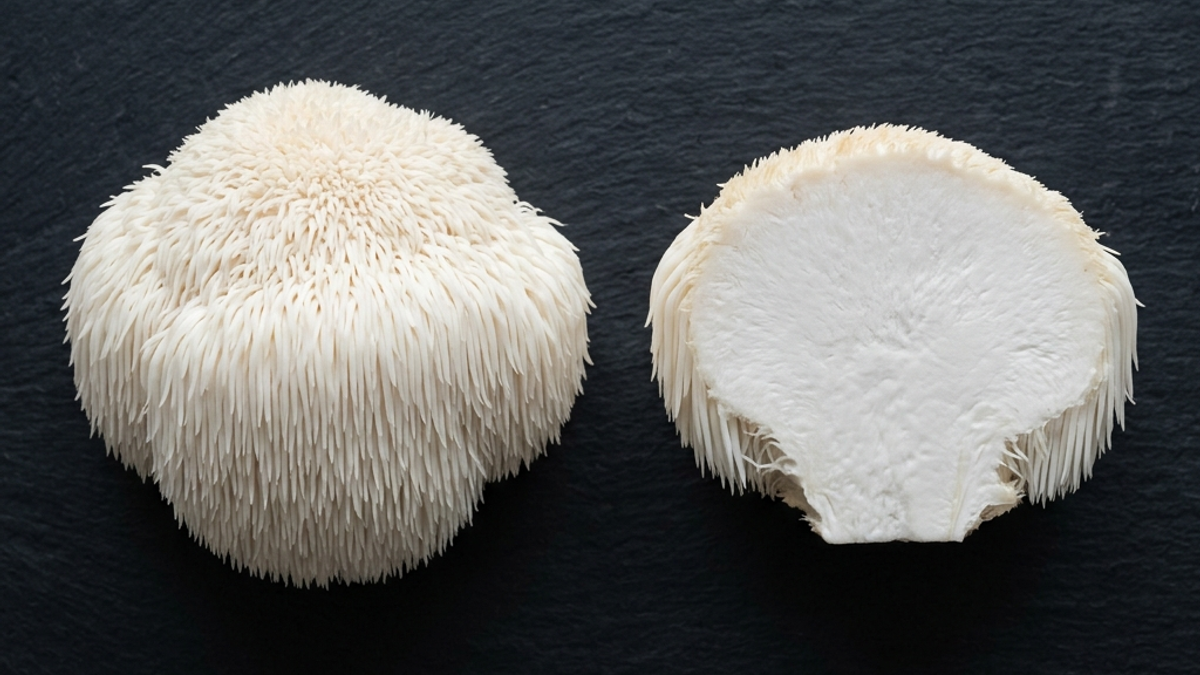
Lion's Mane for Focus and Memory: What the Evidence Supports
Scientifically reviewed by Onur Oncer, B.S. (B.S. Physiology, published researcher).
Short answer
Human studies on lion's mane (Hericium erinaceus) point to modest support for focus, memory, and mental clarity — usually at 1,000–3,000 mg per day of properly extracted fruiting body, built over weeks, not hours. The dramatic 'grows new brain cells' claims come from cell and animal research, which is promising but a different kind of evidence. Our blend uses a real, label-stated 1,000 mg dose.

A quick note before we start: this is education, not medical advice. What any supplement does for you depends on your physiology, your other medications, and your goals. The numbers below are what published human studies actually used.
Lion's mane (Hericium erinaceus) is the most-searched ingredient in this whole category, and most of what's written about it lands in one of two places: breathless claims that it "regrows your brain," or a dismissive shrug that it's all hype. As a pharmacist, I find both unhelpful — because the real picture is more measured, and more useful, than either. So let's do the thing the marketing skips: separate what the human evidence supports for focus, memory, and mental clarity from the animal and cell research that everyone quotes but few label correctly.
This post is part of our complete guide to functional mushrooms. If you want the deeper mechanism story, that lives in the pharmacology of lion's mane; here I'm staying on the question most people actually ask: what should I realistically expect?
The honest split: human evidence vs. animal research
Almost every confident claim about lion's mane traces back to one of two very different bodies of work, and conflating them is where the overselling starts.
- Preclinical research — cells in a dish and animals — is where the famous "nerve growth factor" and "neurite outgrowth" findings come from. It explains a possible mechanism.
- Human trials measured something more grounded: cognitive test scores, reaction time, and mood in actual people. This is the evidence that tells you what a supplement might do for you.
Both are legitimate. But only the second kind answers "will this help me focus." Keeping them separate is the whole point of this article, so I'll flag which is which every time.
What the animal and cell research shows (and doesn't)
In the lab, lion's mane is genuinely interesting. Its two signature compound classes — hericenones (concentrated in the fruiting body) and erinacines (concentrated in the mycelium) — have been studied for their ability to nudge nerve growth factor (NGF), a protein that helps maintain neurons and the connections between them.
In an in-vitro study using a neuronal cell line (opens in new tab), an aqueous lion's mane extract induced NGF secretion and promoted neurite outgrowth — neurons extending new branches — in cell culture (Lai et al., 2013). A 2025 systematic review of erinacines in preclinical models (opens in new tab) pulled together the cellular and rodent work and found dose-dependent benefits on cognitive and behavioral outcomes, plus activation of pro-survival signaling pathways (Spangenberg et al., 2025).
Here's the honest line: this is all preclinical. You can't extrapolate "promoted neurite outgrowth in a dish" to "grows new brain cells in you." Cells and rodents are where hypotheses are born, not where human effects are proven. So the accurate way to describe this work is that lion's mane is studied for supporting neurotrophic signaling — not that it's a proven "grow new neurons" pill. Anyone selling it as the latter is running ahead of the evidence.
What the human trials actually support
Now the part that matters for a real person studying for an exam or grinding through a work week.
Older adults: the most-cited trial
The trial people quote most is a 2009 double-blind, placebo-controlled clinical trial (opens in new tab) in Phytotherapy Research, which followed older adults over 16 weeks at 3,000 mg/day of fruiting-body powder and measured higher scores on a cognitive function scale versus placebo (Mori et al., 2009). It's a real study with a real control group — but it's small (n=30), and it was run in adults with age-related cognitive decline, so I read it as dose-and-direction evidence, not a promise of anything for a healthy person. One trial is never the whole story.
Healthy adults: the cleaner signal
The fairer question is whether lion's mane does anything when you're not in a clinical group. The best citation here is a 2023 double-blind, placebo-controlled pilot trial in healthy young adults (opens in new tab), which gave 1.8 g/day of lion's mane to adults aged 18–45 for 28 days. Participants performed faster on a Stroop (attention) task even after a single dose, with a trend toward lower subjective stress over the month (Docherty et al., 2023). It's a small pilot, so I hold it loosely — but it's the cleanest "works on its own, in healthy people" signal we have, and it lines up with the same story.
Zooming out: what a review found
A 2025 systematic review of lion's mane as a supplement (opens in new tab) synthesized the randomized and pilot trials and reported a small average improvement on a standard cognitive screening score across the intervention groups (Menon et al., 2025). "Small" is the operative word — and exactly why I'd rather you hear it from us than from a label promising the moon. Modest, real support for memory and mental clarity is still worth having; it's just not magic.
A word on speed
There is a 2023 crossover trial reporting same-session effects of 1 g of lion's mane (opens in new tab) on working memory and reaction time within two hours (La Monica et al., 2023). I cite it for completeness, but with a caveat: that study compared lion's mane against a guayusa tea extract (which contains caffeine), so it isn't a clean read on what lion's mane alone does acutely. The durable, well-supported benefit is the slow, weeks-long one — which is how we'd frame a caffeine-free product anyway.
Why the dose decides everything
Here's where most products quietly fail. The human studies that show a benefit generally use 1,000–3,000 mg/day of properly extracted material. A lot of supplements are dosed around 500 mg — below the studied range before you account for anything else.
And "500 mg" isn't even a fixed amount of anything useful. Five hundred milligrams of mycelium-grown-on-grain can contain an order of magnitude less active compound than 500 mg of dual-extracted fruiting body. "1,000 mg of dual-extracted fruiting body" tells you something; "proprietary mushroom blend, 1,500 mg" tells you nothing, because you can't see how much lion's mane is actually in there. That's the entire game — and it's why our blend lists a real 1,000 mg lion's mane dose right on the label instead of hiding it. (For the full method: the functional mushroom dosing primer and how to read a mushroom supplement label.)
What to expect — honestly
Lion's mane is not caffeine and not a stimulant. The human research describes a gradual, weeks-long shift — cleaner focus, steadier attention, better word recall — usually noticeable around 2–4 weeks of consistent daily use. If a company promises you'll feel sharper within an hour, they've either added a stimulant or they're overselling.
For the work-and-study lane, that slow build is a feature, not a bug. Caffeine gives you a sharp peak and an afternoon crash; lion's mane offers a quieter baseline you don't have to keep re-dosing through the day. You can absolutely take it alongside your coffee. We dig into the daily-use version of this in lion's mane for focus at work, and the version built around long study sessions in caffeine-free focus for studying.
A quick word on safety
Lion's mane is generally well tolerated in the studies we have — the most commonly noted issues are mild, like stomach discomfort. Still, "natural" doesn't mean "automatically fine for everyone." As a pharmacist, I'd ask a pharmacist or physician first if you're pregnant, nursing, taking prescription medications, or managing a medical condition — not because lion's mane is risky, but because the right call always depends on the rest of your physiology and your medication list.
The bottom line
The human evidence supports lion's mane as modest, real support for focus, memory, and mental clarity — at a clinical-range dose, taken consistently for weeks. The spectacular "new brain cells" claims live in the preclinical lab and should stay labeled as such. Get the dose right (clinical range, fruiting body, a gut that absorbs it), be patient, and you're working with the evidence instead of around it. Anything louder than that is marketing.
References
- Lai PL, Naidu M, Sabaratnam V, et al. Neurotrophic properties of the lion's mane medicinal mushroom, Hericium erinaceus (higher Basidiomycetes) from Malaysia. International Journal of Medicinal Mushrooms. 2013;15(6):539–554. PMID: 24266378 (opens in new tab) · doi:10.1615/intjmedmushr.v15.i6.30 (opens in new tab)
- Spangenberg ET, Moneypenny A, Bozzo GG, Perreault ML. Unveiling the role of erinacines in the neuroprotective effects of Hericium erinaceus: a systematic review in preclinical models. Frontiers in Pharmacology. 2025;16:1582081. PMID: 40626304 (opens in new tab) · doi:10.3389/fphar.2025.1582081 (opens in new tab)
- Mori K, Inatomi S, Ouchi K, Azumi Y, Tuchida T. Improving effects of the mushroom Yamabushitake (Hericium erinaceus) on mild cognitive impairment: a double-blind placebo-controlled clinical trial. Phytotherapy Research. 2009;23(3):367–372. PMID: 18844328 (opens in new tab) · doi:10.1002/ptr.2634 (opens in new tab)
- Docherty S, Doughty FL, Smith EF. The acute and chronic effects of lion's mane mushroom supplementation on cognitive function, stress and mood in young adults: a double-blind, parallel groups, pilot study. Nutrients. 2023;15(22):4842. PMID: 38004235 (opens in new tab) · doi:10.3390/nu15224842 (opens in new tab)
- Menon A, Jalal A, Arshad Z, Nawaz FA, Kashyap R. Benefits, side effects, and uses of Hericium erinaceus as a supplement: a systematic review. Frontiers in Nutrition. 2025;12:1641246. PMID: 40959699 (opens in new tab) · doi:10.3389/fnut.2025.1641246 (opens in new tab)
- La Monica MB, Raub B, Ziegenfuss EJ, et al. Acute effects of naturally occurring guayusa tea and Nordic lion's mane extracts on cognitive performance. Nutrients. 2023;15(24):5018. PMID: 38140277 (opens in new tab) · doi:10.3390/nu15245018 (opens in new tab)