Fruiting Body vs. Mycelium Supplements: Which Is Better?
Scientifically reviewed by Dr. Danielle Oncer, PharmD (pharmacology, dosing & safety) and Jon Klipstein (supplement formulation expert, Die Tryin Co.).
Short answer
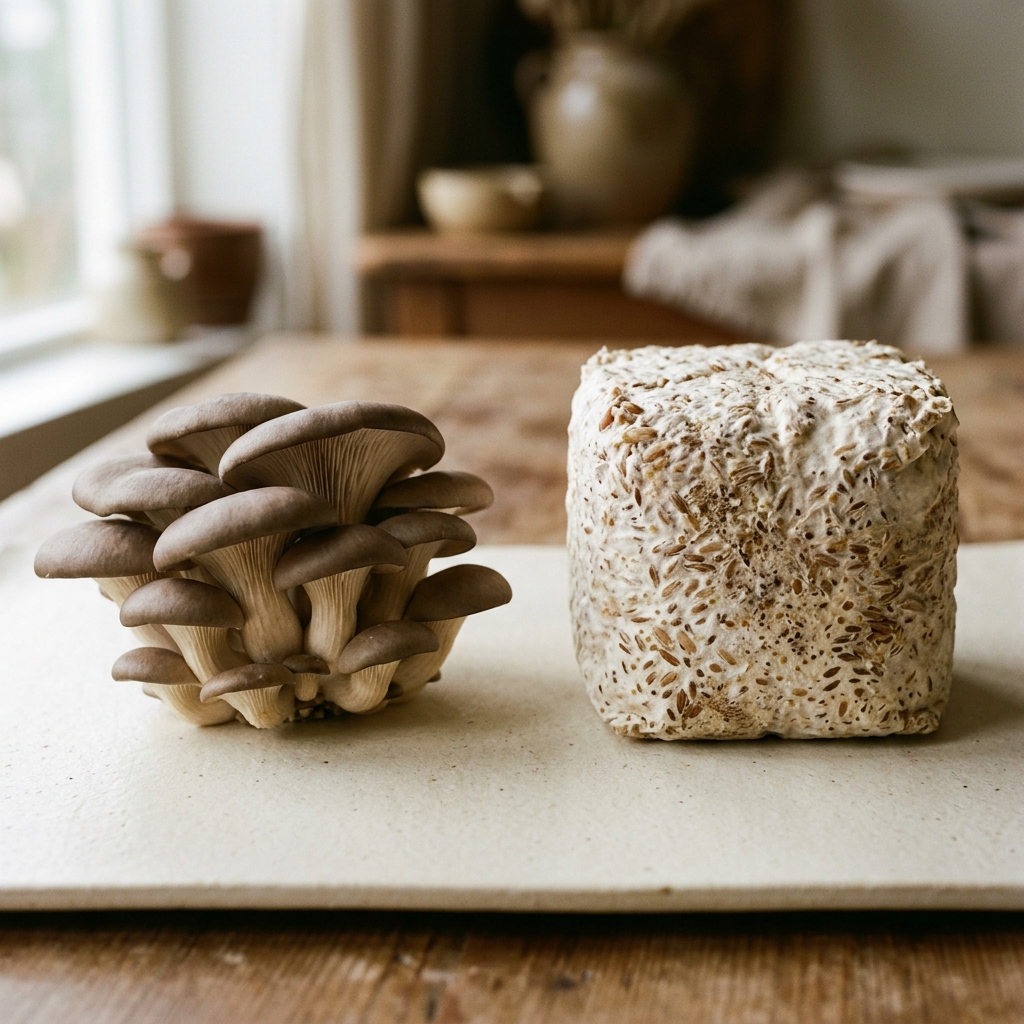
Fruiting body is the mushroom you'd recognize — the part above ground where most of the studied compounds concentrate. Mycelium is the root-like network, and when it's grown on grain the finished powder can carry starchy filler. Neither is automatically wrong, but the label should tell you which you're getting. We use dual-extracted — no mycelium-on-grain, no fillers.
If you've compared two mushroom supplements and seen one say "fruiting body" while the other says "mycelium" — or says nothing at all — you've found the single detail that changes what's physically in the jar. It's not marketing trivia. Which part of the mushroom a product uses, and how that part was grown, decides how much of the studied compounds you're actually getting.
Here's the short version: for most functional mushrooms, the fruiting body is where the compounds research focuses on tend to concentrate, and it's the form most clinical studies have used. Mycelium isn't worthless — but when it's grown on grain, the finished powder can be diluted by the grain it grew on. The label should tell you which one you're holding, and a lot of them don't.
What's the difference between fruiting body and mycelium?
A mushroom is the visible part of a much larger organism. Two terms describe two different parts of it:
- Fruiting body is the mushroom you'd recognize — the cap and stem that grow above the surface. It's the reproductive structure, and for many species it's where the studied bioactive compounds are most concentrated.
- Mycelium is the root-like network of fine threads the fungus grows through whatever it's feeding on. It's the larger, mostly-underground part of the organism, and it has its own compounds — but in supplements, the question isn't really "mycelium yes or no," it's how the mycelium was grown.
That second point is where most of the real-world difference lives.
Fruiting body vs. mycelium: where the active compounds are
The reason this distinction matters comes down to chemistry. Many of the functional compounds in mushrooms — the beta-glucans in particular — sit inside tough fungal cell walls. A review of how beta-glucans interact with immune-cell receptors (opens in new tab) treats them as exactly the kind of active fractions worth concentrating and liberating. In most functional species, the fruiting body is the richer, more consistent source of those compounds.
It's also what the research tends to use. The clearest example is lion's mane: the 2009 double-blind clinical trial in Phytotherapy Research (opens in new tab) that's so often cited used 3,000 mg per day of fruiting-body powder. When you see a dose range quoted for a mushroom, it usually traces back to studies run on the fruiting body — which makes "fruiting body" the form whose numbers you can actually compare against.
Why this matters: a product can contain a real mushroom and still under-deliver the compounds you came for, simply because of which part it used and how that part was processed. (For why extraction matters on top of which part you use, see the pharmacology of lion's mane.)
The mycelium-on-grain catch
Mycelium itself isn't the problem — the common way it's produced is what to watch for. Mycelium-on-grain means the mycelium is grown on a grain substrate (often rice or oats), then dried and milled together with that grain. It's a legitimate, cost-effective method, and there's genuine mushroom content in the result.
But so is the grain. Because the two are milled together, the finished powder can be a meaningful percentage of starch from the substrate — and unless the label breaks it out, you can't tell how much of what you're buying is mushroom versus filler.
This isn't a story about anyone cheating. Mycelium-on-grain is widespread because it's affordable, and it has real uses. The issue is silence: if a label doesn't say which part you're getting, that absence is itself the information. An honest product has every reason to tell you, and no reason not to.
How to tell which one you're getting
You don't need a lab — you need the label to use its words. When you compare two products:
- Look for "fruiting body" stated plainly, ideally with an extract ratio (like 10:1) so you can compare concentration honestly.
- Watch for mycelium-on-grain tells — phrases like "mycelial biomass," "full spectrum," or a grain (rice, oats) listed in the ingredients.
- Treat silence as a signal. A label that never says which part it uses has made a choice about what to tell you.
This is one item on a larger checklist — per-ingredient dosing, extract ratio, a real Certificate of Analysis, and reasonable claims are the rest. We walk through all of them in how to read a mushroom supplement label.
What we use, and why
We use dual-extracted across all seven mushrooms, with the part named for each — no mycelium-on-grain and no added fillers. Two deliberate choices are bundled in there:
- Fruiting body, because for these species it's the more concentrated, more research-aligned source of the compounds people are after.
- Dual extraction (water and alcohol), because the beta-glucans and other actives sit inside that tough cell wall, and pulling out both the water-soluble and alcohol-soluble compounds is how you make them available rather than merely present.
And we publish the dose of each mushroom, because — as the whole fruiting-body-vs- mycelium question shows — the word "mushroom" on a label doesn't tell you what's actually in the jar. You can see exactly what's in ours on the science behind the blend, or how we built the blend.
If you're weighing this alongside other buying questions — like whether a "mushroom coffee" is even caffeine-free — our decaf mushroom coffee breakdown covers that one, and the full guide to functional mushrooms maps the whole category.
The bottom line
Fruiting body vs. mycelium isn't a trick question, and it isn't a war — both are real parts of the organism. But for most functional mushrooms, fruiting body is the more concentrated, more research-backed choice, and mycelium-on-grain can quietly dilute a powder with the substrate it grew on. The deciding factor is whether the brand tells you which one you're getting. If it does, you can evaluate it. If it won't, you already have your answer.
References
- Akramiene D, Kondrotas A, Didziapetriene J, Kevelaitis E. Effects of beta-glucans on the immune system. Medicina (Kaunas). 2007;43(8):597–606. PMID: 17895634. https://pubmed.ncbi.nlm.nih.gov/17895634/ (opens in new tab)
- Mori K, Inatomi S, Ouchi K, Azumi Y, Tuchida T. Improving effects of the mushroom Yamabushitake (Hericium erinaceus) on mild cognitive impairment: a double-blind placebo-controlled clinical trial. Phytotherapy Research. 2009;23(3):367–372. PMID: 18844328. https://pubmed.ncbi.nlm.nih.gov/18844328/ (opens in new tab)