Reishi vs Lion's Mane: Which One Do You Actually Want?
Scientifically reviewed by Onur Oncer, B.S. (B.S. Physiology, published researcher).
Short answer
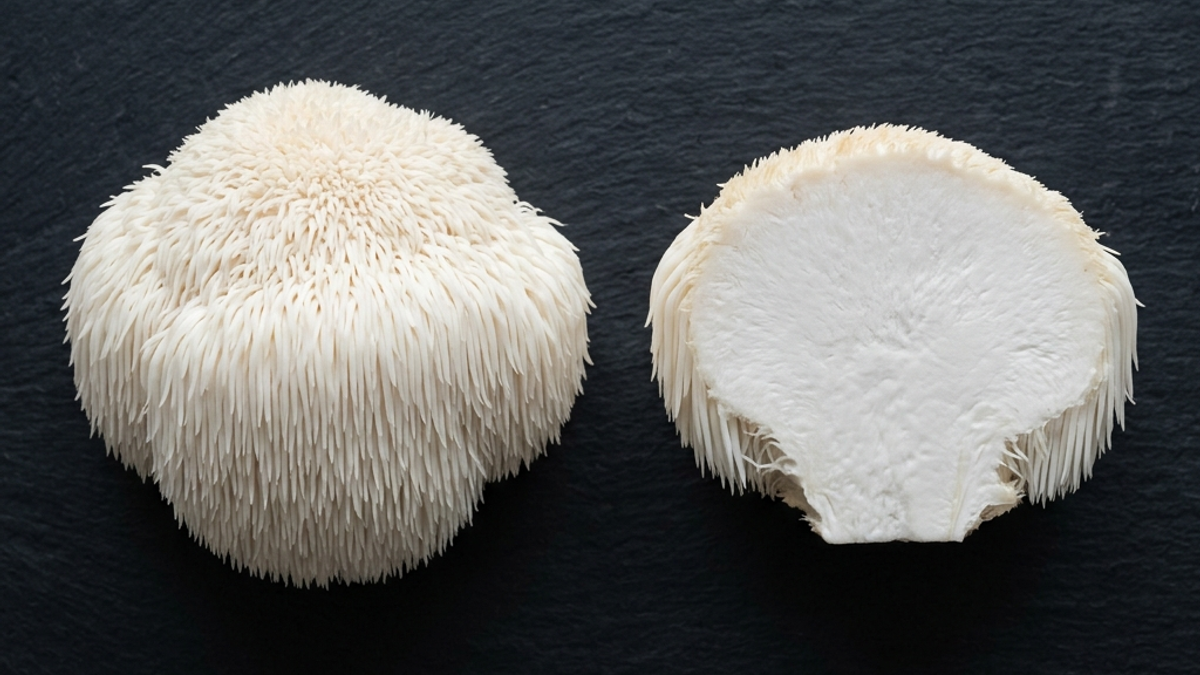
Lion's mane and reishi are studied for different things. Lion's mane is the one with human trials on cognition, so it sits in the focus and memory lane. Reishi is studied for immune modulation and a healthy stress response. They are not interchangeable, and there is no reason you cannot take both.
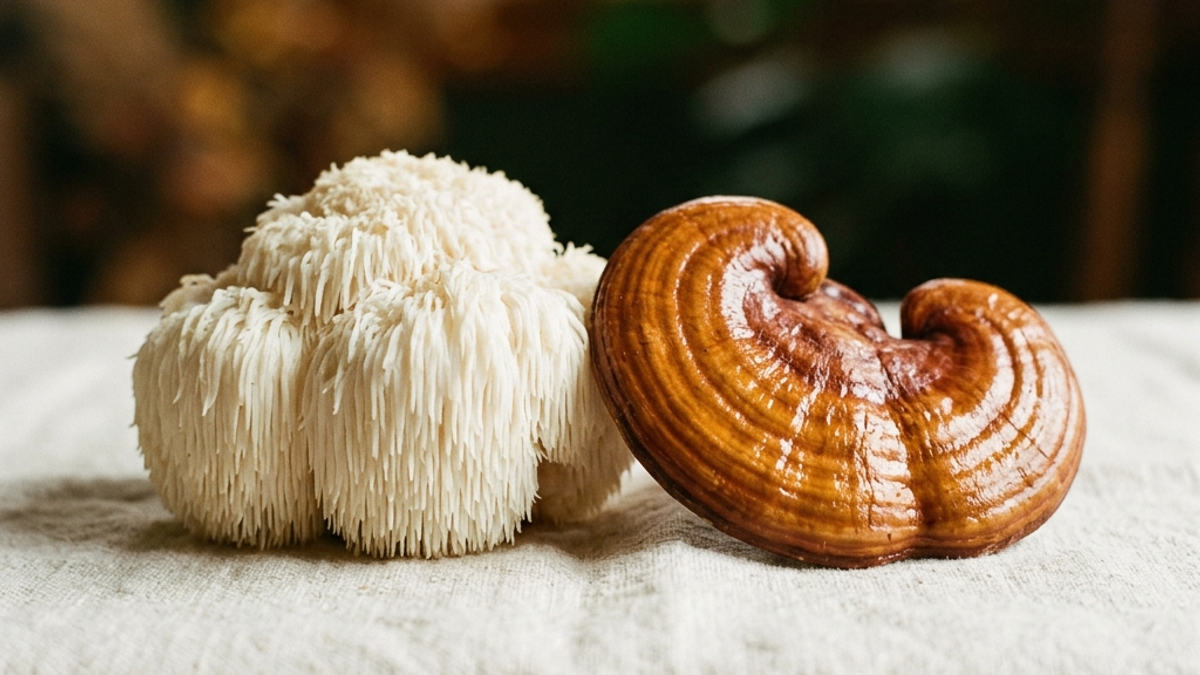
These are the two mushrooms people ask about most, and they get compared as though they are competing for the same job. They are not. Picking between reishi and lion's mane is less like choosing between two brands of the same thing and more like choosing between a notebook and a pair of running shoes.
Here is the honest split, and then the evidence for each.
The short version
| Lion's mane | Reishi | |
|---|---|---|
| Latin name | Hericium erinaceus | Ganoderma lucidum |
| Studied for | Focus, memory, cognitive performance | Immune modulation; traditionally, a healthy stress response |
| Human trial evidence | Several placebo-controlled cognitive trials | A placebo-controlled trial in healthy adults measuring immune markers |
| Where it is weaker | Trials are small; one review found only a modest average effect | No comparable human trial for calm or mood as an outcome |
| Typical research dose | ~1.8 g to 3 g per day | Varies widely by extract type |
Lion's mane: the cognitive one
If you want the mushroom with actual human cognitive data, this is it.
A 2009 double-blind, placebo-controlled trial (opens in new tab) gave 30 adults 3,000 mg a day of lion's mane fruiting body powder for 16 weeks and found significantly higher scores on a cognitive scale versus placebo. Worth knowing: those participants had mild cognitive impairment, so this is not a study about making a healthy person sharper.
The trial that speaks more directly to most readers is a 2023 double-blind pilot in healthy adults aged 18 to 45 (opens in new tab), using 1.8 g a day of lion's mane on its own. Participants performed a cognitive task significantly faster after a single dose. Two caveats we insist on: the 28-day arm was largely null, and a reduction in subjective stress was only a non-significant trend. So the clean finding is acute, not chronic — the opposite of what most marketing implies.
Zoom out and the picture stays honest. A 2025 systematic review (opens in new tab) pooling the available trials found a combined weighted increase of 1.17 points on a standard cognitive screen. Real, measurable, and small. That is the accurate shape of the lion's mane evidence: consistent direction, modest size.
There is also a large body of preclinical work on erinacines (opens in new tab), the compounds that get quoted when someone tells you lion's mane grows new brain cells. That research is in cells and rodents. It is genuinely interesting and it is not a human result, and the gap between those two things is where most of this category's marketing lives. We go through all of it in the lion's mane guide.
Reishi: the immune and stress one
Reishi's human evidence sits somewhere different.
The strongest trial we have is a 2023 randomized, double-blind, placebo-controlled study in healthy adults (opens in new tab) that gave reishi beta-glucan for 84 days. Against placebo it found increases in T-cell populations, an improved CD4/CD8 ratio, higher natural killer cell count and activity, and higher serum IgA. It was safe and well tolerated. That is a real immune-modulation signal in people who were not sick to begin with, which is unusual and useful in this category.
The important limit: it measured markers. Whether that translates into anything you would notice day to day was not something the study looked at, so nobody should tell you it proved more than it measured.
Now the part where we go against our own commercial interest. Reishi is best known as a calming mushroom, and it is classed as an adaptogen (opens in new tab), a category studied for how the body handles stress. But when you go looking for a human trial where reishi produced a measured improvement in mood or calm, it is not there. The often-cited reishi trial measured physical fitness in a specific patient population, not wellbeing. So the calm role rests on traditional use and mechanism rather than a clean human outcome.
We are equally direct about sleep: we make no sleep claim for reishi, because we hold no trial that measured one.
Can you take them together?
Yes, and this is the question behind most "vs" searches anyway.
There is no known interaction between them, they work in different lanes, and blends routinely include both. Combining them is not the clever part. The part that decides whether a product does anything is whether each mushroom is present at an amount you can read on the label — which, in this category, is where most products quietly fail. If a bag tells you it contains a "2,000 mg blend" of six mushrooms, you cannot know how much lion's mane you are getting, and neither can anyone else.
If you take prescription medication or manage a health condition, check with a physician or pharmacist before adding either one. That is a pharmacist's advice about any new supplement, not a warning specific to mushrooms.
If you can only pick one
Pick lion's mane if what you want is focus and memory support. It is the only one of the two with human cognitive trials, and the honest version of those trials is still the better bet than reishi for that job.
Pick reishi if immune support is what you are after, or you want the traditional wind-down role and you are comfortable that the calm side rests on tradition rather than a human outcome trial.
Pick both if you would rather cover both lanes, which is the ordinary reason blends exist.
What dose to look for
Read the research dose, then read the label, and see whether they are in the same universe.
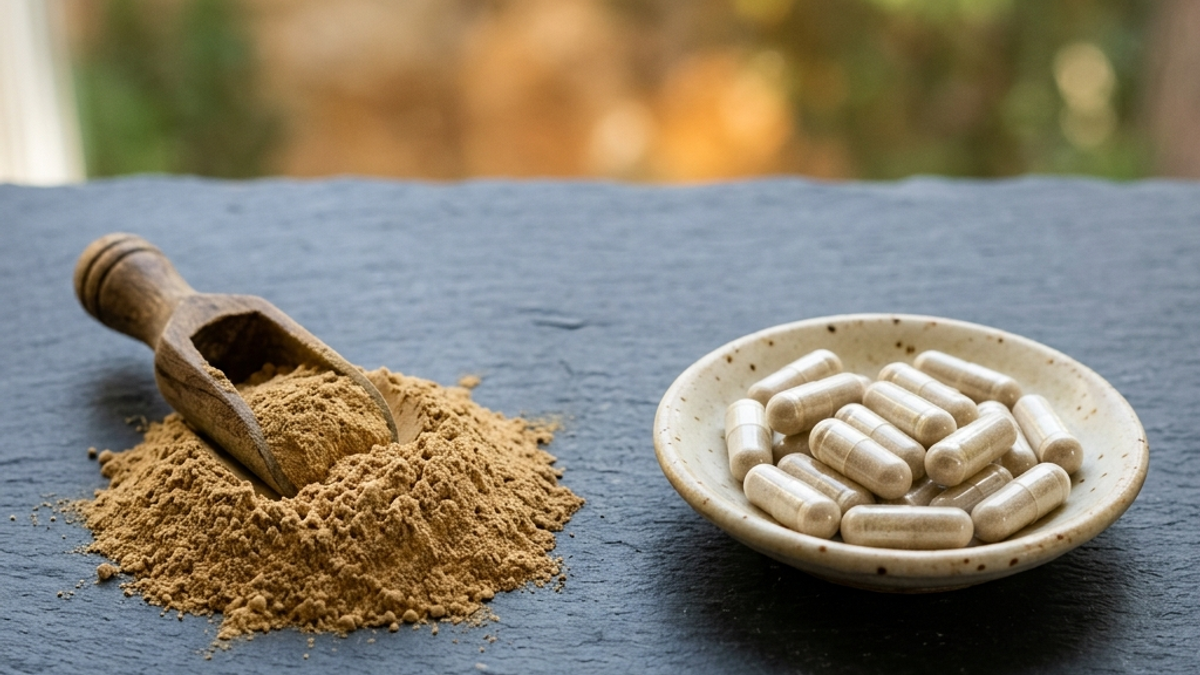
The lion's mane cognitive trials ran between roughly 1.8 g and 3 g a day. That is a useful reference point, though extract concentration means a smaller amount of a concentrated extract is not automatically weaker than a larger amount of plain powder — which is exactly why the extract type has to be printed too. Reishi study doses vary much more widely depending on the preparation.
For what it is worth on our own label: our blend carries 1,000 mg of lion's mane and 500 mg of reishi per scoop, each printed as its own line with its own number rather than pooled into a blend total. That is the format we think every label should use, and the skill of reading one is worth having regardless of what you buy — we wrote a guide to it.
The useful way to think about it
Reishi versus lion's mane is the wrong frame. They are not substitutes, and a product containing both is not hedging — it is covering two different jobs.
What actually separates a good purchase from a bad one is not which mushroom is on the front of the bag. It is whether the back of the bag tells you how much of it you are getting. Everything else is a preference.
References
- Mori K, Inatomi S, Ouchi K, et al. Improving effects of the mushroom Yamabushitake (Hericium erinaceus) on mild cognitive impairment: a double-blind placebo-controlled clinical trial. Phytotherapy Research. 2009;23(3):367–372. PMID: 18844328. https://pubmed.ncbi.nlm.nih.gov/18844328/ (opens in new tab) — participants had mild cognitive impairment; not a healthy-population result.
- Docherty S, Doughty FL, Smith EF. The acute and chronic effects of lion's mane mushroom supplementation on cognitive function, stress and mood in young adults. Nutrients. 2023;15(22):4842. PMID: 38004235. https://pubmed.ncbi.nlm.nih.gov/38004235/ (opens in new tab) — pilot, small sample; the acute result was significant, the 28-day arm largely was not.
- Menon A, Jalal A, Arshad Z, et al. Benefits, side effects, and uses of Hericium erinaceus as a supplement: a systematic review. Frontiers in Nutrition. 2025;12:1641246. PMID: 40959699. https://pubmed.ncbi.nlm.nih.gov/40959699/ (opens in new tab) — the cited figure is the combined weighted MMSE increase of 1.17.
- Spangenberg ET, Moneypenny A, Bozzo GG, Perreault ML. Unveiling the role of erinacines in the neuroprotective effects of Hericium erinaceus: a systematic review in preclinical models. Frontiers in Pharmacology. 2025;16:1582081. PMID: 40626304. https://pubmed.ncbi.nlm.nih.gov/40626304/ (opens in new tab) — cellular and rodent models only.
- Chen SN, Nan FH, Liu MW, et al. Evaluation of immune modulation by β-1,3;1,6 D-glucan derived from Ganoderma lucidum in healthy adult volunteers, a randomized controlled trial. Foods. 2023;12(3):659. PMID: 36766186. https://pubmed.ncbi.nlm.nih.gov/36766186/ (opens in new tab) — measured immune markers, not infection outcomes.
- Panossian A, Wikman G. Effects of adaptogens on the central nervous system and the molecular mechanisms associated with their stress-protective activity. Pharmaceuticals. 2010;3(1):188–224. PMID: 27713248. https://pubmed.ncbi.nlm.nih.gov/27713248/ (opens in new tab) — mechanism review, not a product trial.
These statements have not been evaluated by the Food and Drug Administration. This product is not intended to diagnose, treat, cure, or prevent any disease.