Every autumn the same shelf appears: bottles promising to "boost your immunity" and help you "fight off" whatever's going around. It's a tempting story, and it's the wrong one. The honest version of immune support is quieter and, once you understand it, more useful — it's about supporting the normal, everyday work your immune system already does, not handing it a weapon against a specific bug.
This guide walks through what the human research actually supports about mushrooms and immune function: which mushrooms have real data, what beta-glucans do, why the gut keeps coming up, and how to tell a serious immune product from a decorative one. As a pharmacist, I'll be as clear about the limits as about the promise — because on a health topic, the limits are where trust is either earned or lost.
A ground rule first, because it shapes everything below: nothing here treats, prevents, or cures any illness. "Supports a healthy immune system" is a real, defensible thing to say about these ingredients. "Boosts your immunity to fight off colds and flu" is not — it's a disease claim the evidence doesn't support, and any brand that makes it is selling past the science. We built Shroombiosis to stay on the right side of that line: seven mushrooms, three superfoods, and a pre/pro/postbiotic stack — caffeine-free, dual-extracted fruiting body, every dose on the label.
What immune support really means (and doesn't)
Start with the phrase itself, because it's where most of the category goes wrong. "Immune support" is a structure/function idea: supporting the systems that let your immune system do its ordinary job well. It is not a promise to attack a named infection, prevent a cold, or shorten a flu. That distinction isn't legal hair-splitting — it's the difference between what the research shows and what marketing wishes it showed.
Here's the nuance people miss: your immune system is not a dial you want turned to maximum. A well-functioning immune system is balanced and responsive — quick when it needs to be, quiet when it doesn't. "Boosting" it, if that even meant anything, isn't the goal; supporting its normal regulation is. So when you see the word "immunomodulation" in the studies below, read it as helping the system do its normal job well, not cranking it up.
That's why the compliant, honest framing matters so much on this topic. The ingredients in a good blend can support normal immune function — there's real mechanism and real human data behind that. What they can't do is "fight" a specific illness for you, and we won't imply otherwise. If you take one idea from this whole guide, let it be that the modest, accurate claim is also the true one.
The gut is where your immune system lives
Ask most people where their immune system is and they'll point to their blood or their glands. The more accurate answer is lower down. A large share of the body's immune tissue sits in and around the gut, in constant conversation with the trillions of microbes living there. Which means one of the most direct everyday ways to support your immune system isn't a mega-dose of anything — it's taking care of your gut.
The lining of your gut is one of the busiest immune sites in the body. It's home to gut-associated lymphoid tissue (GALT) — a network of immune cells packed into the gut wall, sampling everything that passes through. A 2024 review in Trends in Immunology (opens in new tab) describes GALT as a hub kept in a constant state of readiness by the resident gut microbiota: the microbes there help sustain the immune structures that produce antibodies like IgA and, in humans, help diversify the body's wider immune cells. In plain terms, your gut bacteria and your immune system are in a daily working relationship — and the health of one is tied to the health of the other.
This is the physiological reason an immune mushroom product should think about the gut at all. If the tissue doing so much of the immune work sits against the microbiome, then feeding and supporting that microbiome is part of supporting immune function — not a separate project. It's also why the two things beta-glucans do at once, which we'll get to next, are such a neat fit for this topic: one molecule that both feeds the gut and speaks to immune cells is doing double duty in exactly the place that matters. We unpack the full physiology in your gut and your immune system: the real connection, and the broader foundation in our complete guide to gut health and the microbiome.
Which mushrooms support the immune system?
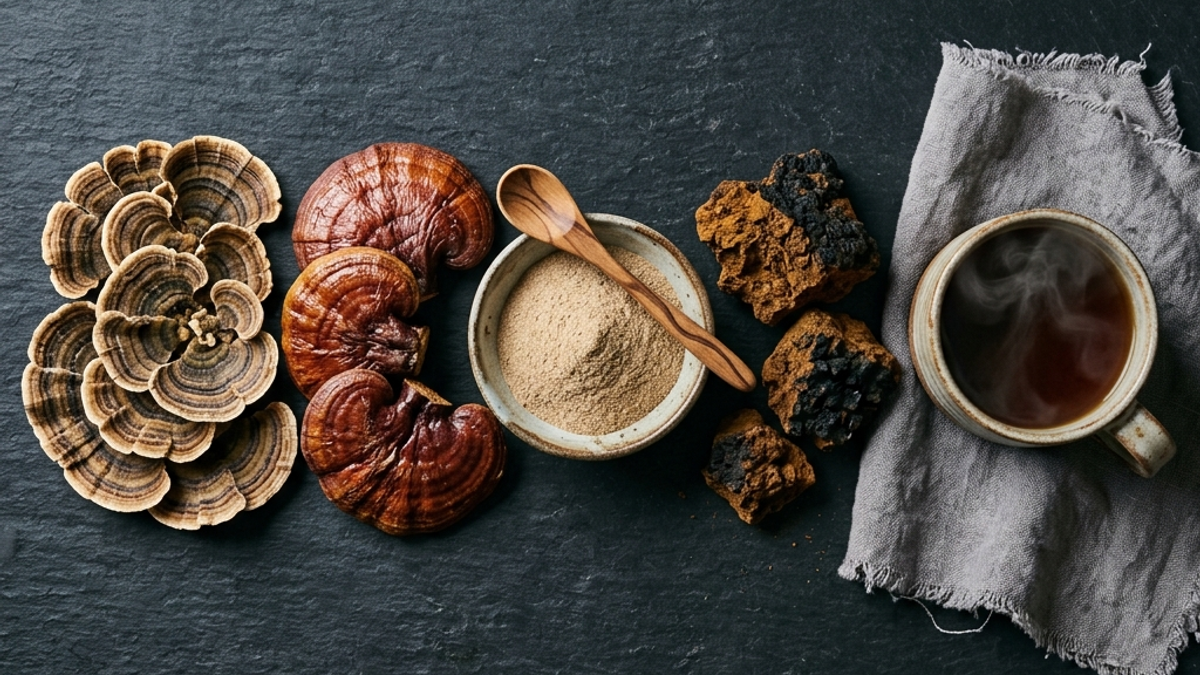
Turkey tail, reishi, and chaga are the three mushrooms in our blend with an immune role, and their human evidence runs in that order. What they share is beta-glucans, complex polysaccharides in the mushroom cell wall that pull double duty. Like other dietary fiber, they get past your digestive enzymes and reach the large intestine intact, where gut bacteria ferment them (opens in new tab). Your immune cells also recognize them directly.
A review of how beta-glucans interact with the immune system (opens in new tab) describes them as "biological response modifiers" that bind receptors such as Dectin-1 and CR3 on macrophages and natural-killer cells — in effect, a molecule your immune system is built to notice. Dectin-1 was originally described as the beta-glucan receptor, and its signaling shapes an innate immune response (opens in new tab).
A more recent structure–function review of mushroom beta-glucans as immunomodulators (opens in new tab) adds the why: the immune activity of a beta-glucan is driven by its structure — the β-1,3 backbone with β-1,6 branching, the triple-helix shape, the molecular weight — and it varies by mushroom species and how it's extracted. That's a mechanistic review whose underlying data is largely in vitro and in animal models, so read it as "here's how these molecules modulate immune function," not as a human outcome. But it's the reason "dual-extracted" and "fruiting body" aren't marketing words — the structure has to survive intact to do anything.
Zoom out to the whole category and the picture holds up. A systematic review of 34 randomized controlled trials of fungal beta-glucans (opens in new tab) found that the primary physiological effect of supplementation was immunomodulation, and that the supplements were well tolerated. The authors also noted that the optimal dose is still unsettled and that the cellular and molecular findings were inconsistent across trials — which is exactly why we say beta-glucans help modulate normal immune function rather than claiming they "enhance" or "boost" it. That's the honest read of a real evidence base: a consistent direction, an imperfect one, described without overstating.
Turkey tail — the most-studied of the three
Turkey tail (Trametes versicolor) is the most-researched immune mushroom in the blend, rich in beta-glucans and a related compound called PSP (polysaccharopeptide). A Phase 1 human trial of freeze-dried turkey tail mycelial powder (opens in new tab), in which three groups of three people took 3, 6, or 9 g a day for six weeks, found it was well tolerated and associated with faster lymphocyte recovery and increased natural-killer-cell activity. We cite that strictly for the immune-function and safety signal — nothing more. Turkey tail is never tied to any disease outcome, population, or implication; it's an immune-and-gut support ingredient, full stop. For the mechanism underneath, dedicated laboratory work on turkey tail's PSP and immune cells (opens in new tab) documents that PSP activates immune cells and enhances macrophage activity — again, the immune-cell-activation mechanism only, cited for how the molecule behaves, not for any clinical outcome. The full breakdown lives in turkey tail, beta-glucans and your immune system.
Reishi — beta-glucans in a healthy population
Reishi (Ganoderma lucidum) is best known in our blend for calm and a healthy stress response, but it also carries the immune-relevant beta-glucans — and it has its own human data on that front. A 2023 placebo-controlled trial of a reishi beta-glucan in healthy adults (opens in new tab) gave the compound for 84 days and measured, versus placebo, higher T-cell and natural-killer-cell counts, an improved CD4/CD8 ratio, and higher serum IgA, with good tolerability. That "in healthy adults" detail matters — it's exactly the everyday, structure-and-function context this whole guide is about, not a study in a sick population. We keep our read of it measured: the trial measured immune markers, not infection outcomes, so we describe reishi beta-glucans as helping modulate normal immune function, never as defending against colds or flu. (Reishi's calm-and-stress side is its own subject — we cover it in reishi for calm and stress, and the immune angle in reishi and immune support.)
Chaga — traditional and preclinical only
Chaga (Inonotus obliquus) is where the honesty bar rises highest. There are no high-quality human immune trials for chaga. What exists is traditional use and preclinical research: a review of medicinal mushrooms and their bioactive compounds (opens in new tab) documents chaga's high antioxidant capacity in vitro and in animal models, tied to compounds like phenolics and melanin. A high antioxidant reading in a test tube or an animal doesn't automatically carry over to a person, because dose, absorption, and what survives digestion are questions those studies can't settle. So we say exactly that and no more — chaga is traditionally used to support immune health and vitality, with preclinical studies showing high antioxidant capacity — and we don't claim a human immune outcome for it. Antioxidant support and immune support overlap conceptually (oxidative balance is part of the immune environment), but we keep chaga's claims in traditional-and-preclinical language because that's what the evidence supports. We lay out chaga's full evidence separately.
That's the mushroom half of immune support. For the molecule all three share, our primer on beta-glucans in mushrooms goes deeper.
The biotics: pre/pro/postbiotic stack
If the gut is where so much immune tissue lives, then the biotics — the ingredients that feed, seed, and finish the microbiome — belong in an immune conversation, not just a digestive one. This is the lane most mushroom brands skip entirely, and it's where a real immune formula separates itself from a powdered coffee.
Prebiotic fiber feeds the beneficial bacteria you already have. The acacia fiber (gum arabic) in our blend is a prebiotic: a fiber your body can't digest but your microbes can. A dose-response trial in healthy adults (opens in new tab) found that gum arabic significantly increased beneficial Bifidobacteria and Lactobacilli, with an optimal effect around 10 g a day and no adverse effects. That's a microbiome finding, not an immune one — but it's step one, because those are the same populations sitting against all that immune tissue. Notably, mushroom beta-glucans double as prebiotic fiber too, so the mushrooms and the acacia are feeding the microbiome from two directions at once.
Probiotics add live beneficial bacteria, and postbiotics deliver the compounds bacteria produce. Our blend includes all three forms. At the category level, a systematic review and meta-analysis of 26 randomized trials (opens in new tab) found that probiotics support a healthy intestinal barrier — the literal wall between your gut contents and your immune tissue — and help modulate immune activity, while enriching Bifidobacterium and Lactobacillus. We cite that for the healthy-barrier and immune-modulation mechanism only; it tested a mix of strains at the category level rather than our exact strains, and we never frame it as treating or reducing any disease or inflammation. It's context for why a biotic stack belongs in an immune product: a strong gut barrier is part of a well-functioning immune boundary. The full pre/pro/postbiotic breakdown is in our post on the difference between prebiotics, probiotics, and postbiotics.
The takeaway is structural: mushrooms bring the beta-glucans your immune cells recognize; the biotics support the gut environment that so much immune tissue depends on. Neither half is the whole story, which is the entire reason we built the blend to carry both.
How to choose an immune mushroom product (dose, form, testing)
Everything above rolls up to a buying standard you can apply to any immune mushroom product — ours included. Four questions separate a serious formula from a decorative one.
-
Is it dual-extracted fruiting body? Beta-glucans are locked inside tough, chitinous cell walls, so they need a hot-water extraction to free them; other useful compounds are alcohol-soluble and need an alcohol extraction. Dual extraction does both. And the fruiting body — the actual mushroom — carries a higher concentration of beta-glucans than mycelium grown on grain, which often leaves starchy grain in the powder. If the actives never came out of the cell wall, the immune mechanism above can't happen. We use dual-extracted — no mycelium-on-grain, no fillers.
-
Is every dose on the label? A proprietary blend lists ingredients without telling you how much of each is inside — which, for immune mushrooms, means you can't tell whether there's a meaningful amount of beta-glucans or a decorative pinch. A blend that spreads a few hundred milligrams across many mushrooms can't carry much of any one of them. Per-ingredient doses are the heart of how to read a mushroom supplement label and how to spot an underdosed supplement. We publish the full panel so you can see exactly what's in a scoop. To be honest about dosing: for most immune mushrooms there isn't a single citable human serving dose, so the compliant answer is "the amount on the label," and we print ours instead of hiding it. Per 8.3 g scoop, our panel lists turkey tail, reishi, and chaga at 500 mg each.
-
Does it think about the gut, not just the mushrooms? Given how much immune tissue sits around the gut, a real immune formula supports the microbiome too — prebiotic fiber to feed it, and biotics to seed and finish it. A mushroom-only product is doing half the job.
-
Is it third-party tested, and are certifications stated honestly? Every ingredient is sourced to organic, vegan, and gluten-free standards, and formal third-party certification is in progress — a batch-based audit we'd rather complete properly than rush. We say "in progress," never "certified," because on a health product the distinction is the whole point. On testing: an independent lab has tested one lot of the finished blend so far, for pesticides and heavy metals, and both full reports are on our lab results page.
That's the standard, and it's the same whether you're evaluating Shroombiosis or anyone else. If you want the evidence behind each ingredient laid out in one place, that's what our science page is for.
Honest caveats: who should ask first
Two caveats decide whether any of this matters. First, consistency. The human studies ran for weeks to months — turkey tail and reishi trials over 84 days, gut and fiber studies over 4 to 12 weeks. The gut–immune relationship responds to a steady daily supply of fiber and the compounds that feed it, not a one-time dose. Immune support is a daily habit you give several weeks, not a winter panic-buy.
Second, and more important, who should check first. For most healthy adults the mushrooms and biotics here are well tolerated at the amounts studied. But "generally safe" only means the mostly healthy adults in those studies did well at the doses tested. It is a statement about the people studied, not a promise about you, and immune-active ingredients deserve extra care:
- Immune-active medications. If you take an immunosuppressant or other immune-active medication, immune-modulating compounds are exactly the category to run past a professional first. This is the single most important flag on this topic.
- Pregnancy and nursing. Most functional mushrooms simply haven't been studied in pregnancy, and absence of data is a reason for caution, not reassurance.
- Existing conditions and other prescriptions. If you're managing a medical condition or taking prescription medications, your clinician or pharmacist should weigh in on whether a new supplement fits your overall plan.
Talk to a physician or pharmacist before use if you are pregnant, nursing, taking prescription medications, or managing a medical condition. This is structure/function support for how your immune system does its normal job — not a treatment for anything, and not a way to "fight off" a specific infection. When in doubt, ask first. That's the calm, conservative position, and the one we'd want a member of our own family to take.
Read more
This guide is the hub; these posts go deeper on the threads that matter most for immune support:
- Your gut and your immune system: the real connection — the physiology of why gut care and immune support are closer to the same sentence than most people realize.
- Turkey tail, beta-glucans and your immune system — the most beta-glucan-rich mushroom and the human data behind it.
- What are beta-glucans in mushrooms? — the molecule your immune cells are built to recognize, explained.
- Reishi and immune support — reishi's beta-glucan immune angle, distinct from its calm-and-stress lane.
- Daily immune support: a year-round, caffeine-free habit — why immune support is a daily ritual, not a seasonal scramble.
- Functional Mushrooms: The Complete Guide — the parent pillar: the whole category, mushroom by mushroom.
- Gut Health & the Microbiome: The Complete Guide — the sibling pillar: the gut foundation beneath immune function.
Immune support isn't a weapon and it isn't a miracle — it's the quiet, daily work of feeding your gut and supplying the beta-glucans your immune system recognizes, done consistently and at a real dose. That's the whole idea behind the caffeine-free blend we built around it: seven dual-extracted fruiting-body mushrooms and a full pre/pro/postbiotic stack, every dose on the label. If you take one thing from this guide, let it be that the honest claim — supports a healthy immune system — is also the true one.
References
- Bemark M, Pitcher MJ, Dionisi C, Spencer J. Gut-associated lymphoid tissue: a microbiota-driven hub of B cell immunity. Trends in Immunology. 2024;45(3):211–223. PMID 38402045. https://pubmed.ncbi.nlm.nih.gov/38402045/ (opens in new tab)
- Akramiene D, Kondrotas A, Didziapetriene J, Kevelaitis E. Effects of beta-glucans on the immune system. Medicina (Kaunas). 2007;43(8):597–606. PMID 17895634. https://pubmed.ncbi.nlm.nih.gov/17895634/ (opens in new tab)
- Dilrukshi N, Grice ID, Mallard B, Tiralongo J. Mushroom β-glucans as immunomodulators: elucidation of structure–function relationship. Food Chemistry. 2025;495(Pt 2):146468. PMID 41187460. https://pubmed.ncbi.nlm.nih.gov/41187460/ (opens in new tab)
- Vlassopoulou M, Yannakoulia M, Pletsa V, et al. Effects of fungal beta-glucans on health — a systematic review of randomized controlled trials. Food & Function. 2021;12(8):3366–3380. PMID 33876798. https://pubmed.ncbi.nlm.nih.gov/33876798/ (opens in new tab)
- Torkelson CJ, Sweet E, Martzen MR, et al. Phase 1 clinical trial of Trametes versicolor in women with breast cancer. ISRN Oncology. 2012;2012:251632. PMID 22701186. https://pubmed.ncbi.nlm.nih.gov/22701186/ (opens in new tab)
- Dou H, Chang Y, Zhang L. Coriolus versicolor polysaccharopeptide as an immunotherapeutic in China. Progress in Molecular Biology and Translational Science. 2019;163:361–381. PMID 31030754. https://pubmed.ncbi.nlm.nih.gov/31030754/ (opens in new tab)
- Chen SN, Nan FH, Liu MW, Yang MF, Chang YC, Chen S. Evaluation of immune modulation by β-1,3;1,6 D-glucan derived from Ganoderma lucidum in healthy adult volunteers, a randomized controlled trial. Foods. 2023;12(3):659. PMID 36766186. https://pubmed.ncbi.nlm.nih.gov/36766186/ (opens in new tab)
- Sadowska A, Włosek-Pawełas D, Car H. Medicinal mushrooms and their bioactive compounds: from traditional use to therapeutic potential. Molecules. 2026;31(10):1749. PMID 42197308. https://pubmed.ncbi.nlm.nih.gov/42197308/ (opens in new tab)
- Zheng Y, Zhang Z, Tang P, et al. Probiotics fortify intestinal barrier function: a systematic review and meta-analysis of randomized trials. Frontiers in Immunology. 2023;14:1143548. PMID 37168869. https://pubmed.ncbi.nlm.nih.gov/37168869/ (opens in new tab)
- Calame W, Weseler AR, Viebke C, Flynn C, Siemensma AD. Gum arabic establishes prebiotic functionality in healthy human volunteers in a dose-dependent manner. British Journal of Nutrition. 2008;100(6):1269–1275. PMID 18466655. https://pubmed.ncbi.nlm.nih.gov/18466655/ (opens in new tab)
- Mata-Martínez P, Bergón-Gutiérrez M, Del Fresno C. Dectin-1 signaling update: new perspectives for trained immunity. Frontiers in Immunology. 2022;13:812148. PMID 35237264. https://pubmed.ncbi.nlm.nih.gov/35237264/ (opens in new tab)