Tiger Milk Mushroom: Two Species Sold Under One Name
Scientifically reviewed by Dr. Danielle Oncer, PharmD (pharmacology, dosing & safety) and Jon Klipstein (supplement formulation expert, Die Tryin Co.).
Short answer
Tiger milk mushroom names two unrelated fungi. Nearly every US listing is Lignosus rhinocerus, a Malaysian polypore with three human studies. Ours is Pleurotus tuber-regium, an oyster-mushroom sclerotium and a documented Nigerian food, with zero human trials. Same English name, different families, so read the binomial on the label.
If you searched tiger milk mushroom and came away confused, that is the correct response. The name belongs to two different fungi that are not close relatives, sold through the same channels, frequently at the same 300 mg dose. One of them is genuinely hard to find in the wild and has a small research program behind it. The other is a vegetable that people in south-eastern Nigeria have been digging up and cooking for generations.
Ours is the second one. I would rather you hear that in the first paragraph than work it out later from a Latin name in six-point type.
What is tiger milk mushroom?
It is a common name, not a species, and it points at two organisms in two different families.
The first is Lignosus rhinocerus — a polypore in the family Polyporaceae, native to Peninsular Malaysia and neighbouring parts of South-East Asia. In Malay it is cendawan susu rimau; in Chinese, 虎乳灵芝, "tiger milk lingzhi." Nearly everything sold in the United States under the English name is this species.
The second is Pleurotus tuber-regium — an oyster mushroom, family Pleurotaceae. Same genus as the oyster mushrooms in the produce section. Its Chinese name is 虎奶菇, "tiger milk mushroom," and its species epithet means tuber of the king, which is why English-language mycology often calls it the king tuber oyster mushroom.
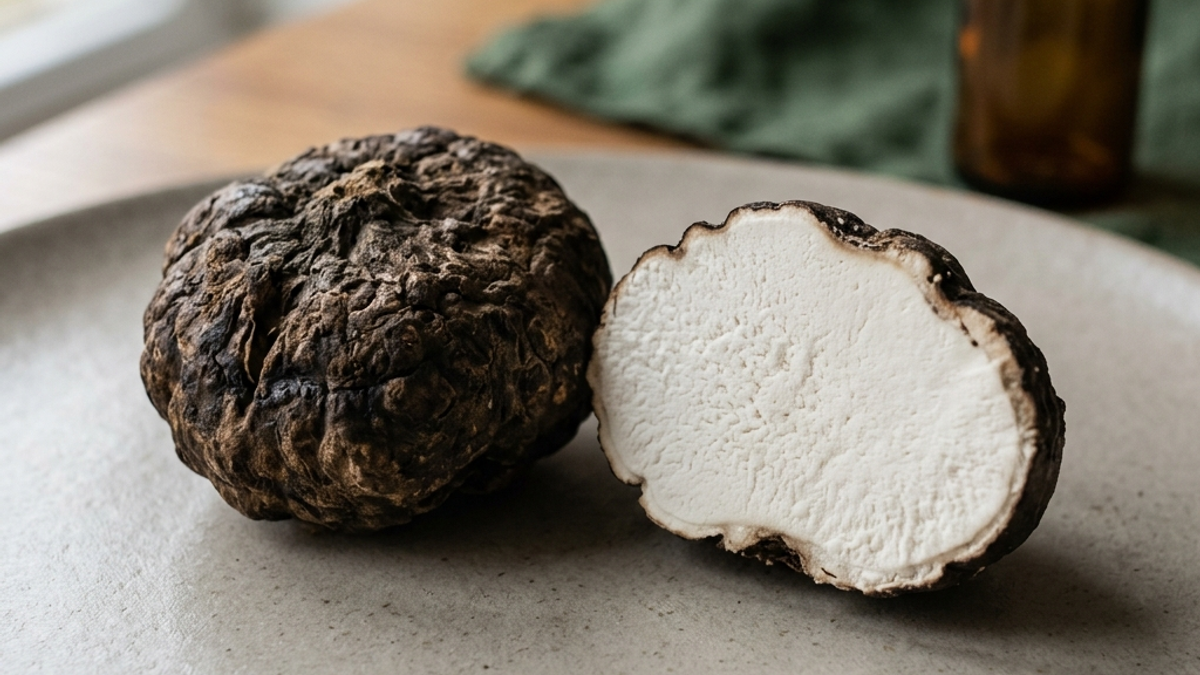
Both species grow a sclerotium: a hard, dense underground mass of compacted fungal tissue that works as a food-and-water bank the fungus can live off when conditions turn against it. Dig one up and you get an irregular lump with a rough dark rind and a chalk-white interior. That shared shape is the whole reason the two share a nickname, and it is roughly where the resemblance ends.
How closely related are the two tiger milk mushrooms?
Not closely. They share a class, not an order.
Lignosus sits in the order Polyporales; Pleurotus sits in Agaricales. For a sense of scale, humans and mice are both mammals in different orders — that is the ballpark of separation we are talking about. Two distant fungi independently evolved the same survival organ, a case of convergent evolution, and the market named them both after it.
Here is the part I find genuinely funny. Polyporales is also home to Ganoderma and Trametes — reishi and turkey tail. Which means the tiger milk mushroom we do not use is a closer relative of two mushrooms already in our blend than our tiger milk mushroom is.
Which tiger milk mushroom is in a US supplement?
Almost certainly Lignosus rhinocerus. Every US retail listing I have been able to check names that species, and most of the modern research on it uses a single standardised cultivated strain from Malaysia.
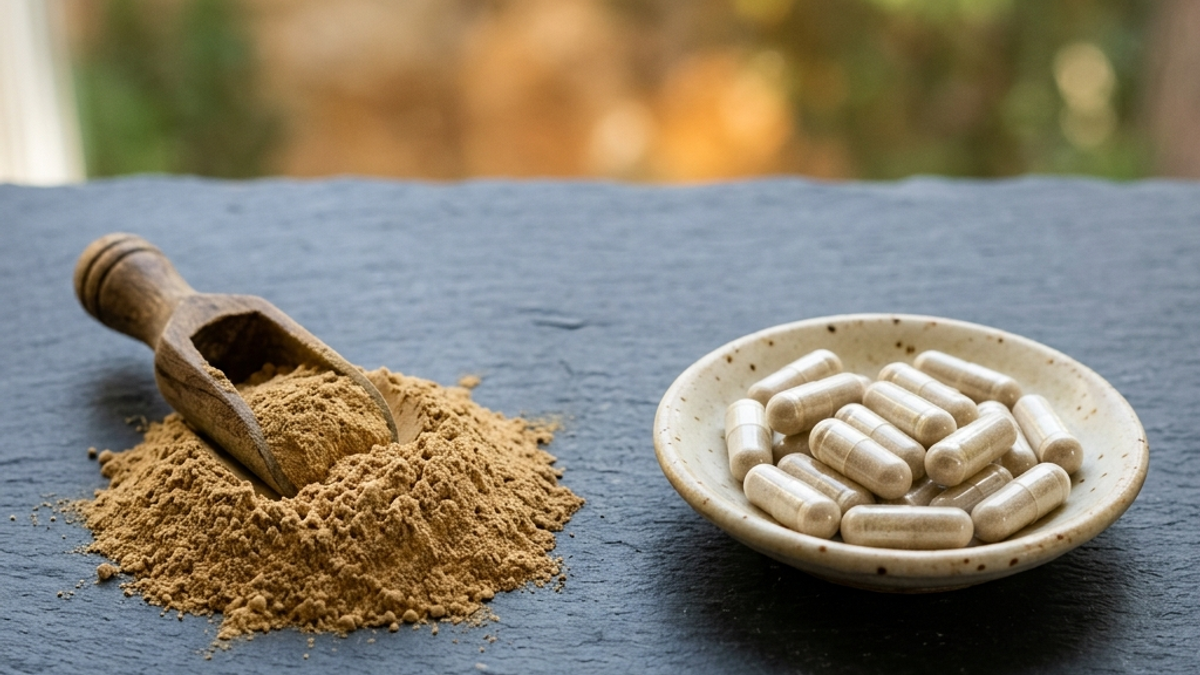
The dose is what makes this hard to catch. Nootropics Depot's Tiger Milk Mushroom capsules print "Tiger Milk Mushroom (Lignosus rhinocerus) (sclerotium) — 300 mg" on their own Supplement Facts panel, checked 9 August 2026. Ours is also 300 mg of sclerotium. Two identical numbers, two identical common names, two different organisms — and nothing on either shelf tag tells you so. If you only ever compare milligrams, this category will fool you, which is the same failure mode we walk through in how to read a mushroom supplement label.
What does the human research on tiger milk mushroom show?
Three human studies exist, all of them on the Malaysian species, and they are thinner than the marketing built on top of them.
The strongest is a randomised, placebo-controlled trial: 52 adults, 1,040 mg a day, six months. The improvement it reports is a within-patient change measured across study visits — participants compared against their own earlier scores. Against placebo, which is the comparison that actually decides whether something worked, the paper describes only a trend. The other human study was open-label with 17 participants and no control arm, so there is nothing to measure its result against. That is shaky evidence, and it is the best evidence this common name has anywhere.
For Pleurotus tuber-regium, the species we actually use, there is no human evidence at all. Not weak evidence, not preliminary evidence. None. PubMed returns no clinical trials for it and ClinicalTrials.gov has no registrations; the only randomised trial anywhere in the species' record was run in goats, and there our organism was the fermenting agent used to pre-treat cassava rather than the thing being eaten.
So I make no human-outcome claim for it. What I can tell you is what it is, because that part has been measured. Fractionation work on this species' sclerotium found its fiber is mainly beta-glucans and chitin, and structural analysis shows those glucans carry the branched beta-1,3/1,6 architecture, which is the configuration the beta-glucan literature identifies as the structurally active class (both papers are in the references below). It also has a documented history as food and traditional medicine in Nigeria under its own name, on record in Mycologia since 1977. That is why it is in the blend: a concentrated source of the compound class this category's mechanism research is built on, from a species people have eaten for generations, at a disclosed 300 mg.
What nobody has run yet is a human trial on this species. So a benefit line would be a guess, and I am not going to promote a composition fact into one. This is the same standard we apply to chaga, where the honest answer is also "tradition and lab work, no human trials."
Is tiger milk mushroom rare?
The scarce one is the one we do not use.
Lignosus rhinocerus is genuinely uncommon in the wild — sparse, seasonal, and difficult to locate, which is precisely why a cultivated standardised strain exists for it. Pleurotus tuber-regium is the opposite. It is common, it cultivates readily on agricultural by-products, and it is farmed on purpose.
Ours is the easy one to grow. I will not call it rare, prized, or sought-after, because it is none of those, and dressing it up would invite exactly the comparison we lose. When you see scarcity language on a tiger milk product, check which organism it is bolted to.
Is tiger milk mushroom a food?
Ours is — a documented food staple in south-eastern Nigeria, where the sclerotium is harvested and cooked. It carries real local names: osu and ero nsu in Igbo, olu ohu in Yoruba, katala and rumbagada in Hausa. A fungus with four names in three languages is not an obscure novelty. It is groceries.
And here is a sentence I will not write, in any form, anywhere on this site: that our tiger's milk carries the Malaysian tradition. The Orang Asli history, the early European natural-history record that logged a fungus under a Latin name meaning tiger's milk, the standardised cultivar, the modern trials — all of that belongs to Lignosus. Borrowing it because the English names match would be a false statement about what is in the jar. The shared name makes it tempting. That is what makes it a trap.
What we print, and what we still do not know
Tiger's Milk is 300 mg of dual-extracted sclerotium in a formula with 4,300 mg of total mushroom mass. It is not carrying this product, and we do not ask it to. What it does is sit on the label with its binomial and its part named — sclerotium, not fruiting body — which most of this category prints for none of its mushrooms. Ours is one of two sclerotia in the blend; poria is the other, and the fruiting-body-versus-mycelium question turns out to have a third answer nobody advertises.
We got this wrong ourselves first. Earlier versions of this site named Lignosus rhinocerus as our species and described all seven mushrooms as fruiting body. Both were wrong, and both were corrected in August 2026.
Two things we still do not hold. We have not run DNA sequencing on our own lot, so the species identification is the supplier's declaration, printed as declared — and given that both organisms are brown-rinded sclerotia moving through the same dried-material trade, that is exactly the kind of declaration worth verifying independently. It is a cheap test and it is on my list. We also have no independent glucan assay, so there is no beta-glucan percentage on this page or any other; the reasoning behind that refusal is in what a COA actually proves.
How to tell the two apart before you buy
Four checks, in order of how much they tell you.
- Read the binomial, not the common name. It should say Lignosus rhinocerus or Pleurotus tuber-regium. If it says neither, you are buying a nickname.
- Check the part. Both are sclerotia. A tiger milk label claiming "fruiting body" has copied a template from another ingredient.
- Match the claim to the species. If a page makes a specific human-outcome claim, ask which of the two species the trial used, and whether it had a control arm.
- Ignore the dose as an identifier. 300 mg is common to both.
That checklist generalises well past this one mushroom, which is really the argument of our mushroom supplement buyer's guide — and if you want the map of how the whole blend fits together, species by species, the functional mushroom guide and our own label are the two places it is written down.
These statements have not been evaluated by the Food and Drug Administration. This product is not intended to diagnose, treat, cure, or prevent any disease.
References
- Cheung PC-K, Lee MY. "Fractionation and characterization of mushroom dietary fiber (nonstarch polysaccharides) as potential nutraceuticals from sclerotia of Pleurotus tuber-regium (Fries) Singer." Journal of Agricultural and Food Chemistry 2000;48(8):3148–3151. PMID: 10956083. https://pubmed.ncbi.nlm.nih.gov/10956083/ (opens in new tab) — the composition study behind "beta-glucan-bearing": the sclerotium's fiber is mainly beta-glucans and chitin. Chemistry only; it tested no biological effect, and we quote no percentage from it.
- Zhang M, Cheung PC-K, Zhang L. "Chemical structure and chain conformation of the water-insoluble glucan isolated from Pleurotus tuber-regium." Biopolymers 2001;59(6):457–464. PMID: 11598880. https://pubmed.ncbi.nlm.nih.gov/11598880/ (opens in new tab) — structural characterization of the sclerotium's branched beta-(1→3)/(1→6)-D-glucan. Same caveat: structure, not effect.
- "Research on a Specialty Mushroom (Pleurotus tuber-regium) as a Functional Food: Chemical Composition and Biological Activities." Journal of Agricultural and Food Chemistry 2020;68(35):9277–9286. PMID: 32786828. https://pubmed.ncbi.nlm.nih.gov/32786828/ (opens in new tab) — modern review confirming the species' composition (polysaccharides, complete-protein amino acids, fiber, minerals). Its biological-activity sections are preclinical, so we cite composition only.
- Oso BA. "Pleurotus tuber-regium from Nigeria." Mycologia 1977;69(2):271–279. PMID: 559245. https://pubmed.ncbi.nlm.nih.gov/559245/ (opens in new tab) — the classic primary record of this species' documented use as food and in Nigerian traditional medicine. Traditional-use documentation, not evidence of any effect.
- Wang C, Liu Y, Duan Y, Lin H. "Exploration of Hypolipidemic Effects of Sterols from Pleurotus tuber-regium (Fr.) Sing Sclerotium." Foods 2025;14(14):2498. PMID: 40724318. https://pubmed.ncbi.nlm.nih.gov/40724318/ (opens in new tab) — extraction chemistry from the sclerotium (the part we use) plus a mouse feeding model. Preclinical only: no human result, and we draw no cholesterol claim from it. Cited because sclerotium-specific research on this species is rare.
- Mo C, Liu R, Yang Z, Ma A. "Polysaccharide from Pleurotus tuber-regium mycelium improves DSS-induced colitis in mice by regulating inflammatory cytokines, oxidative stress and gut microbiota." Food & Function 2024;15(7):3731–3743. PMID: 38489162. https://pubmed.ncbi.nlm.nih.gov/38489162/ (opens in new tab) — easy to over-read, so read the fine print with us: the polysaccharide came from the mycelium, not the sclerotium in our blend, and the model is a chemically induced disease in mice. We cite it as species research on the gut-microbiota mechanism, not as support for our ingredient.