
It's 2 p.m., the coffee has worn off, and you're staring at the same paragraph for the third time. The usual fix is another cup — and another small crash a few hours later. Functional mushrooms are interesting precisely because they promise the opposite: steady focus and energy you build over time, without a stimulant to come down from.
That promise gets oversold constantly. So this guide does something most of the category avoids — it tells you, mushroom by mushroom, what the human research actually supports, where the evidence is still early, and what has to be true for any of it to work in your cup. As a pharmacist, I keep coming back to three things that decide everything: the dose, the extract, and whether you take it consistently.
We built Shroombiosis around that honesty. Seven mushrooms, three superfoods, and three pre/pro/postbiotics: caffeine-free, dual-extracted, with every dose printed on the label. Here's the whole category, explained the way we'd explain it to a friend.
What are functional mushrooms?
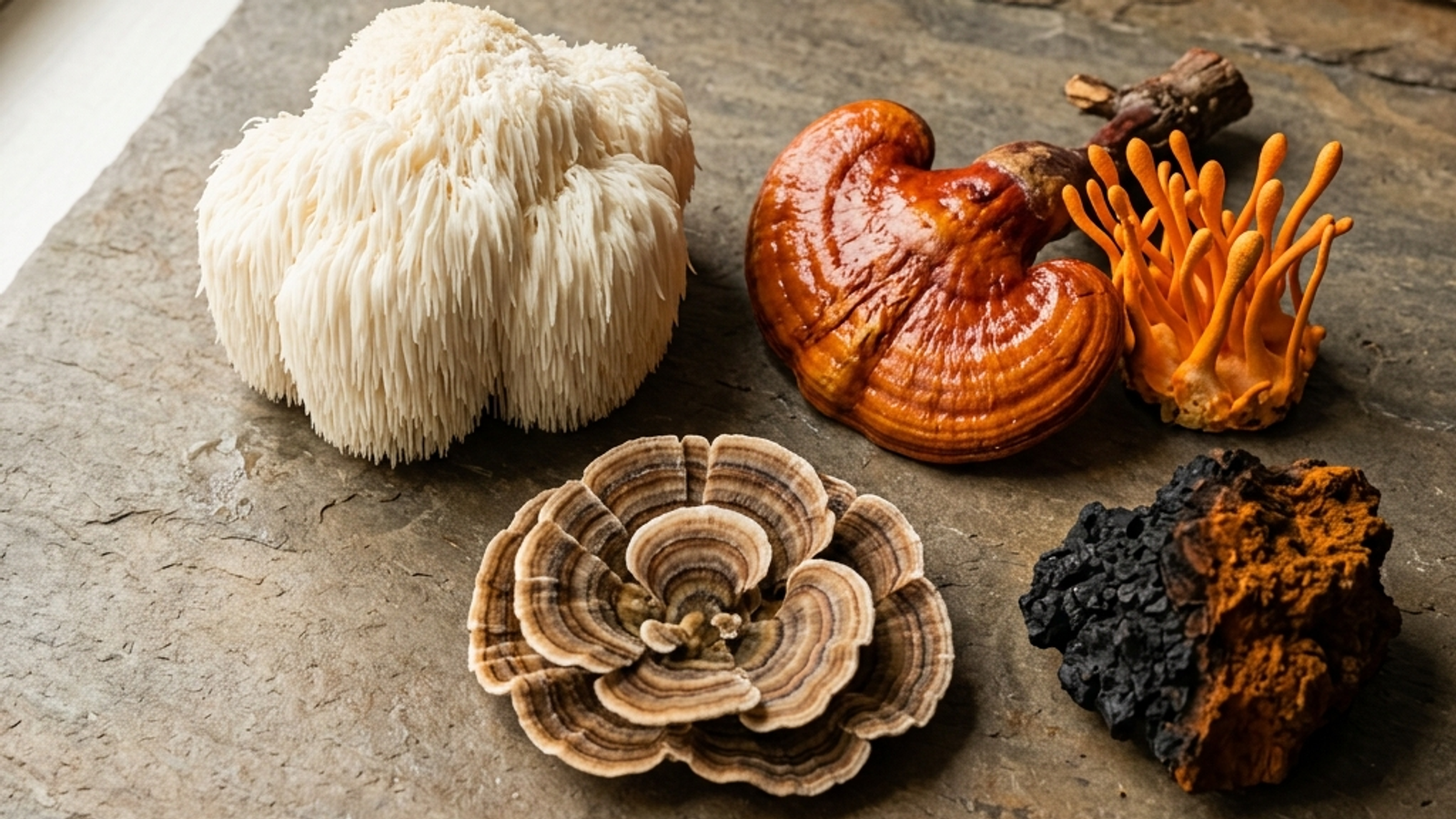
"Functional mushroom" is a category, not a single species. It refers to edible and traditional-use fungi taken for what they do in the body rather than for how they taste — the way you'd reach for lion's mane to study, not to garnish a risotto. You'll also hear "medicinal mushrooms," but in a supplement context the structure/function framing matters: these are foods and supplements that support normal functions, not drugs that treat disease.
The category is old. Reishi, turkey tail, cordyceps, and poria have centuries of use in East Asian traditions; chaga has a long folk history across the northern forests; Tiger's Milk has its own ethnobotanical lineage in Southeast Asia. What's new is that a handful of these now have modern human trials behind specific uses, while others still rest mainly on tradition and early laboratory work. A good guide keeps those two groups clearly separate — and so do we.
The most important framing for everyday life is this: functional mushrooms are a daily habit, not a quick fix. Almost every study that found a benefit ran for weeks. They don't spike and crash the way caffeine does; they work quietly, in the background, if you take them consistently and at a real dose. That's also why they fit so naturally into a caffeine-free routine — you're not borrowing energy you'll have to repay at 4 p.m. You're supporting the systems that produce it.
One more category note, because it shapes everything that follows: the form matters as much as the species. A jar that says "lion's mane" tells you almost nothing on its own. Is it the actual mushroom or mycelium grown on grain? Was it extracted so your body can use the active compounds? How much is in a scoop? Those questions — covered in detail in our guide to reading a mushroom supplement label — are where most of the category quietly falls down.
How they work: the mechanisms
Mushrooms aren't magic, and pretending otherwise is how the category got its hype problem. Their effects trace to a few real, well-described biological mechanisms. Understanding them is the difference between buying on faith and buying on evidence.
Beta-glucans and the immune system
The signature compounds in mushroom cell walls are beta-glucans — complex polysaccharides that the immune system recognizes. A review detailing how beta-glucans interact with immune-cell receptors (opens in new tab) describes them as biologic response modifiers: they bind receptors such as Dectin-1 and CR3 on macrophages and natural killer cells, effectively priming the immune system's first responders. This is the mechanism behind the immune-support angle for turkey tail, reishi, and chaga, and it's also why beta-glucans double as prebiotic fiber that feeds the bacteria in your gut. Extraction matters here: beta-glucans are locked inside tough, chitinous cell walls, which is why hot-water extraction is part of getting them out at all (more on that below).
Adaptogens and the stress response
Some mushrooms are described as adaptogens — compounds proposed to help the body maintain balance under stress. A foundational review defining adaptogens and the stress-response mechanism (opens in new tab) frames them as acting on the hypothalamic-pituitary-adrenal (HPA) axis and related stress-signaling pathways, nudging the system back toward equilibrium rather than stimulating or sedating it. This is the mechanistic backdrop for reishi's place in the calm and stress-resilience lane. It's a mechanism review, not product proof — but it's the right lens for understanding why a calming mushroom isn't a sedative.
Neurotrophins and cognition
The focus-and-memory story runs through neurotrophins — proteins like nerve growth factor (NGF) and brain-derived neurotrophic factor (BDNF) that keep neurons alive and support the brain's ability to adapt and form new connections. A review outlining the role of neurotrophins in brain plasticity (opens in new tab) explains why supporting these signals matters for cognition and why dietary plant compounds can modulate them. This is general background — the review isn't specific to lion's mane — but it's the physiological context for why a "focus mushroom" is even plausible. Dr. Danielle's deep dive into the pharmacology of lion's mane follows this thread all the way to the neuron.
The gut-brain axis
This is the mechanism we find most under-appreciated, and it's our biggest lane. Your gut and brain are in constant two-way conversation. A landmark review of how gut microbes influence brain and behavior (opens in new tab) lays out the gut-brain axis as real, measurable physiology — not wellness metaphor. And the gut isn't just talking; it's manufacturing. Research on how gut bacteria regulate the body's serotonin production (opens in new tab) underscores why roughly 90% of the body's serotonin is made in the gut, a standard piece of physiology with real implications for mood and energy. Feed and support your microbiome — with prebiotic fiber, beta-glucans, and the right biotics — and you're supporting the foundation that focus and steady energy are built on. We unpack this connection in our piece on why real energy starts in the gut.
None of these mechanisms prove that any product "works." They explain what would have to happen for it to — which is exactly the standard we hold our own formula to.
The seven mushrooms in our blend
Here's the heart of the guide: the seven mushrooms we actually use, what each one is for, and — just as important — where the evidence is solid versus where it's traditional. We sort them honestly. Three have meaningful human data; three are traditional and preclinical only; one sits in between.
Lion's Mane — focus and study
Lion's Mane (Hericium erinaceus) is the focus mushroom, and it has the strongest cognitive evidence in the blend. It supports memory, focus, and cognitive clarity — the deep-work and studying angle, clean focus without caffeine jitters. A 2009 double-blind clinical trial in Phytotherapy Research (opens in new tab) used 3,000 mg/day of fruiting-body powder over 16 weeks and found higher cognitive-scale scores versus placebo in older adults with mild cognitive impairment. More relevant to a healthy reader, a 2023 placebo-controlled trial on pure lion's mane in healthy young adults (opens in new tab) used 1.8 g/day on its own for 28 days and found faster cognitive task performance (an acute effect), with only a non-significant trend toward reduced stress (p=0.051). Together these point to a clinical research range of roughly 1,000–3,000 mg/day of dual-extracted fruiting body. (To be precise: the 2009 trial was in adults with mild cognitive impairment, so it's structure/function context, not a claim that lion's mane "treats" decline; the 2023 study was a small pilot.)
Cordyceps — steady, caffeine-free energy
Cordyceps supports stamina, energy, and natural endurance. We frame it for daily life: stamina for a long day and steady afternoons, not time-to-exhaustion on a treadmill. Cordyceps is also three different organisms trading under one name, so it is worth knowing which species is actually in the jar. A narrative review of human evidence on cordyceps (opens in new tab) — much of the human research base is on the Cordyceps militaris species — aggregates trials showing ergogenic and recovery effects via oxygen use and energy metabolism, though it notes that more standardized RCTs and dosing work are still needed. A separate trial showing improved time to exhaustion and aerobic markers (opens in new tab) supports the oxygen-use and ATP-energy mechanism, with one caveat: it combined cordyceps with rhodiola, so the cordyceps-alone effect is likely milder. We don't print a milligram figure for cordyceps — like everything but lion's mane, the dose is on the label.
Reishi — calm and stress resilience
Reishi (Ganoderma lucidum) promotes calm and supports a healthy stress response and immune health. It serves the settled-nervous-system, resilience-to-stress lane. An RCT in women with fibromyalgia (opens in new tab) (6 g/day for 6 weeks) found improved aerobic endurance, flexibility, and subjective wellbeing — which we cite as resilience and wellbeing context, framed strictly as structure/function in a disease population. A key honesty point: reishi is not a sleep cure. The human evidence we have is about wellbeing and physical resilience, not a measured sleep outcome, so we keep it in the calm and stress-resilience lane rather than promising better sleep. What that looks like as an actual daily habit is in our honest take on reishi for restful evenings. Readers weighing this lane against the focus one usually want a direct comparison of reishi and lion's mane.
Turkey Tail — gut and immune support
Turkey Tail (Trametes versicolor) supports gut flora and immune balance. It's rich in beta-glucans and PSP, which act both as prebiotic fiber for your microbiome and as the immune-priming compounds described above. A Phase 1 clinical trial of turkey tail (opens in new tab) found it safe and tolerable, with faster lymphocyte recovery and increased NK-cell activity — strong support for the immune-and-gut angle. That trial was conducted in a breast-cancer recovery population, so we frame turkey tail only as immune support, full stop. It is never tied to any cancer benefit, outcome, or implication.
Chaga — antioxidant support (traditional and preclinical only)
Chaga (Inonotus obliquus) provides antioxidant support and is traditionally used to support immune health and vitality. Here the honesty bar rises: there are no high-quality human trials. A review of medicinal mushrooms and their bioactive compounds (opens in new tab) documents chaga's high antioxidant capacity in vitro and in animal models (phenolics, melanin). So we say exactly that — traditionally used, with preclinical studies showing high antioxidant capacity — and we don't claim a human health outcome.
Poria — fluid balance and calm (traditional TCM only)
Poria (Wolfiporia cocos) is traditionally used to support fluid balance, digestion, and a calm mood within Traditional Chinese Medicine. There's no solo human study to lean on. The closest research is a finding of rapid immune-marker modulation, but it came from a multi-ingredient blend (aloe, poria, and rosemary), so it can't be attributed to poria alone. We keep poria firmly in traditional-use language for its fluid-balance, digestion, and calm associations. Our full poria mushroom guide covers the rest: why it is a sclerotium rather than a fruiting body, why it appears in 25 of the 100 formulas in China's 2018 classic-prescription catalog, and why almost no other blend carries it.
Tiger's Milk — a traditional, beta-glucan-rich mushroom (traditional only)
Tiger's Milk (Pleurotus tuber-regium (Fr.) Sing) is a beta-glucan-rich functional mushroom — a distinctive, under-served ingredient with a real ethnobotanical history and a small but growing base of preliminary research. Human data is very limited, so every Tiger's Milk statement stays in traditional-use framing. The common name is shared with an unrelated Malaysian species, so read the binomial rather than the nickname when you compare products.
For the full breakdown of how five of these mushrooms map to gut, focus, and energy, see our post on science-backed ways mushrooms support gut health, focus, and energy. And for the same lanes framed around the calm, energy, and gut comfort many women describe, see functional mushrooms for women.
Beyond the mushrooms: superfoods and biotics
A blend isn't just its mushrooms. Two of the things that most distinguish Shroombiosis from a typical gym-shelf product sit outside the fungi: three supporting superfoods and three pre/pro/postbiotics. The biotics, especially, are a lane most mushroom brands don't touch at all.
The three superfoods
Organic Cacao (Theobroma cacao) provides mood and antioxidant support. A crossover trial on flavanol-rich cocoa and executive function (opens in new tab) found that cocoa flavanols blunted the fatigue-related decline in executive function — an acute finding in men using high-flavanol cocoa, which we don't over-generalize. Cacao naturally contains theobromine, but the blend stays caffeine-free; we treat cacao as a mood and focus support, not a stimulant.
Ceylon Cinnamon (Cinnamomum verum — always Ceylon, never cassia) offers antioxidant support and supports healthy glucose metabolism. A randomized trial of Ceylon cinnamon (opens in new tab) found improved metabolic parameters, including fasting glucose, versus placebo. That trial was run in a diabetes population, so we cite the glucose-metabolism finding as mechanism only and say exactly what's compliant — supports healthy glucose metabolism — never anything about treating, managing, or lowering blood-sugar disease.
Coconut Milk Powder (Cocos nucifera) contributes healthy fats that support energy and the absorption of fat-soluble mushroom compounds. This is a formulation rationale as much as an ingredient: preclinical research showing MCTs can improve absorption of fat-soluble nutrients (opens in new tab) (an animal carotenoid study) supports the general lipid-absorption principle — why putting a fat source alongside fat-soluble compounds is a deliberate choice, not filler.
The pre/pro/postbiotics — our biggest differentiator
This is the part that sets a functional blend apart from a powdered coffee. The full pre/pro/postbiotic trio — a prebiotic fiber, a probiotic, and a postbiotic — works together on the gut-brain axis described earlier.
Acacia Fiber (acacia gum / Acacia senegal) is the prebiotic — fiber that feeds the beneficial bacteria you already have. In a 12-week fiber-supplement trial in healthy adults (opens in new tab), the supplement shifted gut microbiome composition, though it did not improve the trial's measures of physiological resilience. The supplement studied was acacia gum combined with carrot powder, so we credit it as a fiber-supplement finding rather than attributing the whole effect to acacia in isolation.
Bacillus subtilis DE111® is a probiotic that supports healthy gut flora and immune function. A double-blind clinical trial on DE111® in healthy adults (opens in new tab) (1 billion CFU/day for 4 weeks) shifted the systemic immune profile toward anti-inflammatory immune-cell populations, while gut microbiota and GI markers were largely unaffected and it was safe and well-tolerated — a pilot in healthy adults, so we frame it as maintenance and support, not treatment. DE111® is a spore-forming strain — spores are naturally heat- and acid-resistant, which is what lets it hold up stirred into a hot drink. In vitro work on its survival through gastric (stomach-acid) transit (opens in new tab) documents that acid durability specifically (mechanistic, not a human efficacy claim).
Bifidobacterium animalis subsp. lactis CECT 8145 (BPL1® HT) is a postbiotic that supports gut and metabolic health. The "HT" means heat-treated — a postbiotic form, not a live probiotic, which is why it's heat-stable. A randomized trial of the BPL1® strain in abdominally obese adults (opens in new tab) found improved adiposity biomarkers, an effect strongest in women, along with increased Akkermansia. Two honesty notes: that was a structure/function finding in an obese population, never a weight-loss claim — and the trial studied the live BPL1® strain, while our ingredient is the heat-treated (HT) postbiotic form, so we present the strain's research as supporting evidence and are precise that ours is the postbiotic version.
This biotic stack is genuinely where we differ most from a gym-brand mushroom product. The gut is the root system; we feed it (prebiotic fiber), seed it (probiotic), and add a postbiotic — the kind of formulation thinking we walk through on our science page.
Fruiting body, mycelium, and dual extraction
Two formulation choices decide whether a mushroom supplement contains what its label implies. They're invisible in marketing photos and obvious on a careful ingredient panel, so they're worth understanding before you buy anything in this category — ours included.
Fruiting body vs. mycelium-on-grain. The fruiting body is the mushroom itself — the part with the highest concentration of beta-glucans and other studied compounds. Mycelium is the root-like network the fungus grows from; in supplements it's usually grown on grain and dried with that grain still attached. The result can be a powder that's substantially starch, with a lower concentration of the active compounds you came for. There's nothing inherently fraudulent about mycelium, but "mushroom" on the front and "mycelial biomass on grain" in the fine print are not the same product. We use dual-extracted — no mycelium-on-grain, no fillers. (For the full breakdown of this one choice, see fruiting body vs. mycelium supplements.)
Why dual extraction (water and alcohol). Mushrooms hold two different families of useful compounds, and no single solvent pulls out both. Beta-glucans are water-soluble, so they need a hot-water extraction to free them from those tough, chitinous cell walls. Other compounds — the triterpenes in reishi, for example — are alcohol-soluble and need an alcohol extraction to capture. Use only water and you leave the triterpenes behind; use only alcohol and you miss the beta-glucans. Dual extraction does both and recombines them, which is why "dual-extracted" is a meaningful phrase rather than a marketing flourish. It's also why an unextracted, raw mushroom powder — even a fruiting-body one — may not deliver much: the cell walls never opened. (Full breakdown: dual extraction explained.)
Put those two choices together and you have the quiet test that separates a real functional product from a decorative one: dual extraction, and a label that names the part you're getting. Our blend is dual-extracted throughout, and we name the part rather than rounding all seven to "fruiting body." Poria and Tiger's Milk are sclerotia, and we say so.
How much do you actually need?
This is where the category gets evasive, so we'll be direct. For most of these ingredients, there isn't a single citable human dose — the honest answer is "the amount on the label," and we publish ours. The one exception is lion's mane.
Lion's mane is the only ingredient where the research gives a real, citable range. The clinical studies cluster around 1,000–3,000 mg/day of fruiting-body powder: the 2009 cognition trial used 3,000 mg/day, and the 2023 healthy-adult study used 1.8 g/day on its own. We cite that as the clinical research range, and our label discloses our actual serving — we don't pretend the study dose and our serving are automatically the same number. (The honest dosing picture for every mushroom is in how much of each mushroom you actually need.)
For everything else — cordyceps, reishi, turkey tail, chaga, poria, Tiger's Milk, the superfoods, and the biotics — the library doesn't provide a defined human serving dose, so we won't invent one. Where a study used a number, it was often a high amount in a clinical or disease setting (reishi's 6 g/day, turkey tail's escalation up to 9 g/day) that is research context, not a serving recommendation. The compliant, honest answer is: every dose is on the label. That's the whole point of publishing the full panel — you can see exactly what you're getting and compare it yourself, which is the skill we teach in how to read a mushroom supplement label.
The dosing principle that matters more than any single milligram figure is consistency. Nearly every study that found a benefit ran for weeks — 4 weeks, 12 weeks, 16 weeks. Functional mushrooms reward a daily habit, not a heroic one-time dose. The fair follow-up question is whether daily use needs a break, and there is no good evidence that it does. A real amount taken every day for a month or two is the version of this that actually does something.
Caffeine-free vs. mushroom coffee
If you've shopped this category, you've probably met it as "mushroom coffee" — and there's a real, definitional difference between that and what we make. We'll keep this to category facts we can stand behind, not invented numbers.
The clearest distinction is caffeine. Mushroom coffees — the well-known names like Ryze and MUD\WTR — are built on a coffee or tea base, which means they contain caffeine by design. Mushrooms themselves contain none. Shroombiosis is caffeine-free on purpose: it's a mix-in powder, not a coffee, so the steady focus and energy it supports don't arrive with a stimulant you'll crash from. That's not a knock on coffee — it's a different product for a different goal. (If you're choosing one, what to look for in a caffeine-free mushroom coffee alternative is the checklist, and decaf mushroom coffee: is it really caffeine-free? covers the decaf trap.)
The second distinction is transparency. Many products in this space use a proprietary blend, which lists ingredients without telling you how much of each is inside. We publish every dose on the label. The third is form — dual-extracted fruiting body versus mycelium-on-grain, the difference we covered above.
| Factual axis | Typical mushroom coffee | Shroombiosis |
|---|---|---|
| Base | Coffee or tea | Caffeine-free mix-in powder |
| Caffeine | Contains caffeine (coffee/tea base) | Caffeine-free |
| Dose disclosure | Often a proprietary blend | Every dose on the label |
| Mushroom form | Varies; sometimes mycelium-on-grain | Dual-extracted; part named per ingredient |
| Pre/pro/postbiotics | Usually none | Prebiotic fiber + probiotic + postbiotic |
A fair note on this table: it's a category-level comparison, not a line-by-line scorecard of any one competitor's current formula. Specific products change their recipes, and a wrong fact about a competitor is a trust problem we won't risk. Detailed, individually verified head-to-head comparisons — checked against each brand's own label and dated — are coming as their own posts. Until then, the honest summary is the one above: they're coffee-based and contain caffeine; we're a caffeine-free, fully disclosed mix-in.
Is it safe? Who should ask first
For most healthy adults, the mushrooms and biotics in a well-made functional blend are well tolerated at the amounts studied. The human trials cited throughout this guide generally reported good safety and tolerability. But "generally safe" is a narrower statement than it sounds. It means the mostly healthy adults who enrolled in those trials did well at the doses tested, and that is all it means. Trials usually screen out many of the people who most need a safety answer: anyone pregnant, on regular medication, or managing a serious condition. So it is a statement about the people studied, not a promise about you, and the responsible answer to a safety question is to put it to a professional who knows your situation.
Talk to a physician or pharmacist before use if you are pregnant, nursing, taking prescription medications, or managing a medical condition. Those four situations cover the most important reasons to check first. A few specifics, from a pharmacist's perspective:
- Pregnancy and nursing. Most functional mushrooms simply haven't been studied in pregnancy, and absence of data is a reason for caution, not reassurance.
- Prescription medications. Some mushrooms have plausible interactions — immune-active compounds, for instance, deserve a conversation if you take immunosuppressants, and anything affecting glucose metabolism (like cinnamon) is worth flagging if you're on glucose-related medication. A pharmacist can check your specific list.
- Existing conditions. If you're managing a medical condition, your clinician should weigh in on whether a new supplement fits your overall plan.
This is structure/function support, not a treatment for anything. When in doubt, ask first — that's the calm, conservative position, and the one we'd want a member of our own family to take. (A pharmacist's fuller take: are functional mushrooms safe?)
How we formulate and how to choose
Everything in this guide rolls up to a simple buying standard you can apply to any mushroom product, ours included. Here's how we formulate, stated as the questions worth asking before you buy anything in this category:
- Is it dual-extracted fruiting body? That's the test for whether the active compounds are actually present and usable. We use dual-extracted — no mycelium-on-grain, no fillers.
- Is every dose on the label? A proprietary blend hides amounts. We publish the full panel so you can see exactly what's in a scoop and compare it to the research yourself.
- Is it third-party tested, and are certifications stated honestly? Every ingredient is sourced to organic, vegan, and gluten-free standards, and formal third-party certification is in progress — a batch-based audit we'd rather complete properly than rush. We say "in progress," never "certified," because the distinction is the whole point.
- Does the formula think about absorption and the gut? A fat source for fat-soluble compounds, and a pre/pro/postbiotic stack for the gut that everything else depends on, are deliberate choices — not afterthoughts.
That's the standard, and it's the same one whether you're evaluating Shroombiosis or anyone else. If you want to see the evidence behind each ingredient laid out in one place, that's exactly what our science page is for; if you're ready to see the formula itself, the caffeine-free blend we built around this puts every dose where you can read it.
A program like this is also a team effort, which is part of why you can trust it: it's authored by a pharmacist, reviewed for physiology by Onur Oncer, and reviewed for formulation and manufacturing by Jon Klipstein. Different expertise, checking each other — the way health content should be made.
Read more
This guide is the hub; these posts go deeper on the threads that matter most:
- The pharmacology of lion's mane — how it works on neurons, and why dose, extraction, and your gut decide the outcome.
- Science-backed ways mushrooms support gut health, focus, and energy — five mechanisms across lion's mane, reishi, chaga, and cordyceps.
- Why real energy starts in the gut — the gut-brain axis, pre/pro/postbiotics, and steady caffeine-free energy.
- How to read a mushroom supplement label — proprietary blends, dose transparency, and fruiting body vs. mycelium, in practice.
- Fruiting body vs. mycelium supplements: which is better? — the dedicated deep-dive on the single label detail that changes what's in the jar.
- Cordyceps for energy: what the research shows — the non-stimulant stamina mushroom, and where its evidence is strong vs. early.
- Reishi for calm: what the research shows — the adaptogen lane, framed as resilience, never a sleep aid.
- Turkey tail, beta-glucans & your immune system — immune and gut support from the most beta-glucan-rich mushroom.
- Chaga: traditional claims vs. what's studied — an honest look at where chaga has human data, and where it doesn't.
- Dual extraction explained — why water and alcohol extraction is what makes the actives usable.
- Functional mushroom dosing: how much do you actually need? — the honest answer (only lion's mane has a citable human dose).
- Are functional mushrooms safe? A pharmacist's take — tolerability, interactions, and who should ask first.
- Mushroom coffee for focus, without the jitters — what actually drives the focus (lion's mane, not caffeine), and how to get it caffeine-free.
- Best caffeine-free mushroom coffee alternative: what to look for — the five details that separate a real caffeine-free blend from a label.
- Gut Health & the Microbiome: The Complete Guide — the sibling pillar: the gut foundation beneath focus, energy, and immunity.
- Our science page — every ingredient, what it's studied for, and where the evidence is strong versus early.
- The Shroombiosis blend — seven mushrooms, three superfoods, three biotics, caffeine-free, every dose on the label.
Functional mushrooms aren't a miracle and they aren't a myth — they're a daily habit with real, specific evidence behind specific ingredients, and the results depend on getting the dose, the extract, and the consistency right. That's the whole idea behind how we formulate: real support you can build, not borrowed energy you crash from. If you take one thing from this guide, let it be that the label should tell you everything — and ours does.
References
- Mori K, Inatomi S, Ouchi K, Azumi Y, Tuchida T. Improving effects of the mushroom Yamabushitake (Hericium erinaceus) on mild cognitive impairment: a double-blind placebo-controlled clinical trial. Phytotherapy Research. 2009;23(3):367–372. PMID 18844328. https://pubmed.ncbi.nlm.nih.gov/18844328/ (opens in new tab)
- Docherty S, Doughty FL, Smith EF. The acute and chronic effects of lion's mane mushroom supplementation on cognitive function, stress and mood in young adults: a double-blind, parallel groups, pilot study. Nutrients. 2023;15(22):4842. PMID 38004235. https://pubmed.ncbi.nlm.nih.gov/38004235/ (opens in new tab)
- Fiore M, Terracina S, Ferraguti G. Brain neurotrophins and plant polyphenols: a powerful connection. Molecules. 2025;30(12):2657. PMID 40572619. https://pubmed.ncbi.nlm.nih.gov/40572619/ (opens in new tab)
- Jędrejko M, Jędrejko K, Granda D, et al. Current evidence of ergogenic and post-exercise recovery effects of dietary supplementation with Cordyceps militaris in humans — a narrative review. Nutrients. 2026;18(5):781. PMID 41829950. https://pubmed.ncbi.nlm.nih.gov/41829950/ (opens in new tab)
- Chen CY, Hou CW, Bernard JR, et al. Rhodiola crenulata- and Cordyceps sinensis-based supplement boosts aerobic exercise performance after short-term high altitude training. High Altitude Medicine & Biology. 2014;15(3):371–379. PMID 25251930. https://pubmed.ncbi.nlm.nih.gov/25251930/ (opens in new tab)
- Collado-Mateo D, Pazzi F, Domínguez-Muñoz FJ, et al. Ganoderma lucidum improves physical fitness in women with fibromyalgia. Nutrición Hospitalaria. 2015;32(5):2126–2135. PMID 26545669. https://pubmed.ncbi.nlm.nih.gov/26545669/ (opens in new tab)
- Torkelson CJ, Sweet E, Martzen MR, et al. Phase 1 clinical trial of Trametes versicolor in women with breast cancer. ISRN Oncology. 2012;2012:251632. PMID 22701186. https://pubmed.ncbi.nlm.nih.gov/22701186/ (opens in new tab)
- Sadowska A, Włosek-Pawełas D, Car H. Medicinal mushrooms and their bioactive compounds: from traditional use to therapeutic potential. Molecules. 2026;31(10):1749. PMID 42197308. https://pubmed.ncbi.nlm.nih.gov/42197308/ (opens in new tab)
- Tsukamoto H, Yoneya S, Koyama T, et al. A single intake of flavanol-rich cocoa improves inhibitory executive process under cognitive fatigue during aerobic exercise in men: a randomized, double-blind, placebo-controlled crossover trial. Psychopharmacology (Berl). 2025;242(12):2713–2724. PMID 40493074. https://pubmed.ncbi.nlm.nih.gov/40493074/ (opens in new tab)
- Ranasinghe P, Galappatthy P, Constantine GR, et al. Efficacy and safety of Cinnamomum zeylanicum (Ceylon cinnamon) for diabetes mellitus: a randomized, double-blind, placebo-controlled clinical trial. Diabetes & Metabolic Syndrome. 2025;19(12):103357. PMID 41412108. https://pubmed.ncbi.nlm.nih.gov/41412108/ (opens in new tab)
- Mehkri S, Dinesh KG, Ashok G, Bopanna K. Comparative pharmacokinetics of lutein and zeaxanthin from phospholipid, liposomal, and MCT formulations in SD rats. Pharmaceutics. 2025;17(12):1552. PMID 41471067. https://pubmed.ncbi.nlm.nih.gov/41471067/ (opens in new tab)
- Eveleens Maarse BC, Eggink HM, Warnke I, et al. Impact of fibre supplementation on microbiome and resilience in healthy participants: a randomized, placebo-controlled clinical trial. Nutrition, Metabolism & Cardiovascular Diseases. 2024;34(6):1416–1426. PMID 38499450. https://pubmed.ncbi.nlm.nih.gov/38499450/ (opens in new tab)
- Freedman KE, Hill JL, Wei Y, et al. Examining the gastrointestinal and immunomodulatory effects of the novel probiotic Bacillus subtilis DE111. International Journal of Molecular Sciences. 2021;22(5):2453. PMID 33671071. https://pubmed.ncbi.nlm.nih.gov/33671071/ (opens in new tab)
- Mazhar S, Khokhlova E, Colom J, Simon A, Deaton J, Rea K. In vitro and in silico assessment of probiotic and functional properties of Bacillus subtilis DE111®. Frontiers in Microbiology. 2023;13:1101144. PMID 36713219. https://pubmed.ncbi.nlm.nih.gov/36713219/ (opens in new tab)
- Pedret A, Valls RM, Calderón-Pérez L, et al. Effects of daily consumption of the probiotic Bifidobacterium animalis subsp. lactis CECT 8145 on anthropometric adiposity biomarkers in abdominally obese subjects: a randomized controlled trial. International Journal of Obesity (Lond). 2019. PMID 30262813. https://pubmed.ncbi.nlm.nih.gov/30262813/ (opens in new tab)
- Cryan JF, Dinan TG. Mind-altering microorganisms: the impact of the gut microbiota on brain and behaviour. Nature Reviews Neuroscience. 2012;13(10):701–712. PMID 22968153. https://pubmed.ncbi.nlm.nih.gov/22968153/ (opens in new tab)
- Yano JM, Yu K, Donaldson GP, et al. Indigenous bacteria from the gut microbiota regulate host serotonin biosynthesis. Cell. 2015;161(2):264–276. PMID 25860609. https://pubmed.ncbi.nlm.nih.gov/25860609/ (opens in new tab)
- Panossian A, Wikman G. Effects of adaptogens on the central nervous system and the molecular mechanisms associated with their stress-protective activity. Pharmaceuticals (Basel). 2010;3(1):188–224. PMID 27713248. https://pubmed.ncbi.nlm.nih.gov/27713248/ (opens in new tab)
- Akramiene D, Kondrotas A, Didziapetriene J, Kevelaitis E. Effects of beta-glucans on the immune system. Medicina (Kaunas). 2007;43(8):597–606. PMID 17895634. https://pubmed.ncbi.nlm.nih.gov/17895634/ (opens in new tab)