Lion's Mane Pharmacology: How It Actually Works
Scientifically reviewed by Onur Oncer, B.S. (B.S. Physiology, published researcher).
Short answer
Lion's mane supports focus and memory by encouraging nerve growth factor (NGF). It works only when four things line up: a dual-extracted fruiting-body extract, a clinical-range dose (1,000–3,000 mg/day), a gut that absorbs it, and weeks of consistent use.

A quick note before we start: this is education, not medical advice. The right amount of any supplement for you depends on your physiology, your other medications, and your goals. The numbers below are what published clinical trials have actually used.
Lion's mane (Hericium erinaceus) has had its moment. You've seen it everywhere — gas-station gummies, wellness influencers, your brother-in-law's morning coffee. Most of what's written about it falls into two camps: vague hand-waving about "brain health," or aggressive marketing about "biohacking your cognition."
As a pharmacist, I find both frustrating, because the actual science is more interesting than the marketing — and more nuanced than the dismissals. This post is part of our complete guide to functional mushrooms, and it's where I dig into the one most people reach for when they want caffeine-free focus for work and study. So let's go through what's really happening, and what has to be true for any of it to matter.
The two compounds that matter — and where they live
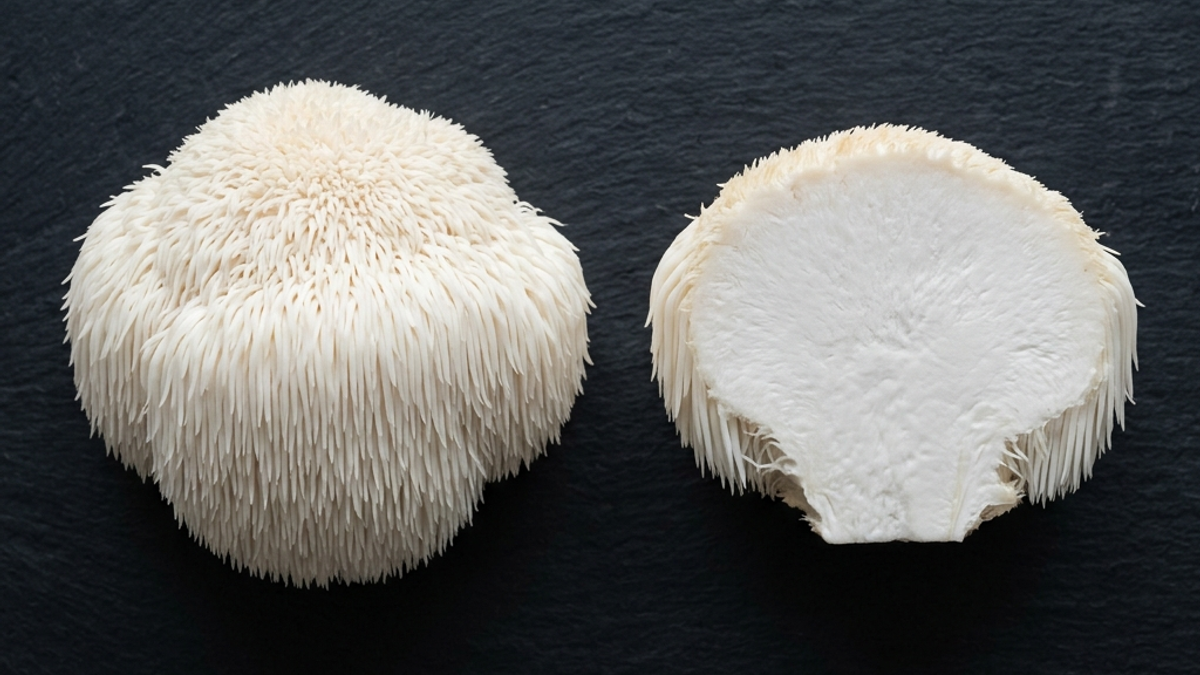
Lion's mane contains two distinct classes of bioactive compounds, and they live in different parts of the mushroom.
- Hericenones are concentrated in the fruiting body — the visible mushroom. They're small enough to cross the blood–brain barrier, and they've been studied for their ability to stimulate nerve growth factor (NGF).
- Erinacines are concentrated in the mycelium — the root-like network. These diterpenoid compounds act on the same pathway and have been studied for brain-derived neurotrophic factor (BDNF) as well.
This is the first place most supplements lose the plot. Mycelium grown on grain leaves a lot of starchy filler in the final powder and very little active compound. Fruiting body that's been dual-extracted — in both water and alcohol — is how you actually capture a meaningful amount of these molecules. If a label doesn't say "fruiting body" and "dual-extracted," you're mostly paying for grain. (If that distinction is new to you, it's the heart of how to read a mushroom supplement label.)
What NGF actually does
Nerve growth factor is a protein your body makes — in smaller quantities as you age — that helps maintain existing neurons and supports the connections between them. NGF and BDNF are the two best-studied neurotrophins: the signaling proteins behind neuronal survival and the kind of plasticity that underlies learning and steady attention. A 2025 review of neurotrophins and brain plasticity (opens in new tab) lays out why this machinery matters and how dietary compounds can modulate its signaling. (That review is general background on the pathway, not a study of lion's mane specifically — I want to be precise about which evidence does which job.)
When studies look at lion's mane and cognitive performance, this is the proposed mechanism: not a stimulant effect, but support for the maintenance machinery your nervous system already runs. For the kind of work that demands sustained attention — writing, studying, debugging, reading something dense — that distinction is the whole point. You're not borrowing alertness from a drug that peaks and crashes; you're supporting the wiring that holds focus in the first place.
Does lion's mane cause "neurogenesis"?
It's the word everyone searches, so let's be precise. Neurogenesis means growing new neurons; neuroplasticity means strengthening and remodeling the connections between the ones you already have. Lion's mane's studied mechanism runs through the neurotrophins above — NGF and BDNF, the signals behind both neuronal survival and plasticity — and laboratory and animal research has explored its hericenones and erinacines for promoting neurite outgrowth (neurons extending new branches).
Here's the honest line: that neurite-and-neurogenesis work is largely preclinical — cells and animals — while the human trials measured cognitive performance, not neuron counts (you can't biopsy a brain in a supplement study). So the accurate way to say it is that lion's mane is studied for supporting the neurotrophic factors involved in neuronal health and plasticity — not that it's a proven "grow new brain cells" pill. Anyone selling it as the latter is ahead of the evidence.
What the human trials actually show
The most-cited human trial is a 2009 double-blind, placebo-controlled clinical trial in Phytotherapy Research (opens in new tab), which followed older adults over 16 weeks of daily supplementation at 3,000 mg/day and measured higher cognitive-scale scores versus placebo. It's a small study (n=30), and one trial is never the whole story — but it's real science with a real control group, which already puts it ahead of most of what gets quoted online. It was run in adults with mild cognitive impairment, so I read it as mechanism and dose evidence, not a promise about reversing anything.
The fairer question for a healthy person studying for an exam or grinding through a work project is: does it do anything when you're not in a clinical group? Here the better citation is a 2023 placebo-controlled trial of pure lion's mane in healthy young adults (opens in new tab), which gave 1.8 g/day of solo Hericium erinaceus to adults aged 18–45 for 28 days. Its clearest win was acute: a single dose sped up task performance about an hour later, alongside a non-significant trend toward reduced subjective stress versus placebo. It's a pilot with a small sample, so I hold it loosely — but it's the cleanest "works on its own, in healthy people" signal we have, and it lines up with the same neurotrophic story.
A word on speed, because it's where expectations go wrong. There is research on acute, same-session effects of a lion's mane extract (opens in new tab) showing cognitive and mood improvements within about two hours — but that study paired lion's mane with guayusa (which contains caffeine), so it can't tell you what lion's mane does on its own, and it isn't how we'd frame a caffeine-free product. The honest read across all of it: the durable focus benefit is the slow, weeks-long one.
Why the dose matters more than the brand
Here's the part the marketing skips. A lot of lion's mane supplements are dosed at around 500 mg per serving. The clinical studies that show a benefit generally use 1,000–3,000 mg/day of properly extracted material.
And "500 mg" isn't even a fixed quantity of anything useful: 500 mg of mycelium-on-grain can contain an order of magnitude less active compound than 500 mg of fruiting body extract. "1,000 mg of dual-extracted fruiting body" tells you something. "Proprietary mushroom blend, 1,500 mg" tells you nothing — you can't see how much lion's mane is actually in there. That's the whole game, and it's why we publish every dose on the label instead of hiding it in a blend.
Timing, fat, and the gut connection
Lion's mane compounds are fat-soluble and absorbed in the small intestine. Taking them with a little fat — cream, butter, a splash of coconut milk — improves absorption compared with water alone. The compounds are also partially handled by your gut microbiota before they reach circulation, which means an out-of-balance gut can quietly reduce how much you actually absorb.
That's not a throwaway detail. It's exactly why we built Shroombiosis with lion's mane, healthy fats, and pre/pro/postbiotics in the same blend — a pharmacology decision, not a marketing gesture. There's more on that in how your gut shapes energy and focus.
What to expect — honestly
Lion's mane is not a stimulant, and it isn't caffeine. The research describes a gradual, weeks-long shift — better word recall, cleaner focus, less mental fatigue — usually noticeable at 2–4 weeks of consistent daily use. If a company promises you'll feel sharper within an hour, they've either added caffeine or they're overselling.
For the work-and-study lane specifically, that slow build is a feature, not a bug. Caffeine gives you a sharp peak and a 2 p.m. crash; the neurotrophic mechanism gives you a quieter, steadier baseline you don't have to keep re-dosing through the afternoon. You can absolutely take lion's mane alongside your coffee — the point isn't to replace a habit you enjoy, it's that the focus support here doesn't depend on a stimulant at all.
A quick word on safety
Lion's mane is generally well tolerated in the studies we have, which is part of why it's such a popular daily-focus ingredient. Still, "natural" isn't a synonym for "automatically fine for everyone." As a pharmacist, I'd ask a pharmacist or physician first if you're pregnant, nursing, taking prescription medications, or managing a medical condition — not because lion's mane is risky, but because the right call always depends on the rest of your physiology and your medication list. That's the same honesty principle behind how we formulate: we'd rather you ask the question than assume the answer.
The bottom line
The mechanism is real, but it only does anything if four things line up: the extract is fruiting body (not mycelium-on-grain), the dose is in the clinical range, your gut supports absorption, and you're consistent for weeks. Miss any one and you've bought an expensive placebo. Get all four right and you're working with your physiology instead of around it — clean, caffeine-free focus you build rather than borrow.
References
- Mori K, Inatomi S, Ouchi K, Azumi Y, Tuchida T. Improving effects of the mushroom Yamabushitake (Hericium erinaceus) on mild cognitive impairment: a double-blind placebo-controlled clinical trial. Phytotherapy Research. 2009;23(3):367–372. PMID: 18844328 (opens in new tab) · doi:10.1002/ptr.2634 (opens in new tab)
- Docherty S, Doughty FL, Smith EF. The acute and chronic effects of lion's mane mushroom supplementation on cognitive function, stress and mood in young adults: a double-blind, parallel groups, pilot study. Nutrients. 2023;15(22):4842. PMID: 38004235 (opens in new tab) · doi:10.3390/nu15224842 (opens in new tab)
- La Monica MB, Raub B, Ziegenfuss EJ, et al. Acute effects of naturally occurring guayusa tea and Nordic lion's mane extracts on cognitive performance. Nutrients. 2023;15(24):5018. PMID: 38140277 (opens in new tab) · doi:10.3390/nu15245018 (opens in new tab)
- Fiore M, Terracina S, Ferraguti G. Brain neurotrophins and plant polyphenols: a powerful connection. Molecules. 2025;30(12):2657. PMID: 40572619 (opens in new tab) · doi:10.3390/molecules30122657 (opens in new tab)