
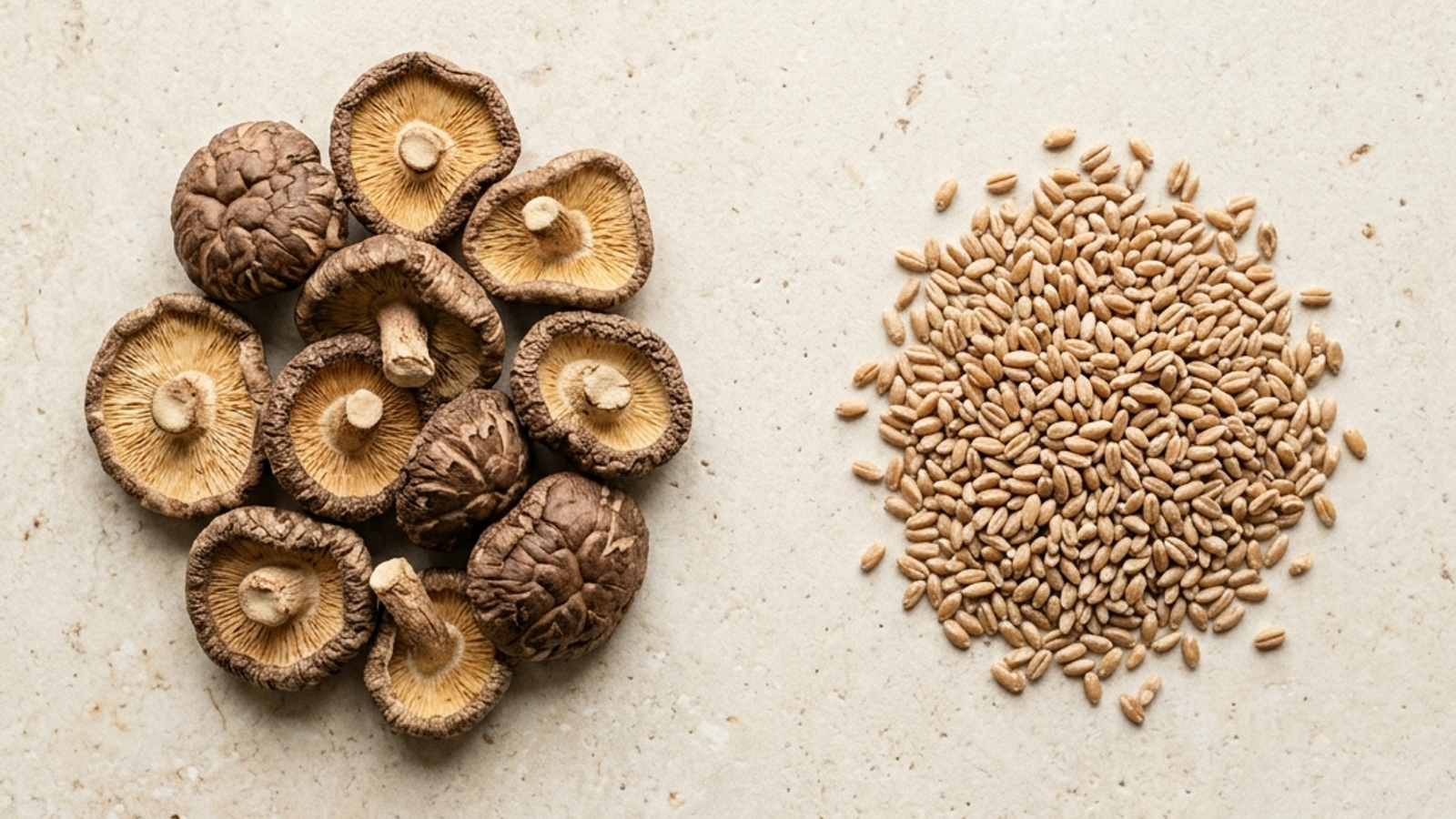
You're standing in front of two jars. Both say "lion's mane." Both have a clean label, a confident font, and a price that feels about right. One of them will do something over the next month; the other is mostly expensive starch — and nothing on the front tells you which is which.
That's the whole problem with this category. The marketing is loud and the panel that actually matters is quiet. As the founder of a mushroom brand, I spend a lot of time reading competitors' labels, and the gap between what the front promises and what the fine print delivers is wider than most shoppers would believe. The good news: once you know the five things to check, you can sort the real products from the decorative ones in about a minute — and you'll never need to trust a marketing photo again.
This guide is the buyer's-side companion to our complete guide to functional mushrooms. That one explains what each mushroom does; this one teaches you how to buy well — fruiting body, extraction, dose disclosure, third-party testing, honest claims, and the caffeine question. We built Shroombiosis against every test below, so I'll use it as a worked example, including the one we don't pass yet: we have no published COA, and I'll show you exactly where that leaves us when we get to testing. The standard is the standard whether you're evaluating us or anyone else.
What to look for: the five-second test
Before we go deep, here's the whole guide compressed into the five things that decide quality. If a product fails any of these, no font choice or earthy photograph rescues it.
- Form: Is it dual-extracted fruiting body, or mycelium-on-grain? The fruiting body is the actual mushroom; mycelium-on-grain often leaves starchy grain in the powder.
- Extraction: Was it extracted at all — and with both water and alcohol? Raw, unextracted powder may not deliver much, because the active compounds stay locked in the cell wall.
- Dose: Is every dose printed, or hidden inside a "proprietary blend"? A blend that lists ingredients without amounts is hiding something.
- Testing: Is it third-party tested, with a certificate of analysis (COA) you can actually see — confirming beta-glucan content and screening contaminants?
- Claims: Are the claims structure/function ("supports focus," "helps maintain") — or disease promises? And if you want all-day energy, is it caffeine-free?
Those five map to the sections below. The thread running through all of them is the same one we hold ourselves to: a good label tells you everything, and a product worth buying has nothing to hide. The skill of reading one is exactly what our guide to reading a mushroom supplement label walks through in detail.
Fruiting body vs. mycelium-on-grain
This is the single label detail that changes what's in the jar, and it's almost invisible in marketing. The fruiting body is the mushroom itself — the cap-and-stem structure you'd recognize, and the part with the highest concentration of beta-glucans and other studied compounds. Mycelium is the root-like network the fungus grows from. There's nothing wrong with mycelium in principle, but in supplements it's usually grown on grain (rice or oats) and then dried and milled with that grain still attached.
The result of mycelium-on-grain can be a powder that is substantially starch — a lower concentration of the active compounds you actually came for, padded out with the substrate it grew on. The tell is in the fine print: "mushroom" on the front, "mycelial biomass" or "myceliated grain" in the ingredient list. Those are not the same product, even when they share a species name.
Why does this matter for whether anything works? Because the compounds you're evaluating — the beta-glucans — are the active fractions. A review of how beta-glucans interact with the immune system (opens in new tab) describes them as biologic response modifiers that bind receptors such as Dectin-1 and CR3 on immune cells: they're the molecules doing the receptor-level work, which is exactly why their concentration and quality are what you're paying for. A fair caveat: that's a mechanistic review of the compound class, not proof that any given product "works" — but it's the reason fruiting body matters. More mushroom, fewer fillers, means more of the fraction that actually engages your biology.
We use dual-extracted — no mycelium-on-grain, no fillers. That's a deliberate choice, and it's the first thing I'd check on any competitor too. For the full breakdown of this one decision, see fruiting body vs. mycelium supplements.
Extraction and the extract-ratio trap
Even a perfect fruiting-body powder can underdeliver if it was never extracted — and "extract ratio" is where a lot of shoppers get quietly misled.
Why extraction matters. Mushroom beta-glucans are locked inside tough, chitinous cell walls. Your digestion doesn't reliably break those open, which is why a raw, unextracted mushroom powder — even a fruiting-body one — may not give your body much to work with. Hot-water extraction frees the water-soluble beta-glucans. But mushrooms also hold alcohol-soluble compounds (the triterpenes in reishi, for example) that water can't pull out. Use only water and you leave those behind; use only alcohol and you miss the beta-glucans. Dual extraction does both and recombines them — which is why "dual-extracted" is a meaningful phrase, not a flourish. (Full breakdown: dual extraction explained.)
The extract-ratio trap. You'll see numbers like 10:1 presented as a quality badge. Here's what a ratio actually means: ten units of raw mushroom went in per one unit of extract. That's it. It tells you about concentration of material — it says nothing about how much of the active compound came out the other end. A 10:1 extract of a low-quality, low-beta-glucan starting material can be weaker than a 4:1 extract of a great one. Worse, a high ratio with no stated beta-glucan percentage and no test behind it is just a marketing figure. We unpack this in what mushroom extract ratios like 10:1 really mean.
So the honest version of "is the extract good?" isn't the ratio. It's three questions: Was it dual-extracted? What's the standardized beta-glucan content (ideally measured as beta-glucans specifically, not lumped in as "polysaccharides," which can include the starch from grain)? And does a third-party test confirm it? Hold any product to those, ours included.
Dosing: is it a real amount?
Here's where the category gets evasive, so I'll be direct. For most functional mushroom ingredients, there isn't a single citable human dose — the honest answer is "the amount on the label," and a good brand publishes that amount so you can judge it. The one ingredient where the research gives a real, citable range is lion's mane.
The lion's mane clinical studies cluster around 1,000–3,000 mg/day of fruiting-body powder. That's the clinical research range, and it's the one number worth memorizing as a shopper, because it gives you a yardstick. If a product is built around lion's mane but a scoop delivers a tiny fraction of that range — and many do — you're holding an underdosed product wearing a credible label. (For the honest dosing picture across every mushroom, see our functional mushroom dosing primer, and for the trap itself, how to spot an underdosed mushroom supplement.)
For everything else — cordyceps, reishi, turkey tail, chaga, and the rest — the research doesn't hand us a defined daily serving, so an honest brand won't invent one. Where a study used a big number, it was often a high amount in a clinical or disease setting, which is research context, not a serving recommendation. The compliant, honest answer is the same one we give: every dose is on the label. That's the whole point of publishing the full panel — you can see exactly what's in a scoop and compare it yourself.
This is also where the proprietary blend does its damage. A proprietary blend lists several ingredients under one combined weight, so you can see that lion's mane and cordyceps are present but not how much of each. It's a legal way to make a 50-mg pinch of an expensive mushroom look like a meaningful dose by hiding it behind a cheaper bulking ingredient in the same number. The defense is simple: prefer products that print every dose, and treat an undisclosed blend as the thing to walk away from.
The dosing principle that outranks any single milligram figure is consistency. Nearly every study that found a benefit ran for weeks — 4, 12, 16. Functional mushrooms reward a daily habit at a real dose, not a one-time heroic scoop. When you're comparing two products, the question isn't "which has the biggest number on the front?" It's "which one am I confident gives me a real amount, every day, for a month?"
Third-party testing and the COA
A label is a claim. A certificate of analysis (COA) is the receipt. For a category where the active ingredient is invisible and the marketing is loud, third-party testing is what turns trust into verification — and it's the step the weakest products skip.
A COA is a report from an independent lab on a specific batch of product. A meaningful one for mushrooms confirms a few things:
- Identity — that it's the species claimed (DNA or other testing), not a cheaper look-alike or a mislabeled substrate.
- Beta-glucan content — measured as beta-glucans specifically, not lumped under "total polysaccharides." This distinction matters enormously, because the starch from mycelium-on-grain registers as polysaccharide too. A high "polysaccharide" number with a low beta-glucan number is a red flag.
- Contaminant screening — heavy metals especially. Mushrooms are efficient absorbers; they readily take up whatever is in their growing substrate, including heavy metals. So a clean heavy-metals panel isn't paranoia, it's basic diligence. A good COA also covers microbials and, where relevant, pesticides.
The buyer's move is simple: can you actually see a recent, batch-matched COA? Some brands publish them; others provide one on request; the weakest can't produce one at all. We walk through how to read one in third-party testing and COAs for mushroom supplements.
Here's where that test leaves us, since I promised you a worked example and not a sales pitch. We don't have a published COA yet. Every batch is tested before it ships, but testing run by the people who manufacture a product isn't independent, and we're not going to call it that. So apply this test to us the way you'd apply it to anyone: we fail it today. When we hold an independent, batch-specific report, it goes on the product page and we'll name the lab that ran it. A brand that quietly lets you assume it passed this test has told you something about itself.
A note on certifications, because this is where honesty gets tested. Plenty of brands stamp badges on the front. Ours is a case study in saying the true thing: every ingredient is sourced to organic, vegan, and gluten-free standards, and formal third-party certification is in progress — a batch-based audit we'd rather complete properly than rush. We say "in progress," never "certified," because the difference between those two words is exactly the kind of precision a buyer should demand from everyone, us included. If a brand's claims are vague about whether a certification is held versus underway, that vagueness is itself information.
Reading the claims honestly
How a product talks about what it does tells you whether the people behind it respect the rules — and you. Supplements are legally limited to structure/function language: they can say a product supports, helps maintain, or promotes a normal function. They cannot legitimately say it treats, cures, prevents, or reverses a named disease. That's not a technicality; it's the line between a supplement and an unapproved drug claim.
So when you read a label or a product page, watch the verbs. "Supports focus," "helps maintain a healthy stress response," "promotes gut balance" are compliant and honest. "Cures brain fog," "treats anxiety," "boosts immunity to fight off illness," "shrinks" anything — those are claims a careful brand won't make, and a brand that makes them is either uninformed or willing to mislead you. Either way, it tells you how much to trust the rest of the label.
The most common slip is the disease-population study used as a product promise. A lot of real mushroom research was run in specific patient groups — and the honest way to cite it is to report the mechanism or finding, never to imply the product treats that condition. Beta-glucans are a perfect example of where this goes wrong: the legitimate angle is the receptor-binding, immune-priming mechanism described in that review of beta-glucans and the immune system (opens in new tab) — they engage immune cells via Dectin-1 and CR3. That's an immune-support and active-fraction story. It is never a cancer claim, and any brand that drifts a beta-glucan or "immune" line toward implying it fights a disease has crossed the line you're watching for.
The buyer's heuristic: a brand that's careful with its claims is usually careful with its formula, too. Precision about language and precision about doses tend to travel together. When you see a brand hedge honestly — "this is structure/function support, not a treatment" — that's not weakness. That's the same discipline that makes the rest of the label trustworthy. You can see how we apply it across every ingredient on our science page.
The caffeine check
If you've shopped this category, you probably met it as "mushroom coffee" — and whether or not a product contains caffeine is a real, definitional fork worth checking before you buy.
The clearest fact: mushrooms themselves contain no caffeine. Most mushroom coffees, though, are built on a coffee or tea base, which means they contain caffeine by design. That's not a flaw — it's a different product for a different goal. But if your reason for reaching past regular coffee is to avoid the stimulant and the afternoon crash, a coffee-based mushroom product quietly defeats the purpose. The category-level truth is simply that most mushroom coffees are coffee- or tea-based and therefore contain caffeine; a caffeine-free mix-in is a fundamentally different choice.
Two traps to check for:
- "Decaf" is not zero. Decaffeinated still means reduced, not absent. If caffeine sensitivity or a wind-down routine is the reason you're shopping, "decaf mushroom coffee" may not be the clean break you think it is. We cover this in decaf mushroom coffee: is it really caffeine-free?.
- Hidden stimulant sources. Some blends carry caffeine from cacao, green tea, guarana, or yerba mate without it being obvious on the front. Read the ingredient list, not the headline.
Shroombiosis is caffeine-free on purpose — a mix-in powder, not a coffee — so the steady focus and energy it supports don't arrive with a stimulant you'll crash from. That's the whole idea: real energy you build, not borrowed energy you repay at 4 p.m. If a caffeine-free routine is what you're after, what to look for in a caffeine-free mushroom coffee alternative is the checklist version of this section.
Does the formula think about your gut?
The best mushroom supplements don't stop at mushrooms. Two formulation choices separate a thoughtful blend from a powdered novelty, and both are worth looking for: whether it helps you absorb what's inside, and whether it supports the gut that everything else depends on.
Absorption. Some mushroom compounds are fat-soluble, and a smart formula puts a fat source alongside them rather than relying on a dry powder to deliver everything. This is a general lipid-absorption principle, not magic: preclinical research showing MCTs improved absorption of fat-soluble compounds (opens in new tab) (an animal study on carotenoids) illustrates why pairing a fat with fat-soluble compounds is a deliberate choice rather than filler. The caveat matters — that's an animal study on a different class of compound, so it supports the general principle, not a human or coconut-specific claim. But as a buyer, a fat source in the formula is a sign someone thought about delivery, not just ingredient count.
The gut. This is the lane most mushroom products ignore entirely, and the one I'd most want a thoughtful blend to address. A genuinely complete formula feeds the gut (prebiotic fiber), seeds it (a probiotic), and adds a postbiotic — the full pre/pro/postbiotic trio, working on the gut-brain axis. The reason this belongs in a mushroom product is that beta-glucans themselves double as prebiotic fiber, so the gut is already part of the story.
If a probiotic is included, one practical thing to check is whether it can survive the trip. A spore-forming strain is built to endure stomach acid and even a hot drink, where a fragile strain might not. In vitro and in silico work on a Bacillus subtilis spore strain's survival through gastric transit (opens in new tab) documents its survival through stomach acid specifically — a mechanistic survivability finding, not a human efficacy claim. As a buyer, the takeaway is simple: a probiotic worth including is one that can actually reach your gut intact.
A formula that addresses absorption and the gut is telling you its makers think in systems, not just SKUs. It's the difference we lean into most, and it's laid out ingredient by ingredient on our gut health pillar.
How to choose a mushroom supplement: the buyer's checklist
Everything above rolls up to one checklist you can apply to any mushroom product on any shelf — ours included. Run a candidate through these and you'll know in a minute whether it's real:
- Is it dual-extracted fruiting body? The test for whether the active compounds are present and usable. Walk away from undisclosed mycelium-on-grain.
- Is every dose on the label? A proprietary blend hides amounts. Prefer a full panel you can compare to the research — and check lion's mane against that 1,000–3,000 mg/day clinical range.
- Is it third-party tested, with a COA you can see? Confirming beta-glucan content specifically (not "polysaccharides") and screening heavy metals. And are certifications stated honestly — "in progress" versus "certified"?
- Are the claims structure/function? "Supports," "helps maintain," not "treats" or "cures." Careful language signals a careful formula.
- Is it caffeine-free, if steady energy is the goal? And free of hidden stimulants from cacao, tea, or guarana.
- Does the formula think about absorption and the gut? A fat source for fat-soluble compounds, and a pre/pro/postbiotic stack, are deliberate, not afterthoughts.
That's the standard, and it's the same whether you're evaluating Shroombiosis or anyone else. This checklist is the one we built the product against, the COA line included. If you want to see the evidence behind each ingredient in one place, that's what our science page is for; if you're ready to see a formula that prints every dose, the caffeine-free blend we built around this puts it all where you can read it.
One more trust note, because the people behind a product are part of its quality: a good health brand shows its work and its reviewers, and it names them plainly enough that you can look the credentials up yourself. This guide is authored by the founder, reviewed for pharmacology and dosing by Dr. Danielle Oncer, and reviewed for formulation and manufacturing by Jon Klipstein. Different expertise, checking each other — the way buyer-facing health content should be made.
Comparing brands without getting fooled
Once you have the checklist, head-to-head comparison gets a lot easier — and a lot more honest. The trick is to compare on verifiable, factual axes only, never on vibes or on health-outcome claims like "works better than X" (which no one can substantiate and which crosses the compliance line anyway).
The axes that actually compare cleanly are the ones in this guide: caffeine (present or not), dose disclosure (full panel vs. proprietary blend), mushroom form (dual-extracted fruiting body vs. mycelium-on-grain), third-party testing (COA available or not), number of mushrooms, and presence of pre/pro/postbiotics. Build a comparison on those and the contrast does the persuading for you.
Here's the category-level version — the structural differences between a typical mushroom coffee and a caffeine-free mix-in like ours:
| Factual axis | Typical mushroom coffee | Shroombiosis |
|---|---|---|
| Base | Coffee or tea | Caffeine-free mix-in powder |
| Caffeine | Contains caffeine (coffee/tea base) | Caffeine-free |
| Dose disclosure | Often a proprietary blend | Every dose on the label |
| Mushroom form | Varies; sometimes mycelium-on-grain | Dual-extracted; part named per ingredient |
| Third-party testing | Varies; COA not always shown | No published COA yet. We say so instead of implying one |
| Pre/pro/postbiotics | Usually none | Prebiotic fiber + probiotic + postbiotic |
A fair note on this table: it's a category-level comparison, not a line-by-line scorecard of any single competitor's current formula. The honest, verifiable thing we can say about the category is that most mushroom coffees are coffee- or tea-based and therefore contain caffeine, while we're a caffeine-free, fully disclosed mix-in. Specific brands change their recipes, and a wrong fact about a competitor is a trust problem we won't risk — so we don't publish unverified per-brand specifics or prices.
That said, detailed, honest, dated comparisons to specific brands are coming as their own posts — each one checked against the brand's own current label and stamped with the date it was verified, so you can trust it the same way you'd trust a COA. Until those are live, use the checklist above and the factual axes here, and you can compare any two jars yourself without getting fooled.
Read more
This is the hub for buying well. Each post below goes deeper on one decision in the checklist:
- How to read a mushroom supplement label — proprietary blends, dose transparency, and fruiting body vs. mycelium, in practice.
- Fruiting body vs. mycelium supplements: which is better? — the single label detail that changes what's in the jar.
- Dual extraction explained — why water and alcohol extraction is what makes the actives usable.
- What mushroom extract ratios like 10:1 really mean — why a ratio is a marketing number, not a quality guarantee.
- Functional mushroom dosing: how much do you actually need? — the honest answer (only lion's mane has a citable human dose).
- How to spot an underdosed mushroom supplement — the gap between a credible label and a real dose.
- Third-party testing and COAs for mushroom supplements — what a certificate of analysis should confirm, and how to read one.
- Decaf mushroom coffee: is it really caffeine-free? — why "decaf" means reduced, not zero.
- Best caffeine-free mushroom coffee alternative: what to look for — the checklist for a real caffeine-free blend.
- Functional Mushrooms: The Complete Guide — the sibling pillar: what each mushroom actually does.
- Gut Health & the Microbiome: The Complete Guide — the gut foundation beneath focus, energy, and immunity.
- Caffeine-free energy and focus: the complete guide — steady energy you build instead of borrow.
- Our science page — every ingredient, what it's studied for, and where the evidence is strong versus early.
- The Shroombiosis blend — seven mushrooms, three superfoods, three biotics, caffeine-free, every dose on the label.
Buying a mushroom supplement well isn't about decoding marketing — it's about checking five things the label can't hide: fruiting body, extraction, dose, testing, and honest claims. Get those right and the jar stops being a gamble. That's the whole idea behind how we formulate: a product with nothing to hide, so the label tells you everything.
References
- Akramiene D, Kondrotas A, Didziapetriene J, Kevelaitis E. Effects of beta-glucans on the immune system. Medicina (Kaunas). 2007;43(8):597–606. PMID 17895634. https://pubmed.ncbi.nlm.nih.gov/17895634/ (opens in new tab)
- Mazhar S, Khokhlova E, Colom J, Simon A, Deaton J, Rea K. In vitro and in silico assessment of probiotic and functional properties of Bacillus subtilis DE111®. Frontiers in Microbiology. 2023;13:1101144. PMID 36713219. https://pubmed.ncbi.nlm.nih.gov/36713219/ (opens in new tab)
- Mehkri S, Dinesh KG, Ashok G, Bopanna K. Comparative pharmacokinetics of lutein and zeaxanthin from phospholipid, liposomal, and MCT formulations in SD rats. Pharmaceutics. 2025;17(12):1552. PMID 41471067. https://pubmed.ncbi.nlm.nih.gov/41471067/ (opens in new tab)