Mushroom Powder vs Capsules vs Gummies: Which Format?
Scientifically reviewed by Dr. Danielle Oncer, PharmD (pharmacology, dosing & safety).
Short answer
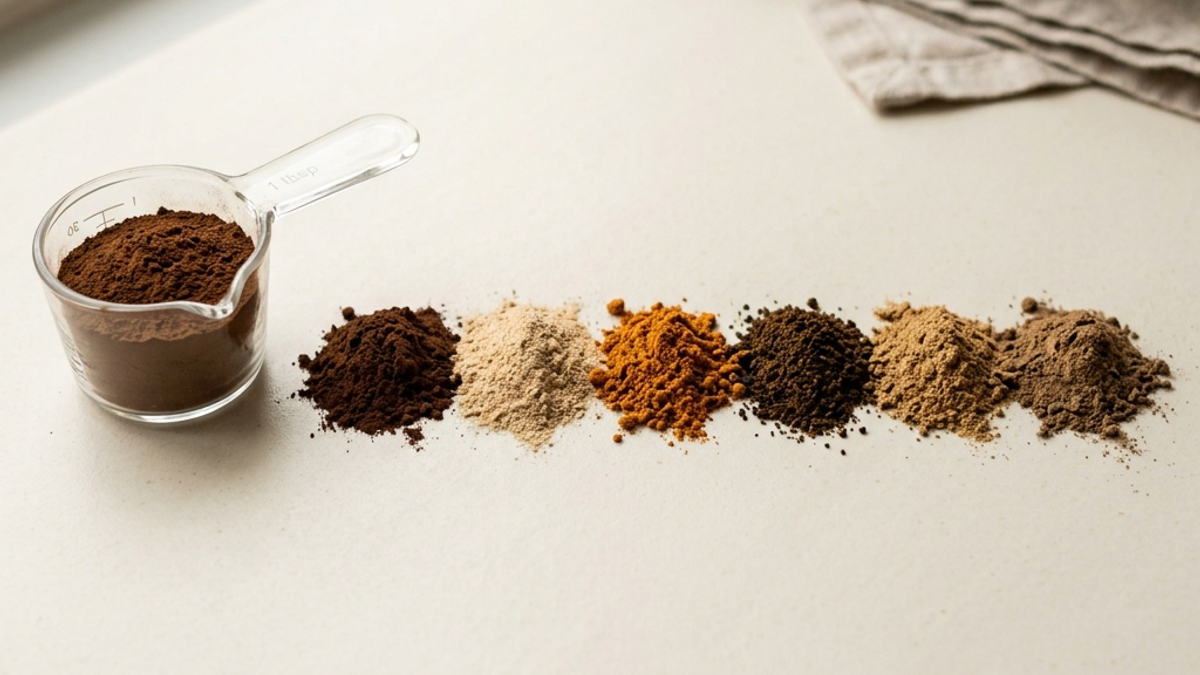
Format decides how much can physically fit. Powder holds the largest dose because nothing limits the volume but the scoop. Capsules are limited by what fits inside one, so a large dose means several. Gummies hold the least, because most of a gummy is the gummy. Pick the format that fits the dose you want.
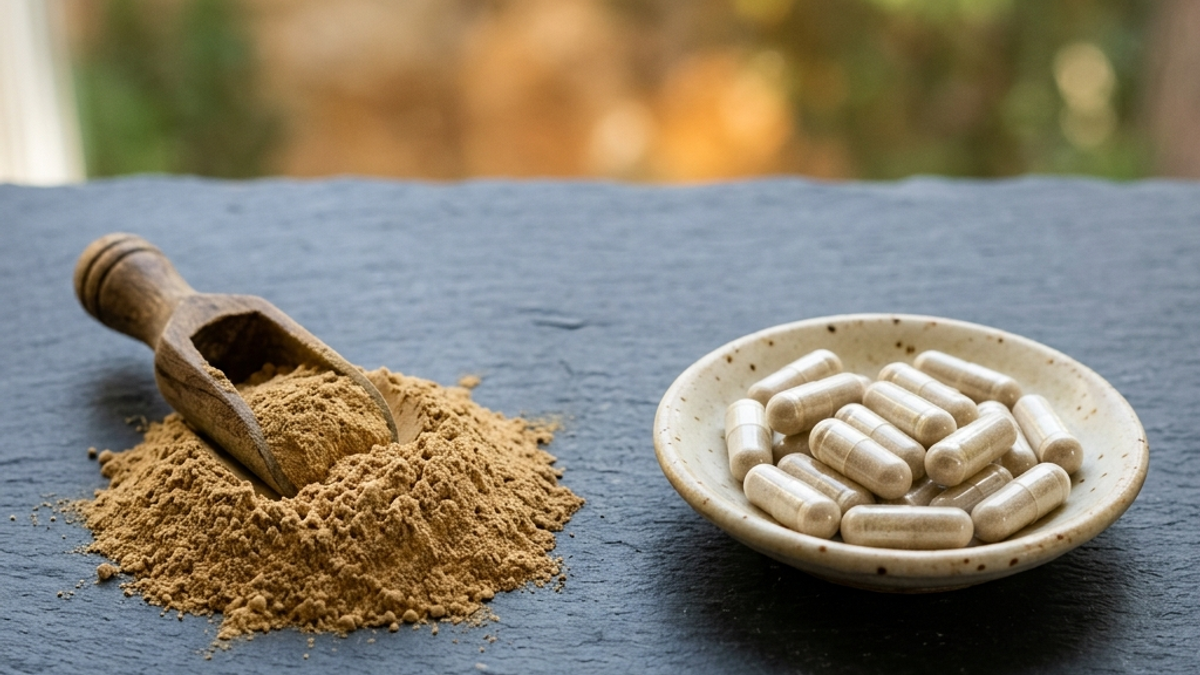
Walk down the supplement aisle and the same mushrooms show up in four different outfits: a tub of powder, a bottle of capsules, a jar of gummies, and a can in the refrigerated case. The marketing for each implies the format is a lifestyle choice.
It is mostly an arithmetic one. The format decides how much can physically fit in a serving, and that constraint explains nearly everything else about how these products are built.
How do capsules, gummies and powders compare?
| Format | What limits the dose | Practical ceiling |
|---|---|---|
| Powder | The size of the scoop and how it tastes | Several grams per serving |
| Capsules | The internal volume of a capsule | Modest per capsule; large doses need several |
| Gummies | Most of a gummy is the gummy | The lowest of the four |
| Ready-to-drink | Water weight, shelf stability, taste | Generally low |
Everything below is a consequence of that table.
Powder
Powder wins on one thing decisively: headroom. Nothing limits the serving except how big a scoop you are willing to stir and how it tastes going down. That is why every multi-mushroom blend you have seen is a powder — several grams of extract has nowhere else to go.
For a concrete number, our own scoop carries 4,300 mg of mushrooms across seven species, plus superfoods and a biotic stack, in a single 8.3 g serving. That quantity simply does not fit in any other format without becoming a handful of pills.
The trade-offs are real, though. You have to measure it, it has to taste like something you will drink daily, and it is less portable than a bottle you throw in a bag. Powder also has to be formulated to be drinkable, which is where flavoring and sweeteners enter — and where some products quietly become mostly flavoring. If the powder you have clumps, settles or tastes too sweet, most of that is fixable in the cup.
Capsules
Capsules are genuinely excellent, and this is the part most powder brands skip past.
They give you an exact dose with no taste, no measuring, and no mixing. If what you want is one mushroom at a sensible amount — lion's mane on its own, say — a capsule is arguably the more pleasant way to take it, and some of the most rigorous products in this category are capsules. Nootropics Depot's mushroom capsules, for example, are third-party lab tested with published Certificates of Analysis and disclosed per-mushroom doses, which is a higher evidence bar than most of the drink category clears. We would rather point at that than pretend capsules are a compromise.
The limit is volume. A capsule holds what a capsule holds, so a large or multi-ingredient dose becomes several capsules per day. A verified capsule product might disclose around 1,000 mg of mushroom extract per serving — perfectly respectable, and roughly a quarter of what a blend scoop carries. Neither number is wrong; they are answers to different questions.
Choose capsules if you want one or two mushrooms at a defined dose and you would rather not taste anything.
Gummies
Gummies solve a real problem — some people will not swallow pills or drink a mushroom beverage, and a supplement nobody takes does nothing. Adherence counts.
The honest limit is that most of a gummy is the gummy. The gelling agent, the sweetener, the flavoring and the acid all take up volume, and whatever is left is where the active ingredient goes. That works well for ingredients that are potent in small amounts. Mushroom extracts, where useful research doses run into hundreds or thousands of milligrams, are not usually one of those.
There is a second thing worth checking: gummies generally need sweetening, so a daily gummy habit often comes with added sugar or sugar alcohols. That may be fine for you. It is just worth knowing it is part of the deal.
The test: read the amount of extract per gummy, then work out how many you would need to reach the amount used in the research. If the answer is uncomfortable, the format is telling you something.
Ready-to-drink
A canned or bottled mushroom drink is the most convenient version of this and generally the least concentrated. It is mostly water, which the manufacturer is paying to ship, and it has to stay stable and drinkable on a shelf for months. Both pressures push the active amounts down.
If convenience is the whole point for you, that is a legitimate reason to buy one. Just do not assume the amounts match a powder.
Tinctures, tablets and tea
The same arithmetic covers the three formats people ask about next.
Tinctures and drops
A tincture is mushroom extracted into alcohol and sold as a liquid you take by the dropperful. Two things decide whether one is worth buying.
The first is the solvent. Beta-glucans dissolve in water, while triterpenes, like the ones in reishi, dissolve in alcohol. So an alcohol-only tincture captures the triterpenes and largely leaves the beta-glucans behind. A tincture made with a hot-water step as well covers both, and our dual extraction explainer walks through why.
The second is quantity. A dropperful is a small volume of liquid, and you need the label to tell you how many milligrams of mushroom are in it. Then run the gummy test: read the amount per dropperful and work out how many dropperfuls it takes to reach the amount used in the research. No milligram figure, nothing to check.
Tablets
A tablet is pressed powder, so it behaves like a capsule. Each one holds a fixed amount, and a large dose means several. The most-cited cognitive trial on lion's mane shows what that looks like in practice. In a 30-person study of Japanese adults aged 50 to 80 with mild cognitive impairment, the lion's mane group took four 250 mg tablets three times a day for 16 weeks (Mori et al., 2009 (opens in new tab)). Twelve tablets a day. We cite it here for the tablet count only. What the trial measured, and how much weight it can carry, is covered in how much lion's mane per day.
Mushroom tea
Steeping mushroom in a mug is a hot-water extraction, and hot water is the right solvent for beta-glucans. It is a short one, though. Commercial extraction simmers the mushroom, often for hours, then concentrates and dries the liquid. A steeped tea bag does neither. The triterpenes mostly stay in the mushroom. The bigger gap is the number. Unless the box states milligrams per bag, there is nothing to multiply. And if the tea is an instant powder you stir in, it is a powder, so the powder section above applies.
What about absorption?
You will see claims that one format absorbs dramatically better than another. Be skeptical. There is no good human evidence establishing a large absorption difference between these formats for mushroom extracts, and a brand asserting one is reaching past what has been shown.
What differs reliably is how much fits in a serving. That is a much larger and much better-documented variable than any absorption edge anyone has demonstrated, and it is the one worth deciding on.
How to actually choose
Work backwards from the dose, not forwards from the format.
- Decide what you want and how much. One mushroom, or several? At roughly what amount? The dosing primer is the place to start if you are not sure.
- Pick the format that holds it. A single mushroom at a modest dose fits neatly in a capsule. Several mushrooms at real amounts needs a powder. There is no way around the volume.
- Then check the label, whichever format you land on. A format is not a quality signal — a capsule can hide a proprietary blend exactly as easily as a tub can, and reading the panel is the skill that travels across every format.
We make a powder, and the reason is the first line of this article rather than any belief that powder is superior: we wanted seven mushrooms plus a full biotic stack in one daily serving, and that only fits in a scoop. If you want one mushroom and hate the taste of anything, buy good capsules instead. That is not a concession — it is just the right tool for a different job.
These statements have not been evaluated by the Food and Drug Administration. This product is not intended to diagnose, treat, cure, or prevent any disease.