Chaga: Traditional Claims vs. What’s Studied
Scientifically reviewed by Dr. Danielle Oncer, PharmD (pharmacology, dosing & safety).
Short answer
Chaga has a long history of traditional use and strong preclinical (test-tube and animal) data for antioxidant activity from its phenolics and melanin. But here's the honest part: there are no high-quality human trials on chaga. So the accurate framing is 'traditionally used' and 'preclinical studies show,' not proven human benefits.
If you've read much about chaga, you've probably seen it described as a miracle mushroom — an antioxidant powerhouse, an immune booster, a fountain of vitality. Some of that traces back to genuine traditional use across Northern and Eastern Europe. Some of it is marketing running ahead of the evidence. So let's do something the supplement aisle rarely does: separate what chaga is traditionally used for from what has actually been studied, and be honest about the gap.
Here's the short version of chaga benefits as the research actually stands. Chaga (Inonotus obliquus) is traditionally used to support immune health and vitality, and preclinical studies show it has high antioxidant capacity — mostly from its phenolic compounds and its dark melanin pigment. The part most brands skip: there are no high-quality human trials on chaga. None. So the accurate framing is "traditionally used" and "preclinical studies suggest," not proven human benefits. That honesty isn't a weakness of this article — it is the article.
What chaga is traditionally used for
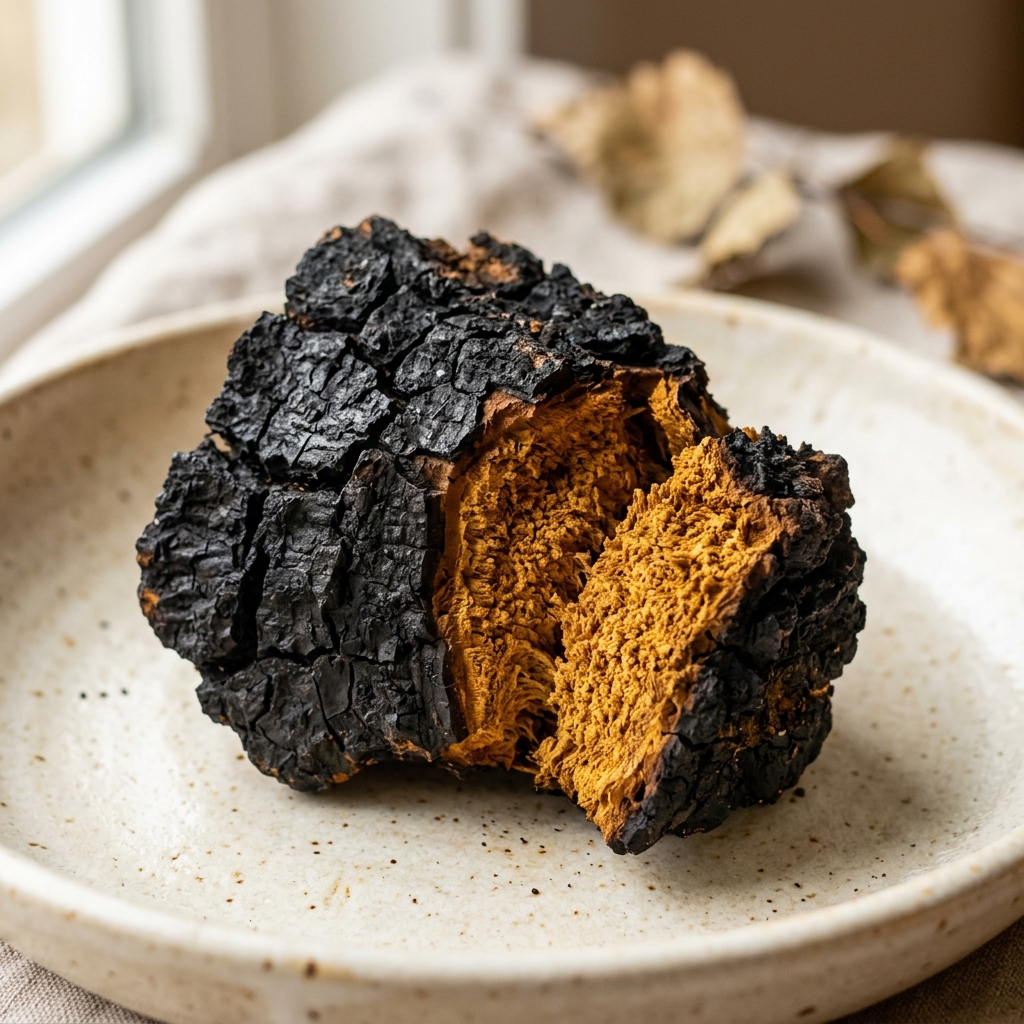
Chaga isn't a typical mushroom. It grows as a hard, charcoal-black mass on birch trees in cold climates, and it's been part of folk practice in Siberia, Scandinavia, and the Baltic region for generations — usually simmered into a dark, earthy tea. In that tradition, it was reached for to support general wellness, immune resilience, and stamina through long winters.
Traditional use matters, and we don't dismiss it. A plant or fungus that people have leaned on for centuries earns a place in the conversation. But traditional use is a starting point for inquiry, not proof of a specific effect. It tells us where to look; it doesn't tell us what we'll find. Treating "people have used it for a long time" as if it were a clinical result is exactly the kind of overreach we try to avoid. If you want the broader picture of how these fungi fit together, our complete guide to functional mushrooms maps each one to what it's actually for.
What's actually been studied: the preclinical antioxidant story
When researchers have put chaga under the microscope — literally — the most consistent finding is antioxidant capacity. A 2026 review in Molecules (opens in new tab) cataloging medicinal mushrooms and their bioactive compounds documents chaga's antioxidant capacity in lab and animal studies, driven by antioxidant compounds such as its phenolic compounds.
Antioxidants, in plain terms, are molecules that help neutralize reactive, unstable compounds. In a test tube or an animal model, chaga extracts measure up well on that axis. That's a real, repeatable laboratory finding, and it's genuinely interesting.
Now the caveat, because it's the whole point of this post: these are preclinical results. In vitro means in glassware — cells in a dish. Animal models are a step closer to a living system, but still not a human one. A high antioxidant reading in a lab does not automatically become a measurable health benefit when a person stirs chaga into a drink. The dose, the absorption, what survives digestion, and what your body actually does with these compounds are all open questions the lab can't answer. So we say "preclinical studies show high antioxidant capacity" — and we stop there.
The honest gap: why there are no human chaga trials
Here's what you won't find in the chaga literature: a well-designed, placebo- controlled human trial showing a specific health outcome. As of now, those studies don't exist for chaga.
That's worth sitting with, because it's not unique to chaga — it's a pattern across a lot of botanicals:
- Whole-food botanicals are hard to patent. Without exclusivity, there's little commercial incentive to fund the large, expensive human trials that pharmaceuticals get.
- Preclinical work is cheaper and faster. Cell and animal studies are where most of the budget lands, so that's where most of the evidence sits.
- "Promising in the lab" is the norm, not the exception. Many compounds look impressive in vitro and never replicate the effect in people.
None of that means chaga doesn't work. It means the human evidence simply hasn't been generated yet, and we won't pretend otherwise. This is the same lens we bring to every ingredient — the difference between a mechanism and a proven outcome is something we walk through in our piece on fruiting body vs. mycelium and in how to read a mushroom supplement label, because spotting that gap is the single most useful skill a supplement buyer can have.
How chaga compares to better-studied mushrooms
It helps to see where chaga sits relative to its shelf-mates. Some functional mushrooms have human trials behind them; chaga doesn't yet — and that distinction should shape your expectations.
- Lion's mane has human clinical trials behind its cognition and focus story. We unpack the mechanism in our lion's mane pharmacology deep-dive.
- Cordyceps has human-evidence reviews behind its steady-energy and stamina lane — much of that human data is on the Cordyceps militaris species — see cordyceps for energy.
- Reishi has human data, mostly in specific populations, behind its calm and resilience role; more in reishi for calm and stress.
- Turkey tail carries the strongest beta-glucan and immune-mechanism evidence; we cover it in turkey tail beta-glucans and immunity.
- Chaga sits in the traditional-use-plus-preclinical tier. Real history, real lab data, no human trials yet.
This isn't a ranking of which mushroom is "best." It's a map of how much we know about each, which is a different and more honest question.
So why include chaga at all?
Fair question, and we'd rather answer it than dodge it. We include chaga in our seven-mushroom, dual-extracted fruiting-body blend for two reasons, both stated plainly. First, its traditional role — chaga has earned a place in the functional-mushroom story, and a blend built around mushroom diversity is incomplete without it. Second, like other functional mushrooms, chaga contributes beta-glucans, the fiber-like cell-wall compounds that show up across this category.
What chaga is not doing in our formula is carrying a human-trial health claim, because it doesn't have one. The ingredients with human data carry the claims that have human data behind them; chaga is here for tradition and mushroom breadth, and we label it that way. Every dose is printed on the label so you can see exactly what's in the jar and in what amount — no proprietary blend hiding the numbers.
The calm takeaway
Chaga benefits, told honestly, come down to this: a genuine traditional history, strong preclinical antioxidant data from its phenolics and melanin, and — so far — zero high-quality human trials. That last fact isn't a reason to write chaga off; it's a reason to keep your expectations grounded and your skepticism healthy.
If that kind of straight talk is what you want from a mushroom blend, it's the same standard behind everything we formulate — and the same reason chaga sits on our label with an honest description, not a halo.
References
Sadowska A, Włosek-Pawełas D, Car H. Medicinal mushrooms and their bioactive compounds: from traditional use to therapeutic potential. Molecules. 2026;31(10):1749. PMID: 42197308 (opens in new tab) · doi:10.3390/molecules31101749 (opens in new tab)