Best Time to Take Mushroom Supplements
Scientifically reviewed by Onur Oncer, B.S. (Shroombiosis founder & formulator; B.S. Physiology, published researcher).
Short answer
For most mushroom supplements, the best time to take them is whenever you will remember to do it daily. The human trials dosed participants every day for weeks, so consistency is what the research actually tested. The one thing that genuinely forces your timing is caffeine: if the product contains it, take it early.
There is a lot of confident advice about when to take mushroom supplements, and most of it is invented. So here is the version that stays inside what the research actually shows, which is smaller than you might expect but more useful.
The honest answer: the best time is the one you will keep. The human trials on these ingredients did not compare morning against evening. They gave people a dose every day for weeks and measured what happened. Daily is the variable that was tested. The hour was not.
That said, three things genuinely affect the timing decision, and one of them matters a lot.
The one that actually forces your hand: caffeine
If your mushroom product contains caffeine — and most of the popular ones do, because they are built on coffee or tea — then your timing is decided for you. Caffeine has a half-life of several hours, which is why an afternoon cup can still be with you at bedtime.
This is the single biggest timing constraint in the category, and it is worth checking before you assume you have a choice. Plenty of products marketed as coffee alternatives still contain a meaningful amount, and "decaf" does not mean zero either — we went through the numbers in why decaf still has caffeine in it.
If the product is caffeine-free, this constraint disappears entirely, and the timing question becomes a preference rather than a problem. That is the practical argument for caffeine-free that has nothing to do with health claims: it hands the schedule back to you, whether that means a morning latte or an evening cocoa.
With food or without?
Either. There is no human trial on a mushroom blend that establishes one is better, and we are not going to invent a rule that sounds authoritative.
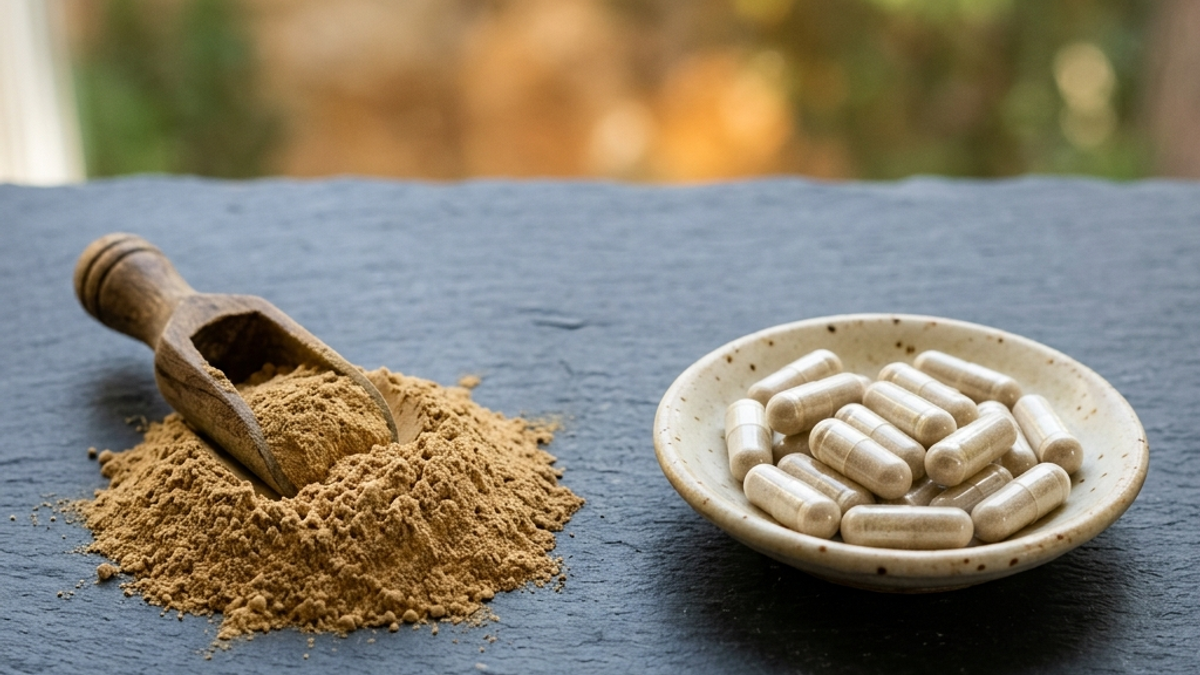
Two practical notes rather than claims. First, some people find any powdered supplement sits more comfortably with food, particularly one containing fiber. Second, if you are new to added fiber or a probiotic, starting with a smaller amount alongside a meal and building up is a sensible way to give your gut time to adjust — that is standard advice for introducing fiber, not a mushroom-specific finding.
Does heat ruin it?
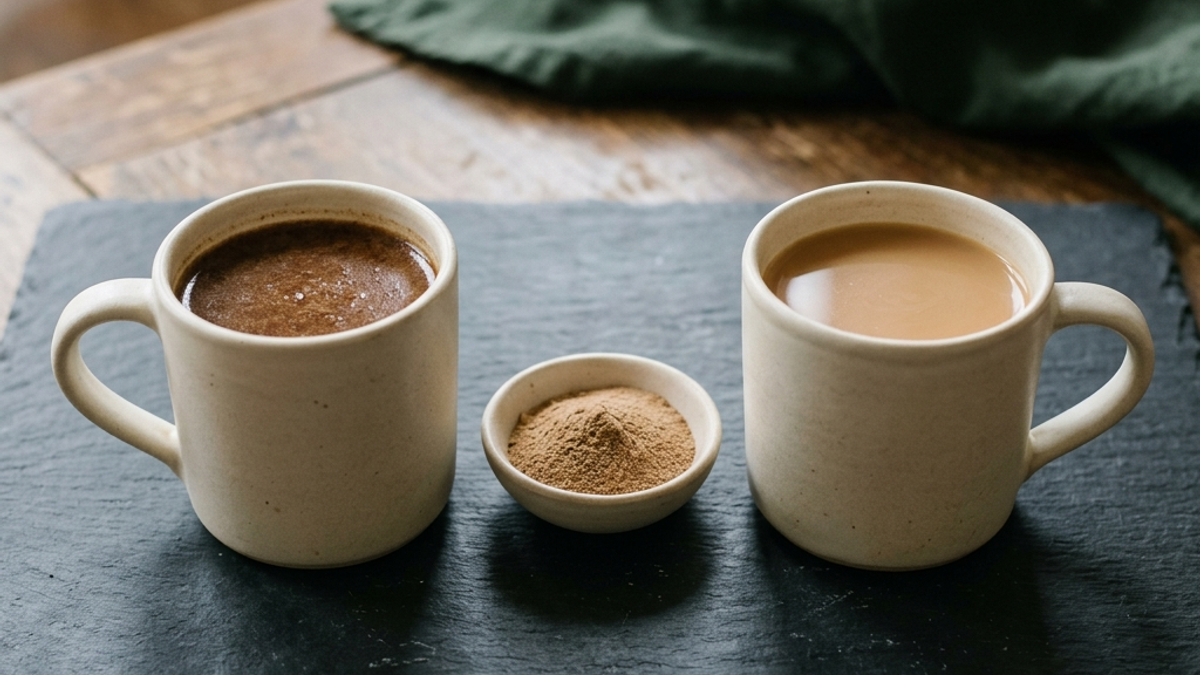
This is the question we get most, usually from people who want to stir a scoop into their morning coffee.
For the mushroom extracts, no. Hot-water extraction is how many of these extracts are made in the first place, so a hot drink is not doing anything the manufacturing process did not already do more aggressively. If you want the detail on why that extraction step exists at all, it is in dual extraction explained.
The probiotic is the more interesting question, and it depends entirely on the strain. The one in our blend, Bacillus subtilis DE111®, is spore-forming — the organism packages itself into a dormant, protective structure. Laboratory work on that strain (opens in new tab) documents its durability through gastric transit, the same property that makes spore-formers a sensible choice for a product someone might stir into something hot. That is a mechanism finding in the lab, not a human efficacy result, and it is the reason a spore strain was chosen rather than a fragile one.
What the research actually did
If you want to anchor your expectations to something real, anchor them here.
The 2009 lion's mane trial (opens in new tab) dosed participants daily for 16 weeks. The 2023 trial in healthy adults (opens in new tab) measured both a single dose and 28 days of daily use — and interestingly, the significant cognitive result there was the acute one, while the 28-day arm was largely null.
We are not going to turn that into a promise about when you will notice something, because no honest reading of it supports one. What it does tell you is that these were studies of daily intake, often sustained over months. A supplement taken three times in a week is not the thing that was tested.
So: a practical answer
- Pick a time attached to something you already do. Coffee, breakfast, the walk to your desk. The anchor matters more than the hour.
- If it contains caffeine, take it early. This is the only timing rule in this article that is not negotiable.
- If it is caffeine-free, take it whenever suits you — including the evening, which is the point of not adding caffeine.
- Take it daily rather than perfectly. Consistency is the variable the research tested, and there is no good evidence that you need to cycle off.
- Do not chase a schedule that you will abandon. A 6 a.m. protocol you keep for nine days is worth less than a mediocre habit you keep for three months.
For what it is worth, our own blend suggests first thing in the morning, with or without food — not because morning is pharmacologically superior, but because it is the easiest hour to attach a habit to. It is caffeine-free, so a later scoop is genuinely fine.
The part nobody sells you
Timing is the most over-discussed variable in this category and close to the least important one. What is on the label matters far more: which mushrooms, at what amounts, in what form. A perfectly timed scoop of an underdosed blend is still an underdosed blend.
If you only take one thing from this page, make it that — and then go and read the panel on whatever you are currently taking. We wrote a guide to doing exactly that, and the dosing side has its own primer.
References
- Mori K, Inatomi S, Ouchi K, et al. Improving effects of the mushroom Yamabushitake (Hericium erinaceus) on mild cognitive impairment: a double-blind placebo-controlled clinical trial. Phytotherapy Research. 2009;23(3):367–372. PMID: 18844328. https://pubmed.ncbi.nlm.nih.gov/18844328/ (opens in new tab) — 16 weeks of daily dosing; participants had mild cognitive impairment.
- Docherty S, Doughty FL, Smith EF. The acute and chronic effects of lion's mane mushroom supplementation on cognitive function, stress and mood in young adults. Nutrients. 2023;15(22):4842. PMID: 38004235. https://pubmed.ncbi.nlm.nih.gov/38004235/ (opens in new tab) — the acute result was significant; the 28-day arm largely was not.
- Mazhar S, Khokhlova E, Colom J, et al. In vitro and in silico assessment of probiotic and functional properties of Bacillus subtilis DE111®. Frontiers in Microbiology. 2023;13:1101144. PMID: 36713219. https://pubmed.ncbi.nlm.nih.gov/36713219/ (opens in new tab) — in vitro and in silico work on spore durability; mechanism, not a human efficacy claim.
These statements have not been evaluated by the Food and Drug Administration. This product is not intended to diagnose, treat, cure, or prevent any disease.