Turkey Tail, Beta-Glucans & Your Immune System
Scientifically reviewed by Dr. Danielle Oncer, PharmD (pharmacology, dosing & safety).
Short answer
Turkey tail is one of the most beta-glucan-rich functional mushrooms, and those beta-glucans are why it shows up in immune conversations. They interact with receptors on immune cells to help prime your normal defenses, and because they're fiber-like, they double as prebiotic fuel for your gut. Think support and maintenance, not a treatment for any condition.
If you've read anything about turkey tail, the same two words keep surfacing: beta-glucans and immune. They belong together, but the connection gets flattened into a slogan fast. So let's slow down and be precise about what turkey tail beta-glucans actually are, how they interact with your immune system, and — just as important — where the honest line sits on what we can and can't say.
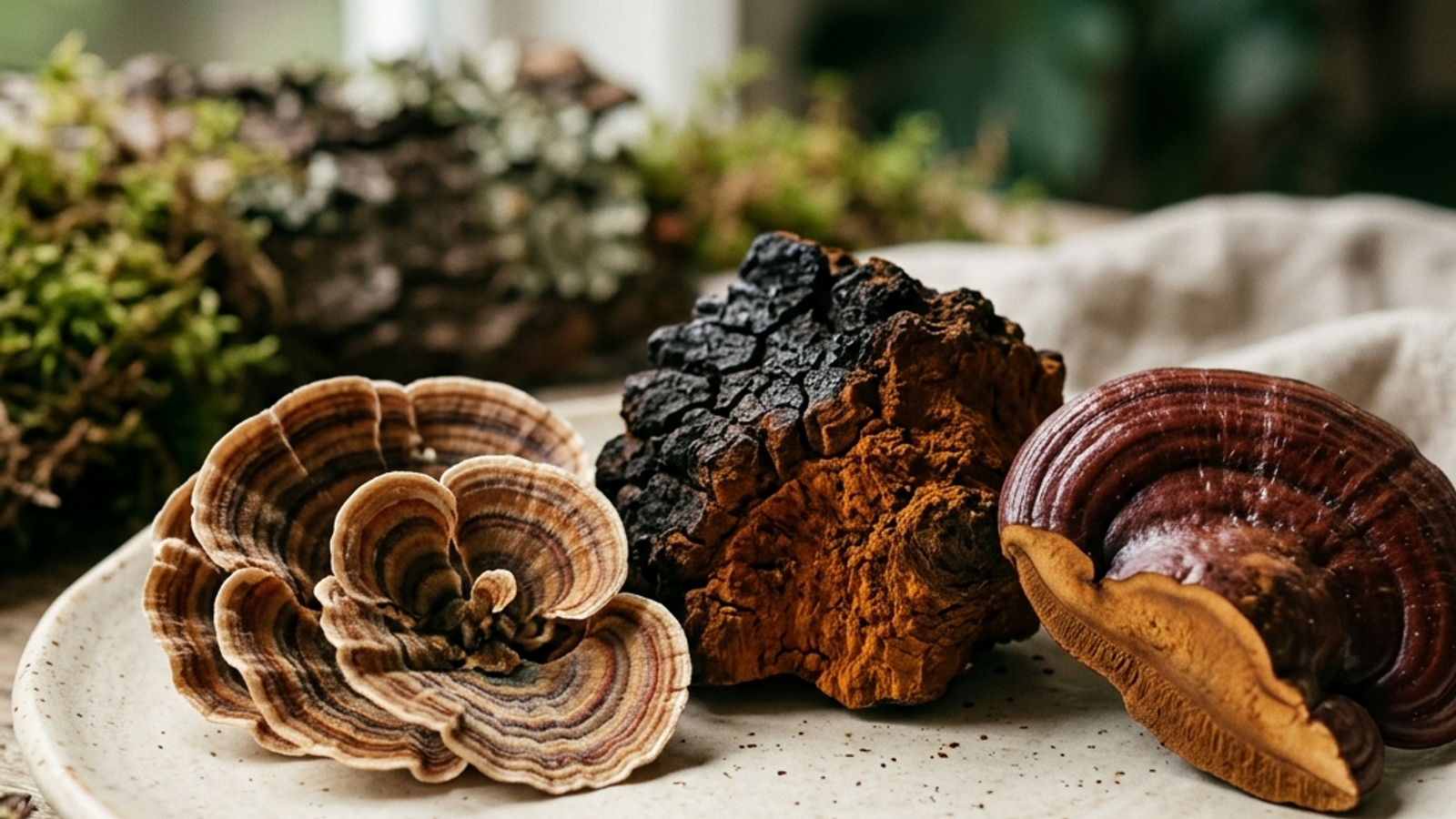
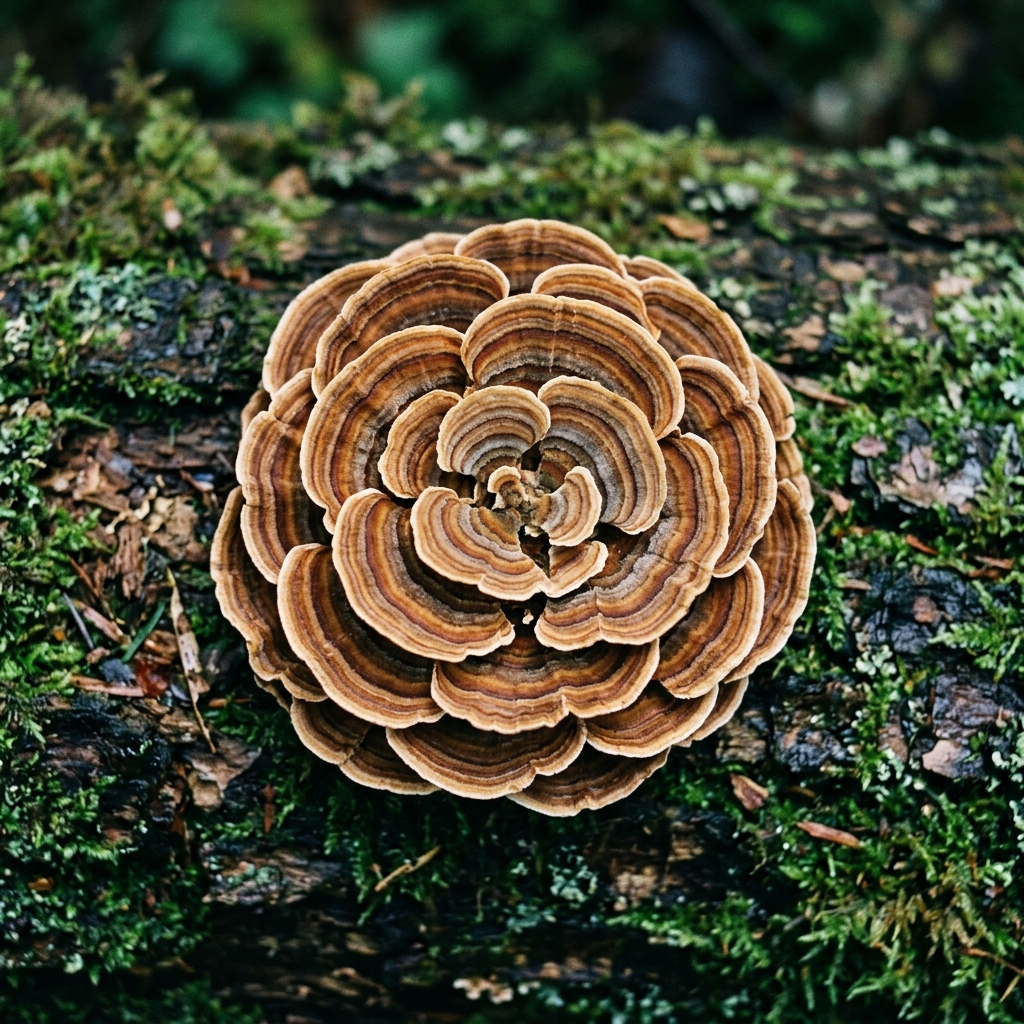
Here's the short version. Turkey tail (Trametes versicolor) is one of the most beta-glucan-rich mushrooms there is. Those beta-glucans are fiber-like compounds that do two jobs: they interact with receptors on your immune cells to help prime your normal defenses, and because your body can't digest them, they also act as prebiotic fiber for your gut. That's the whole, bounded claim. Turkey tail supports immune function and feeds your existing gut flora — it isn't a treatment for any disease, and we won't pretend otherwise.
What beta-glucans actually are
Beta-glucans are long-chain polysaccharides — essentially structural fibers — woven into the cell walls of functional mushrooms. Turkey tail carries a lot of them, including a famous fraction called PSP (polysaccharopeptide). The key feature is what doesn't happen to them: your digestive enzymes can't break these molecules apart. They pass through the upper gut intact.
That indigestibility is the whole point. It's exactly what makes other prebiotic fibers useful, and it's why turkey tail belongs in both the immune conversation and the gut conversation at the same time. The fiber that reaches your lower gut becomes food for the bacteria already living there. The same class of molecule, in a different context, is what your immune cells recognize.
If you want the broader map of which species are richest in these compounds and why that matters for digestion, our companion piece on the best mushrooms for gut health ranks them specifically — this post stays focused on the immune side and the mechanism.
How turkey tail beta-glucans interact with the immune system
This is where the science gets genuinely interesting, and where careful language matters most. Beta-glucans aren't a vitamin your body simply absorbs. They behave more like signals.
A 2007 review of how beta-glucans interact with immune-cell receptors (opens in new tab) describes them as biologic response modifiers — compounds that bind specific receptors on immune cells and, in doing so, help prime the body's normal defenses. The receptors named are ones you'll see repeatedly in this field: Dectin-1 and CR3 (complement receptor 3), sitting on cells like macrophages and natural killer (NK) cells. When a beta-glucan docks onto one of these receptors, it's a bit like a key tapping a lock that the immune system already uses to notice and respond to fungal surfaces.
Two honest notes about that review. First, it's a mechanism paper, not a trial of any product — so read it as the "how it could work" layer, not proof of a result. Second, much of the broader literature on beta-glucans is oncology-heavy; we're citing it strictly for the receptor-binding and immune-priming angle and nothing beyond that. The takeaway worth keeping is simple: turkey tail's beta-glucans have a plausible, well-described way of engaging the immune cells you already have.
The human evidence — and its strict limits
Mechanism is one layer. What about people? Here the cleanest human data on turkey tail itself comes from a 2012 Phase 1 dose-escalation trial of Trametes versicolor (opens in new tab). Researchers escalated the dose up to 9 grams a day in a small group of eleven participants and found turkey tail safe and well tolerated, alongside signals of faster lymphocyte recovery and increased natural-killer-cell activity — exactly the kind of immune-cell behavior the beta-glucan mechanism predicts.
Now the caveat that has to travel with that study every single time we cite it: the trial was run in a specific recovery population (women after breast-cancer chemotherapy). That context means we use it for two things only — turkey tail's good tolerability, and an immune-function signal. We do not read a cancer benefit into it, and neither should you. A supplement supports the structure and function of a healthy body; it does not treat disease. Holding that line isn't legal throat-clearing — it's the difference between honest education and the overreach this industry is known for.
Why turkey tail sits in the gut conversation too
Because beta-glucans are fiber your enzymes can't touch, the portion that travels to your lower gut becomes a meal for your resident bacteria. That makes turkey tail a prebiotic — food for the microbes you already have — rather than a probiotic, which would be live bacteria you add.
That distinction is small but it changes how you should shop. If a label markets a mushroom as a "probiotic," that's a tell worth catching, and a good reason to learn how to read a mushroom supplement label before you buy. Turkey tail sits inside a wider set of options — see the complete guide to mushrooms for immune support. It also explains why a single mushroom is never a complete gut strategy on its own: feeding your bacteria is one link, the bacteria themselves are another, and the compounds they produce are a third. If those three categories blur together for you, the difference between prebiotics, probiotics, and postbiotics untangles them cleanly.
What has to be true for turkey tail to pull its weight
This is our signature question, and it applies neatly here. A few things have to line up before turkey tail's beta-glucans can do anything for you.
- Real beta-glucan content, disclosed. "Turkey tail" on an ingredient line tells you nothing about how much active beta-glucan is inside. Mycelium grown on grain, for instance, can carry a lot of starch and comparatively little beta-glucan. Knowing the difference is exactly why we wrote up fruiting body versus mycelium — it's the single biggest quality variable most labels hide.
- Proper extraction. Beta-glucans are locked inside tough, chitinous cell walls. Without the right extraction, much of that fiber stays trapped and passes through unused. Our explainer on dual extraction covers why hot-water and alcohol steps both matter for getting the full spectrum of compounds out.
- Consistency, not a single serving. Like any prebiotic, the benefit builds as your gut and immune system respond to a steady supply over weeks — not from one impressive-looking scoop. A sensible dosing primer helps set realistic expectations.
Put plainly: the headline isn't "turkey tail does X." It's "turkey tail can contribute Y, if the product is built and used well." That conditional is the part most marketing quietly drops.
How turkey tail fits a complete blend
We don't ask turkey tail to be a one-mushroom miracle, because nothing is. In our formula it plays a defined role — a leading source of prebiotic beta-glucans and a contributor to immune support — while dedicated prebiotic fiber, a heat-stable probiotic, and a postbiotic cover the other links in the chain. Seven mushrooms, superfoods, and the full pre/pro/postbiotic trio, each printed with its dose so you can see what you're getting. You can read more about the reasoning on our science page, and if you want the wider context on the whole category, our complete guide to functional mushrooms is the place to start.
The bottom line
Turkey tail beta-glucans earn their reputation honestly: they're fiber-like compounds that engage your immune cells through receptors like Dectin-1 and CR3, and they double as prebiotic fuel for your gut. The human research points to good tolerability and an immune-function signal — bounded findings we keep bounded, never stretched into a disease claim. Supported, well-fed, steady: that's the register turkey tail belongs in, and it's the register we build in too. If you'd like to see exactly how much of it goes into the blend, every dose is on the label. Function, not friction — built with your physiology, not against it.
References
Akramiene D, Kondrotas A, Didziapetriene J, Kevelaitis E. Effects of beta-glucans on the immune system. Medicina (Kaunas). 2007;43(8):597–606. PMID: 17895634 (opens in new tab)
Torkelson CJ, Sweet E, Martzen MR, et al. Phase 1 clinical trial of Trametes versicolor in women with breast cancer. ISRN Oncology. 2012;2012:251632. PMID: 22701186 (opens in new tab) · doi:10.5402/2012/251632 (opens in new tab)