Reishi and Immune Balance: More Than Calm
Scientifically reviewed by Onur Oncer, B.S. (B.S. Physiology, published researcher).
Short answer
Reishi is best known as a calming adaptogen, but it is also rich in immune-active beta-glucans. In a placebo-controlled trial in healthy adults, a reishi beta-glucan raised T-cell, natural-killer-cell, and IgA levels over twelve weeks — evidence it supports healthy immune function, working over weeks of steady use, not in a single cup.
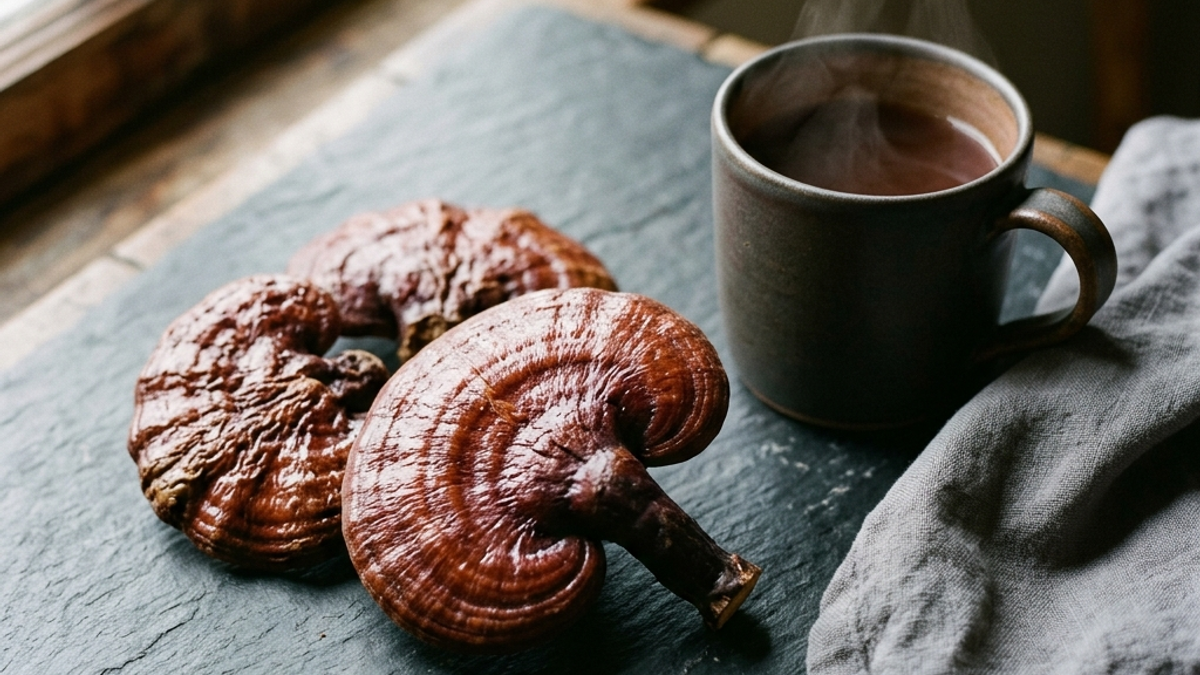
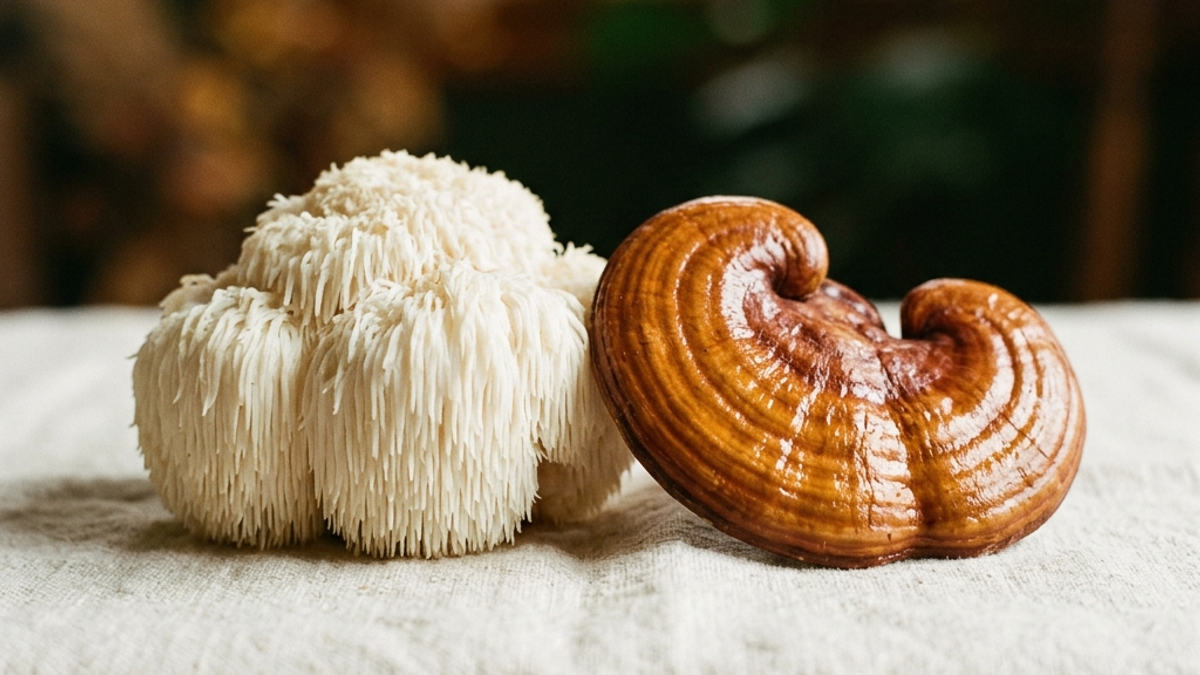
Say "reishi" to most people who know functional mushrooms, and they'll say one word back: calm. It's the mushroom of the evening cup, the one traditionally used to promote a settled, grounded feeling — an adaptogen, in the plain sense of something that supports a healthy stress response. That reputation is well earned, and we've written about it at length. But it's only half of what reishi is.
The other half is immune. Reishi is one of the most beta-glucan-rich functional mushrooms there is, and beta-glucans are exactly the compounds your immune system is built to recognize. So this post deliberately takes the road less traveled for reishi: not the calm angle — reishi for calm and stress and reishi for restful evenings already own that — but the immune one. Reishi is one piece of a bigger picture; the complete guide to mushrooms for immune support covers the rest.
A ground rule first, because this is a health topic: nothing here treats, prevents, or cures any illness, and supporting your immune system is not the same as "boosting" it to fight off a specific bug. What follows is structure and function — how reishi's beta-glucans help a healthy immune system do its normal, everyday job. That's the honest version, and it's the one worth understanding.
The beta-glucan that does both jobs
Here's the neat thing about reishi: the calm side and the immune side aren't run by two different mushrooms. They're two properties of the same one.
On the calm side, reishi behaves like a classic adaptogen — a plant or fungus traditionally used to help the body maintain a healthy stress response. A review of how adaptogens work (opens in new tab) describes them as acting on the body's stress-response system (the HPA axis and its stress-signaling molecules) to support balance under load. That's the mechanism behind reishi's traditional "settling" reputation, and it's the thread our calm posts pull on.
On the immune side, the active players are reishi's beta-glucans — branching sugar molecules abundant in its cell walls. These aren't inert fiber. A review of how beta-glucans interact with the immune system (opens in new tab) describes them as "biological response modifiers" that bind receptors such as Dectin-1 and CR3 on macrophages and natural-killer cells — in effect, a molecule your immune system is built to notice. So a single reishi extract carries both a stress-response story and an immune-recognition story. Same mushroom, two conversations.
The human immune evidence — in healthy adults
Mechanism is one thing; what happens in an actual person is another. This is where reishi's immune side gets its strongest support.
A 2023 placebo-controlled trial in healthy adults (opens in new tab) gave a reishi-derived beta-glucan daily for 84 days and measured the immune profile against placebo. The reishi group showed higher T-cell and natural-killer-cell counts, along with higher IgA — a first-line antibody. Read plainly: over twelve weeks, markers of everyday immune activity moved in the supported direction, in ordinary healthy people.
That "in healthy adults" phrase is doing real work. It means this is exactly the structure-and-function context this whole post is about — a normal immune system doing its normal job a little more actively — not a study in a sick population. We'll be honest about its limits, too: it's a single randomized trial, and we read it as a measured immune-support signal, nothing broader.
Zoom out from that one study and the pattern holds. A systematic review of 34 randomized trials of fungal beta-glucans (opens in new tab) concluded that beta-glucans from mushrooms and yeast can help modulate immune function and are well tolerated. The review was candid that individual outcomes varied from trial to trial — so we frame it carefully: consistent evidence that these compounds are well-tolerated and can help modulate immune activity, not a uniform, guaranteed effect. That's the honest shape of the beta-glucan literature, and reishi sits squarely inside it. If you want the molecule itself explained from scratch, we wrote a full primer on beta-glucans in mushrooms.
Is reishi actually bioactive over weeks?
A fair question sits underneath all of this: does swallowing reishi for weeks actually do anything measurable in a person, or is it just a warm ritual? One more human trial speaks to that — carefully.
In a randomized trial that dosed reishi for several weeks (opens in new tab), participants showed improvements in physical measures like endurance, flexibility, and movement velocity versus placebo. We cite this for one narrow reason only: it's evidence that reishi is bioactive and well tolerated over weeks of steady use — that the mushroom does something detectable in the body across time. That study was run in a specific clinical population, so we do not read it as a calm, wellbeing, or general-benefit result — only as a tolerability-and-bioactivity data point. It tells us the timescale is weeks, and that reishi clears that bar.
How reishi's two sides fit our blend
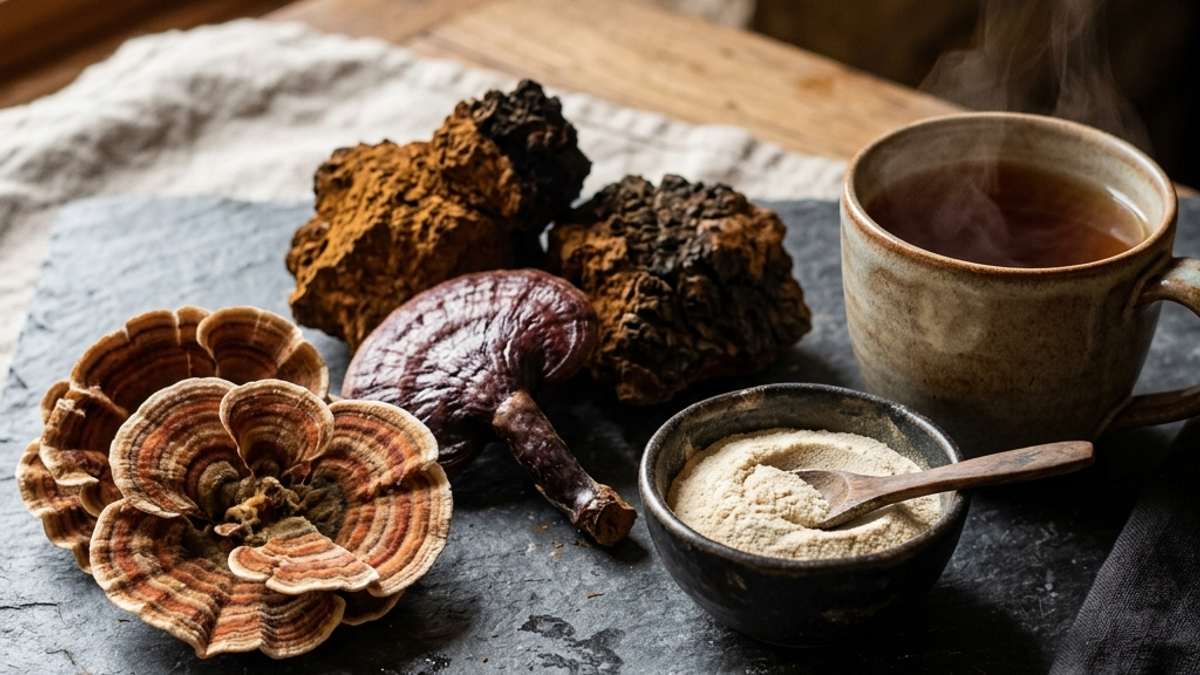
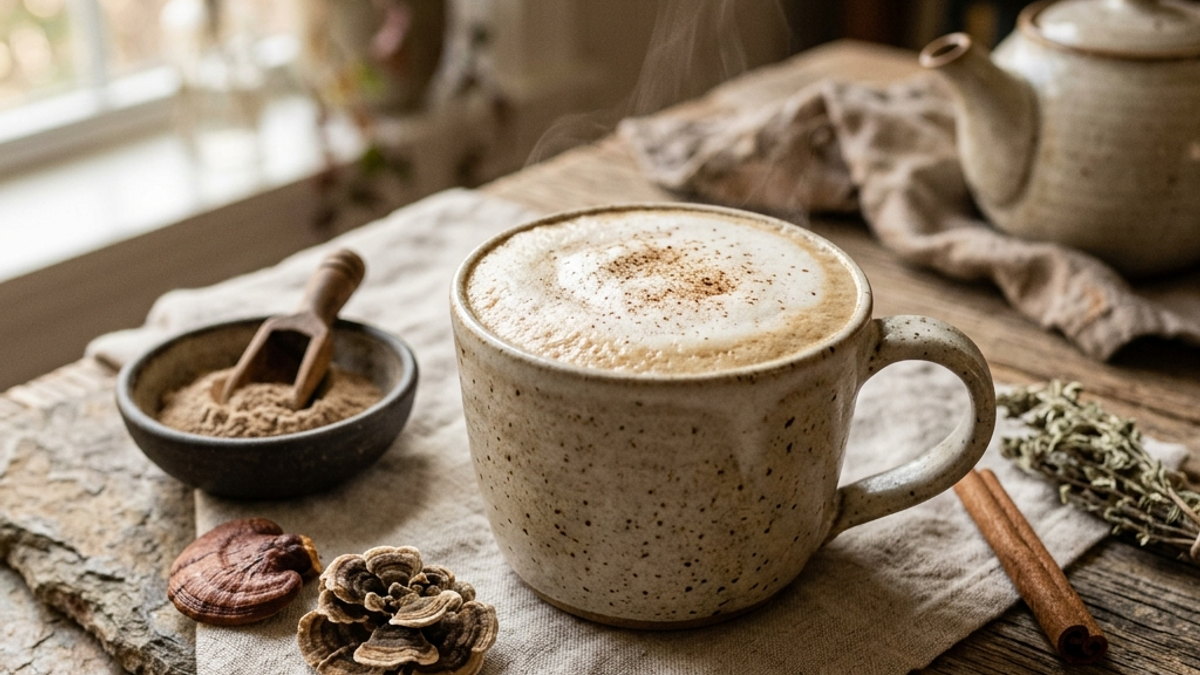
This dual nature is exactly why reishi sits in the Shroombiosis blend rather than a single-note calm supplement. Its adaptogenic, stress-response side supports the "settled evening cup" experience; its beta-glucan side joins the wider immune conversation happening in our formula — alongside turkey tail and chaga, the other beta-glucan-rich mushrooms in the mix.
And because a large share of your immune tissue lives against your gut microbiome, reishi's beta-glucans do double duty there too: they behave like prebiotic fiber that feeds your microbiome and they're recognized by your immune cells — the same dual role we unpack in the gut and immune system connection and in our look at turkey tail's beta-glucans and immunity. Reishi isn't the loudest immune mushroom in the cup, but it's a genuine contributor, and it brings the calm side along for free.
What has to be true for any of this to matter
Two honest caveats, the same two we apply to every ingredient.
First, consistency. Every human reishi trial worth citing ran for weeks — 84 days in the healthy-adult immune study, multiple weeks in the others. This is a steady-daily-habit ingredient, not a single-dose one. Whatever reishi contributes, it contributes over time. That is why immune support works better as a habit you keep year-round than as a cold-season scramble.
Second, framing. "Reishi supports a healthy immune system" is a real, defensible statement grounded in the beta-glucan evidence above. "Reishi boosts your immunity to fight off colds or flu" is not — it's a disease claim the research doesn't support, and any brand that makes it is selling past the evidence. We won't. Dose and quality decide whether any of this does anything, which is why we publish every milligram on the label instead of hiding reishi in a proprietary blend. For reishi, that's 500 mg of reishi extract per scoop. The 2023 trial above used an isolated reishi beta-glucan, a different material from a reishi extract, so it's evidence about that compound rather than about our serving.
The bottom line
Reishi has a split reputation for a good reason: it earns both halves. It's a calming adaptogen with a real traditional-use and stress-response story, and it's a beta-glucan-rich mushroom with human evidence — in healthy adults — for supporting everyday immune function. Most content only tells you the first half. The honest, fuller picture is that reishi shows up in your cup doing two quiet jobs at once.
For the wider category view, this is part of our complete guide to functional mushrooms; to see where the immune side connects to your microbiome, start with our guide to gut health.
References
Panossian A, Wikman G. Effects of adaptogens on the central nervous system and the molecular mechanisms associated with their stress-protective activity. Pharmaceuticals (Basel). 2010;3(1):188–224. PMID: 27713248 (opens in new tab) · doi:10.3390/ph3010188 (opens in new tab)
Akramiene D, Kondrotas A, Didziapetriene J, Kevelaitis E. Effects of beta-glucans on the immune system. Medicina (Kaunas). 2007;43(8):597–606. PMID: 17895634 (opens in new tab)
Chen SN, Nan FH, Liu MW, Yang MF, Chang YC, Chen S. Evaluation of immune modulation by β-1,3;1,6 D-glucan derived from Ganoderma lucidum in healthy adult volunteers, a randomized controlled trial. Foods. 2023;12(3):659. PMID: 36766186 (opens in new tab) · doi:10.3390/foods12030659 (opens in new tab)
Vlassopoulou M, Yannakoulia M, Pletsa V, Zervakis GI, Kyriacou A. Effects of fungal beta-glucans on health – a systematic review of randomized controlled trials. Food & Function. 2021;12(8):3366–3380. PMID: 33876798 (opens in new tab) · doi:10.1039/d1fo00122a (opens in new tab)
Collado-Mateo D, Pazzi F, Domínguez-Muñoz FJ, et al. Ganoderma lucidum improves physical fitness in women with fibromyalgia: a randomized controlled trial. Nutrición Hospitalaria. 2015;32(5):2126–2135. PMID: 26545669 (opens in new tab) · doi:10.3305/nh.2015.32.5.9601 (opens in new tab)