Poria Mushroom: What It Is, and Why Almost No Blend Has It
Scientifically reviewed by Dr. Danielle Oncer, PharmD (pharmacology, dosing & safety) and Jon Klipstein (supplement formulation expert, Die Tryin Co.).
Short answer
Poria (Wolfiporia cocos) is a sclerotium — an underground storage mass, not a fruiting body — from a fungus that grows on pine roots. It appears in 25 of the 100 formulas in China's 2018 catalog of classic prescriptions, second only to licorice. Human evidence for poria alone: none.
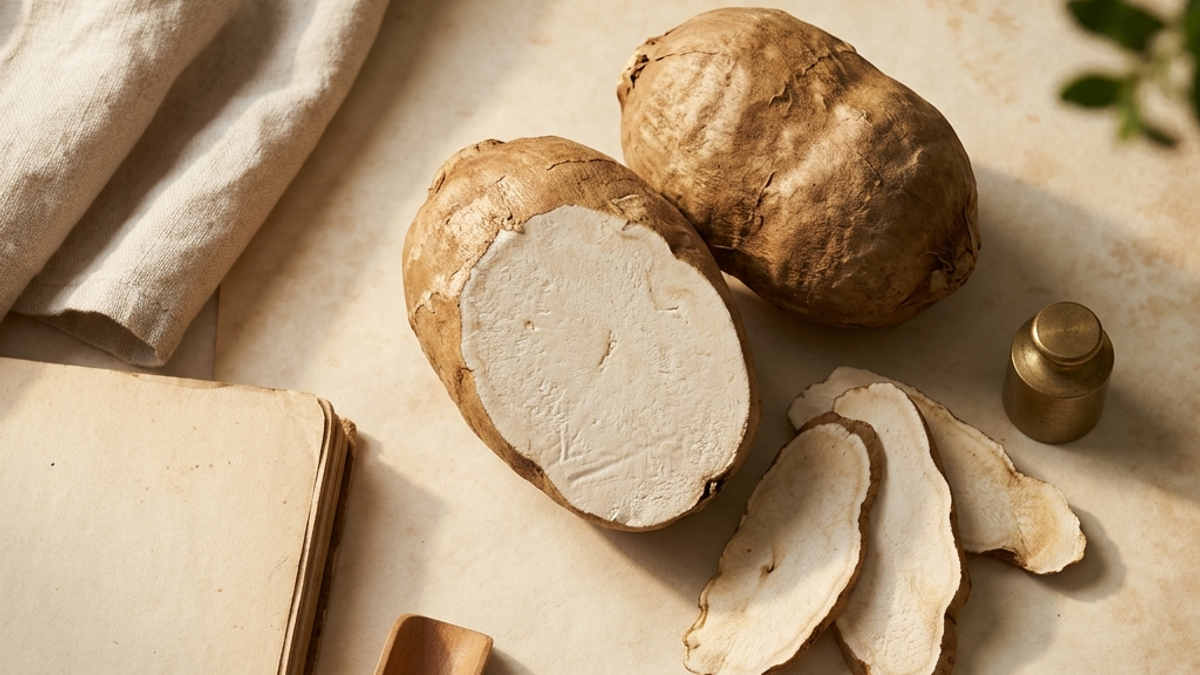
Poria is the ingredient on our label nobody recognises. Lion's mane sells itself. Reishi arrives with a reputation attached. Poria gets emails asking whether we invented it.
We didn't. By written record it is the oldest thing in the tub — and it is in almost nobody else's.
What is poria mushroom?
Poria is the dried sclerotium of Wolfiporia cocos (syn. Poria cocos), a wood-decay fungus that lives on and around pine roots. In Chinese it is fu ling, in Japanese bukuryō.
What gets harvested is not a cap. It is a lumpy, potato-like mass that forms underground (sometimes fist-sized or larger) with a dark brown rind and a dense white interior that slices like a hard cheese. That white interior is the part used. Peeled, sliced and dried, it is nearly odourless and almost tasteless, which is a large part of why it ended up in so many formulas: it does not argue with anything else in the pot.
Ours is 500 mg of dual-extracted poria sclerotium per scoop, one of seven mushrooms making up 4,300 mg in total. Every one of those amounts is printed on the label.
Why the oldest ingredient in our formula has a 2,200-year paper trail
Poria's earliest written appearance is in the Wushi'er Bingfang (Recipes for Fifty-Two Ailments), a silk manuscript recovered from the Mawangdui tombs, copied around 215 BCE and buried when the tomb was sealed in 168 BCE. It is one of the oldest surviving medical manuscripts anywhere.
From there the trail stays unbroken. Poria carries an upper-grade entry in the Shen Nong Ben Cao Jing, the foundational Chinese materia medica, and it is still there eighteen centuries later in Li Shizhen's Ben Cao Gang Mu of 1596.
I find that genuinely remarkable, and I also want to be blunt about what it is worth. Antiquity is a reason to investigate a fungus. It is not evidence that the fungus does anything. Plenty of substances have a two-thousand-year record and no measurable effect, and the history of medicine is largely the story of finding that out. Age tells you where to look. Nothing more.
Is poria really central to Chinese medicine, or is that a marketing line?
It is central, and unusually for this kind of claim, it is countable.
In April 2018 China's National Administration of Traditional Chinese Medicine published the Catalogue of Ancient Classic Prescriptions (First Batch): 100 formulas selected from more than 100,000 candidates across 103 pre-Qing works, compiled to give classical prescriptions a defined regulatory pathway. Poria appears in 25 of those 100 formulas, which a 2025 review in the Journal of Ethnopharmacology places second only to licorice, and roughly 10% of the preparations in the Pharmacopoeia of the People's Republic of China contain it.
Second, not first. I want to be precise about that ceiling, because the sentence one step away from it is false, and you will see brands write it: "the most-used substance in Chinese medicine." Licorice outranks poria in that catalog. What poria is, is the fungus a national regulator's own shortlist puts in a quarter of its classical formulas, which is a stranger and more specific fact than the exaggeration.
Sclerotium, not fruiting body: why we corrected our own site
A sclerotium is a compacted survival structure: hyphae packed dense to store water and carbohydrate underground, so the fungus can wait out bad conditions. A fruiting body exists to release spores. A sclerotium exists to sit there. They are different organs doing different jobs, and the extract you get from each is not the same material.
Which is why, until August 2026, one line on this site was wrong. Our spec strip said "dual-extracted fruiting body" across all seven mushrooms. Two of the seven, poria and Tiger's Milk, are sclerotia. We wrote that blanket line ourselves, which is exactly how I know how easy it is to write: you set a group header once, it renders on every page that includes the partial, and nobody re-reads it against the label. We fixed it and named the part per ingredient instead.
Naming the actual part is more transparent, not less, and US labeling rules expect the plant part to be identified. So if you are comparing labels: a brand asserting "fruiting body only" across a seven-mushroom blend that includes poria is describing something that cannot be true. That is a useful tell, and it is the same skill we walk through in how to read a mushroom supplement label and in fruiting body vs. mycelium.
Is Wolfiporia cocos even the right name?
The naming is genuinely under revision for the Chinese material.
A 2022 taxonomic reassessment by Papp and Dai concluded that Wolfiporia cocos is properly restricted to North American collections, and that the correct name for Chinese fu ling is Wolfiporia hoelen. Most of the trade has not caught up: Wolfiporia cocos remains the commercial name on labels, in pharmacopoeias, and across nearly every published paper on the material, which is why it is the name on ours.
So we write "Wolfiporia cocos (syn. Poria cocos)" and note that the naming is being revised. Fungal taxonomy gets rearranged constantly as sequencing catches up with 19th-century descriptions. It is a sign the field is working. Cordyceps went through the same thing in 2007, when the wild caterpillar fungus was moved into a different genus and left the cultivated species behind. For a buyer, the questions that actually matter are which organism was harvested and which part of it, and those answers do not change with the binomial.
What does the research on poria actually show?
No human evidence for poria on its own. Not thin evidence. None. That is the accurate rung, and everything below sits underneath it.
The closest human study is not a poria study. A 2023 trial in PLoS One gave participants a nutraceutical containing aloe vera gel, extracts of poria and rosemary, and reported rapid changes in immune-surveillance markers (NKT and γδ T-cell activation) in the hours after a single dose. Three ingredients produced one result. Nothing in it can be assigned to poria, and I will not pretend otherwise by citing it as though it were.
The category-level mechanism is better established than the ingredient-level effect. Fungal cell-wall beta-glucans are recognised by receptors on immune cells such as Dectin-1 and CR3, the pathway most of the mushroom-and-immunity literature runs through, described in a 2007 review in Medicina. A 2025 review in Food Chemistry sharpens that considerably: beta-glucan activity depends on structure: β-1,3 backbone, β-1,6 branching, molecular weight. It varies by species and by extraction method, with most of the underlying data still in cells and animals.
Which is precisely why I will not tell you poria's glucans behave like turkey tail's. And I cannot tell you how much glucan is in ours, because we hold no glucan assay for it, and the supplier's certificate of analysis carries no glucan figure. Our manufacturer runs its own testing. That is not independent, so we do not call it third-party tested, and the independent reports we do hold (lab results) cover pesticides and heavy metals, not glucans. We do not publish a percentage we cannot document. When we have an assay, the number goes on the site.
What is left is traditional use, stated as traditional use: poria is traditionally used to support fluid balance, digestion, and a calm mood. That is the honest description of a 2,200-year record with no modern solo trial behind it. If you want the same treatment applied to another ingredient with a big reputation and no human data, we did it for chaga.
Why isn't poria in other mushroom blends?
Because the category standardised early and has had little reason to move. RYZE, to take the most visible example, blends six mushrooms, and poria is not one of them (per RYZE's own label, checked August 2026). The species that recur across the shelf are the ones with the most English-language research behind them, and choosing on that basis is defensible. I would not call it a mistake.
But "everyone includes it" and "it is the right choice" are two different statements, and the category routinely collapses them into one. A blend assembled from the species with the most Western papers is a blend assembled from a literature search, which is a fine method and not the only one.
I included poria for three reasons, and none of them is that it is unusual. First, the formula was built to sit closer to the classical-formula tradition than to the standard shelf set, and in that tradition poria is nearly a constant. Second, it occupies the digestion-and-calm lane in a caffeine-free blend where nothing else is doing that job traditionally. See also the best mushrooms for gut health. Third, and less romantically: it contributes almost no flavor. In a powder somebody drinks every morning, an ingredient that stays out of the way is worth more than it sounds.
Who should check before taking it
Anyone who is pregnant or nursing, taking prescription medication, or managing a health condition should talk to a physician or pharmacist before starting this or any supplement. That is our standing line on the whole formula, and I am not going to soften it for one ingredient.
Two specifics worth saying out loud. There is no poria-specific human interaction data I can point you to, and the absence of a documented interaction is not the same as a documented absence of one — an ingredient with no modern solo trials also has no modern safety trials. And poria's traditional uses sit in the fluid-balance category, which on its own is a good reason to mention it at the counter rather than assume it is inert. Bring the label, not the brand name. A pharmacist can only assess what they can actually read. Danielle covers the interaction question properly in are functional mushrooms safe with medications?
What poria carries in our formula, and what it doesn't
500 mg per scoop, dual-extracted sclerotium, disclosed on the label with every other amount and nothing hidden inside a proprietary total. What poria carries here is a documented traditional role and a plant part named accurately. What it does not carry is a human-outcome claim, because there is not one to carry. The ingredients in this formula with human trials behind them do that work, and we keep the two categories separate on purpose.
If that distinction is the kind of thing you want from whoever makes your morning drink, it is the same standard behind everything in the formula, and the reason poria sits on our label with a history and an honest gap instead of a halo.
These statements have not been evaluated by the Food and Drug Administration. This product is not intended to diagnose, treat, cure, or prevent any disease.
References
- Lei J, Gong D, Duan L, Tang R, Gu W, Zhang F, Zhao Y, Zhang M, Yang X, Yu J. "A multidimensional perspective on Poria cocos, an ancient fungal traditional Chinese medicine." Journal of Ethnopharmacology 2025;348:119869. PMID: 40280371. https://pubmed.ncbi.nlm.nih.gov/40280371/ (opens in new tab) — source for the Catalogue of Ancient Classic Prescriptions (First Batch) figures (25 of 100 formulas; second to licorice) and the ~10% Pharmacopoeia figure.
- Yu L, McGarry S, Cruickshank D, Jensen GS. Rapid increase in immune surveillance and expression of NKT and γδT cell activation markers after consuming a nutraceutical supplement containing Aloe vera gel, extracts of Poria cocos and rosemary. PLoS One 2023;18(9):e0291254. PMID: 37699014. https://pubmed.ncbi.nlm.nih.gov/37699014/ (opens in new tab) — multi-ingredient supplement; results are not attributable to poria alone.
- Dilrukshi N, Grice ID, Mallard B, Tiralongo J. Mushroom β-glucans as immunomodulators: elucidation of structure–function relationship. Food Chemistry 2025;495(Pt 2):146468. PMID: 41187460. https://pubmed.ncbi.nlm.nih.gov/41187460/ (opens in new tab) — mechanism review; underlying data largely in vitro and animal.
- Akramiene D, Kondrotas A, Didziapetriene J, Kevelaitis E. Effects of beta-glucans on the immune system. Medicina (Kaunas) 2007;43(8):597–606. PMID: 17895634. https://pubmed.ncbi.nlm.nih.gov/17895634/ (opens in new tab) — mechanistic review, not a product trial.
- Ríos JL. "Chemical constituents and pharmacological properties of Poria cocos." Planta Medica 2011;77(7):681–691. PMID: 21347995. https://pubmed.ncbi.nlm.nih.gov/21347995/ (opens in new tab) — the classic review of the sclerotium's two active classes (polysaccharides and triterpenes); it states plainly that clinical papers are insufficient to establish efficacy, which is our position too.
- Nie A, Chao Y, Zhang X, et al. "Phytochemistry and Pharmacological Activities of Wolfiporia cocos." Frontiers in Pharmacology 2020;11:505249. PMID: 33071776. https://pubmed.ncbi.nlm.nih.gov/33071776/ (opens in new tab) — review of the dried sclerotium (the part we use); source for the triterpene + polysaccharide mechanism framing. Preclinical evidence only.
- "Regulatory effects of Poria cocos polysaccharides on gut microbiota and metabolites: evaluation of prebiotic potential." NPJ Science of Food 2025. PMID: 40263347. https://pubmed.ncbi.nlm.nih.gov/40263347/ (opens in new tab) — in a lab fermentation model using human fecal microbiota, poria polysaccharides were fermented into short-chain fatty acids. A flask study, not a feeding trial — mechanism context only.
- Duan Y, et al. "Poria cocos polysaccharide improves intestinal barrier function and maintains intestinal homeostasis in mice." International Journal of Biological Macromolecules 2023;249:125953. PMID: 37517750. https://pubmed.ncbi.nlm.nih.gov/37517750/ (opens in new tab) — mouse study of an isolated polysaccharide fraction; preclinical gut-barrier mechanism, not a human result.
- Xiong Q, Li Z, Yang D, et al. "Progress in the study of bioactivity, chemical composition and pharmacological mechanism of action in Wolfiporia cocos (F.A. Wolf) Ryvarden & Gilb." Frontiers in Pharmacology 2025;16:1521235. PMID: 40098611. https://pubmed.ncbi.nlm.nih.gov/40098611/ (opens in new tab) — the newest comprehensive review of the species, covering polysaccharides, triterpenoids and sterols, including sections on intestinal-flora and glycolipid-metabolism research. Everything it catalogues is preclinical; it updates the map without changing the human-evidence gap this page describes.
- Di YM, Sun L, Lu C, et al. "Benefits of herbal formulae containing Poria cocos (Fuling) for type 2 diabetes mellitus: A systematic review and meta-analysis." PLoS One 2022;17(12):e0278536. PMID: 36455062. https://pubmed.ncbi.nlm.nih.gov/36455062/ (opens in new tab) — the largest body of human data poria appears in: 73 randomized trials with 6,489 participants. Every one tested a multi-herb formula taken alongside conventional medication, so nothing in it is attributable to poria alone — which makes it the clearest documentation of this page's point that the solo-poria human trial has still not been run. Nothing here is a claim about our product.