What Is Cordyceps Mushroom? Species, Forms, and Evidence
Scientifically reviewed by Dr. Danielle Oncer, PharmD (pharmacology, dosing & safety) and Jon Klipstein (supplement formulation expert, Die Tryin Co.).
Short answer
Cordyceps is a group of insect-parasitic fungi, not one ingredient. Ophiocordyceps sinensis is the wild caterpillar fungus of Chinese tradition; Cordyceps militaris is the cultivated orange species behind most modern research; CS-4-type materials are fermented mycelium. Different organisms, different evidence — so read the species, not the word.
Two jars can both say Cordyceps on the front and hold organisms that are not the same species, were not grown the same way, and were not tested in the same trials. That is not a technicality. It is the most useful thing to understand about this mushroom before you spend money on any version of it.
I have degrees in physiology and chemistry, and most of my lab life came down to one question: what is actually in this sample. So the part of cordyceps marketing that gets to me isn't the hype — it's the flattening. Three genuinely different materials get collapsed into one word, and then the oldest of them lends its reputation to the other two for free.
This page is about the genus rather than a single benefit — which organisms the word covers, which history belongs to which, and how to read a label without taking anything on faith. If what you actually want is the energy question, that one has its own page: cordyceps for energy.
What is cordyceps?
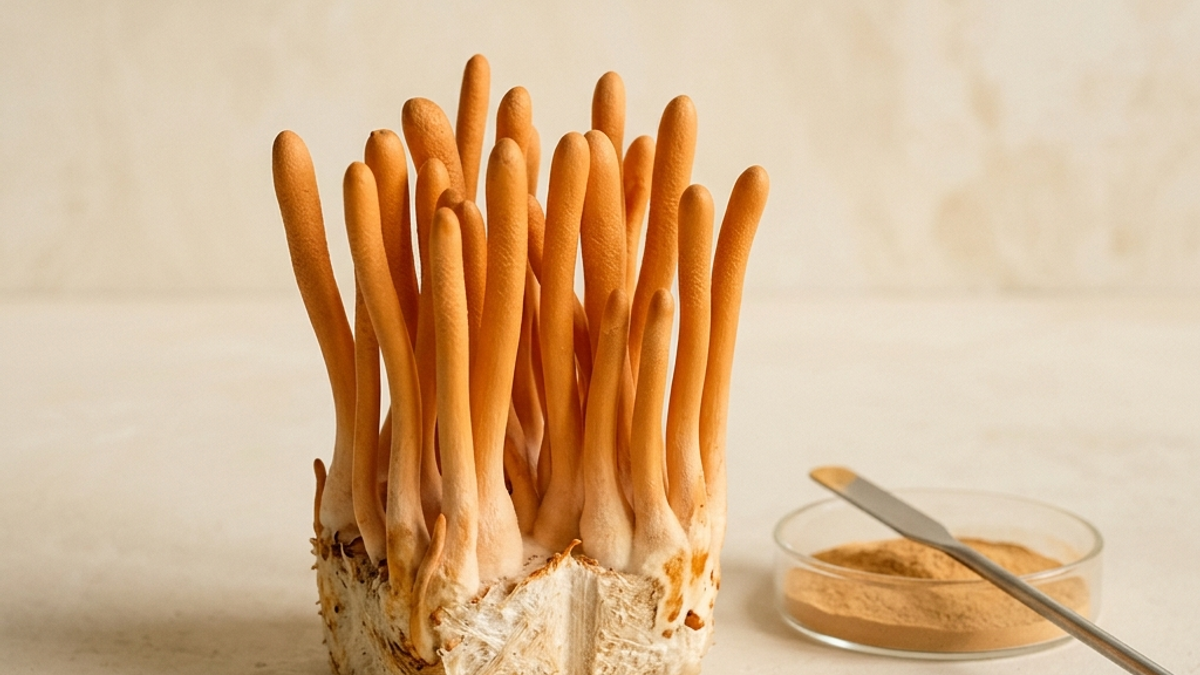
Cordyceps is a genus of fungi that make their living inside insects — entomopathogenic fungi, meaning fungi that infect insects rather than wood or soil. A spore lands on a host and germinates, threads of fungal tissue grow through the insect, and when conditions turn the fungus pushes a club-shaped fruiting body out through the husk. The photographs going around are not exaggerated. That is genuinely how the organism eats.
Several hundred species have been described. Three of them, or rather three materials, account for essentially everything sold — and telling them apart is the whole job.
Is all cordyceps the same species?
No. They are not even close, and one of them is not in the same genus anymore.
| In the jar | The organism | How it's produced | Label wording you'll see |
|---|---|---|---|
| Wild caterpillar fungus | Ophiocordyceps sinensis | hand-collected at high elevation from infected ghost-moth larvae | "Cordyceps sinensis," "dong chong xia cao," "wild-harvested" |
| Cultivated cordyceps | Cordyceps militaris | fruited on prepared substrate in controlled rooms; bright orange clubs | "Cordyceps militaris," "fruiting body," sometimes "cordycepin" |
| Fermented mycelium | sinensis-lineage strains — CS-4, Paecilomyces hepiali | grown as mycelium in liquid fermentation and harvested as biomass | "CS-4," "Cordyceps sinensis mycelium," "Paecilomyces hepiali" |
Take the taxonomy first, because it is the cleanest proof that these are not variations on a theme. The wild caterpillar fungus was moved out of Cordyceps in the 2007 revision of the group and now sits in Ophiocordyceps — a different genus in a different family. The two things everyone compares as "militaris vs sinensis" stopped being the same genus almost twenty years ago. The trade kept the old name because the old name is the one that sells.
The third row is a different kind of difference, and it's the one that trips people up. Mycelium is the thread network a fungus feeds with; a fruiting body is the mushroom it eventually pushes up. Fermented material is grown in a tank and harvested as biomass, so nothing ever fruits. Those are two different parts of the organism. A label names one.
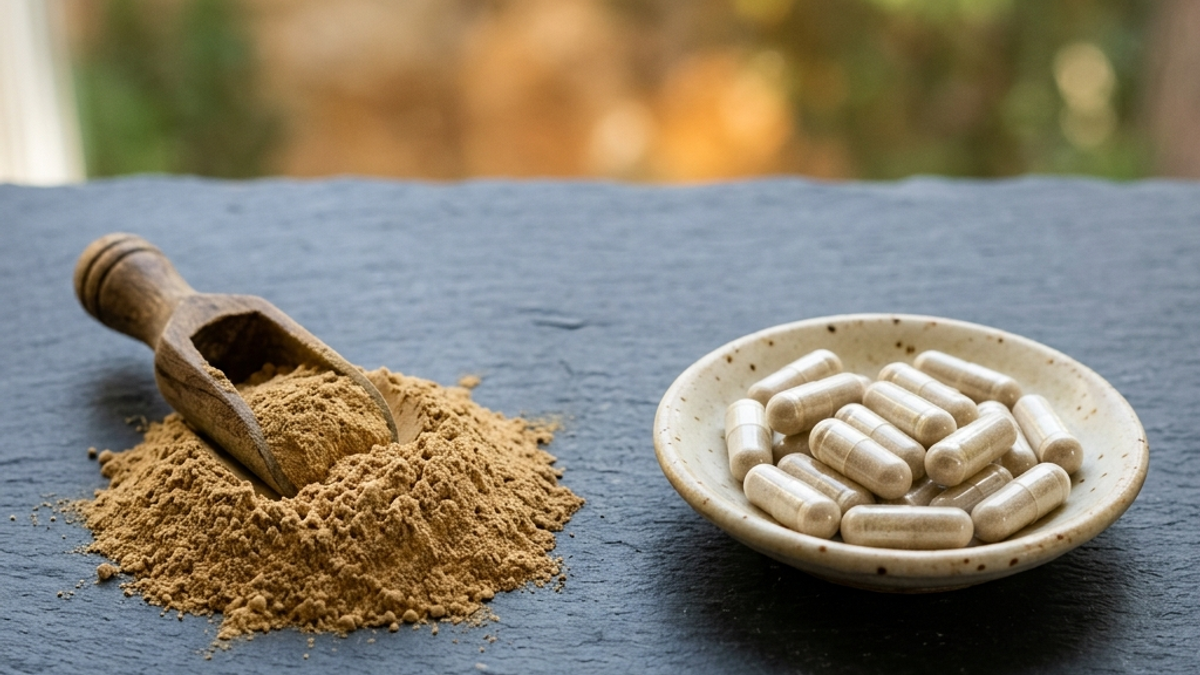
Shroombiosis uses the third row: our Cordyceps is Paecilomyces hepiali, a sinensis-lineage strain grown in liquid fermentation and supplied as a 10:1 extract, at 1,000 mg per scoop. The species is printed here and in the ingredient list because that is the level of naming this page argues every label owes you.
That is not a verdict on fermented mycelium, which has a real body of older clinical work behind it and is not going to apologize for being grown in a tank. It's a verdict on pooling. When someone tells you what "cordyceps" does, ask which of the three they mean, because a wild insect fungus, a cultivated orange mushroom and a fermentation biomass are sitting in that one word together.
Why can't a cultivated product claim the dong chong xia cao history?
Because that history belongs to one organism. 冬虫夏草 — dōng chóng xià cǎo, "winter worm, summer grass" — names the wild caterpillar fungus, gathered from a specific habitat and prepared within a specific tradition. It was scarce and costly and rationed accordingly. That reputation was earned by that material.
A cultivated Cordyceps militaris fruiting body is a perfectly legitimate ingredient with its own, more modern, more reproducible evidence base. It is not the thing in the classical record. Neither is a tank-grown mycelium. So when a militaris label reaches for "used for centuries in traditional Chinese medicine," the sentence is performing a species swap halfway through itself — and the scientific literature is more careful than the copywriting, since a 2026 review of medicinal mushrooms in Molecules keeps Cordyceps militaris and Cordyceps sinensis as separate entries (opens in new tab) rather than filing them under one heading.
Borrow the history or borrow the trials. You don't get both, and you don't get either for a species you didn't use.
Why did cultivation replace wild harvest?
Because wild supply can neither scale nor be verified, and cultivation fixes both problems at once.
The caterpillar fungus is collected by hand, at altitude, in a short season, by people whose income depends on the haul. That combination puts hard pressure on wild populations and pushes the price up every year. And a material that expensive, sold in small dried pieces that are difficult to identify by eye, is an obvious target for substitution — that's a market observation, not an accusation against anyone in particular. Cordyceps militaris, by contrast, fruits indoors on prepared substrate year-round in orange clubs you can recognize across a room, and liquid fermentation turns out mycelial biomass at industrial volume.
So the industry moved, and for a buyer that is mostly good news. Given the choice between a romantic origin story I can't check and a material whose identity I can, verification wins every time. Wild-harvested is not automatically the better ingredient here. It is the harder one to prove.
What does the human research on cordyceps actually show?
Early evidence, in one narrow lane: stamina and post-exercise recovery. Not much else, in humans, that I'd stand behind.
The clearest picture we have sits in a narrative review in Nutrients that gathers the human trials on Cordyceps militaris specifically and links supplementation to ergogenic and post-exercise recovery effects (opens in new tab) through oxygen use and energy metabolism — but the authors' own conclusion is that the field still needs standardized trials with defined doses, which is the sentence that tends to get left out of the citation. A narrative review maps where evidence points. It doesn't settle anything.
The most-quoted endurance result in this entire category — improved time to exhaustion and aerobic markers after short-term high-altitude training — came from a Rhodiola crenulata- and Cordyceps sinensis-based supplement (opens in new tab), and that detail cuts twice. Rhodiola has its own performance literature, so the cordyceps-alone contribution is milder than the headline implies; and the cordyceps in it was sinensis-lineage, so the result doesn't transfer cleanly onto a militaris label either. It still shows up quoted next to militaris ingredient lists.
Now the limits.
There is no consensus human dose. Nothing in the research I'm willing to cite gives cordyceps a settled milligram range the way the lion's mane trials give theirs. Our own label prints 1,000 mg of Cordyceps in a scoop, and I can't hold that number up against a research consensus, because there isn't one to hold it up against yet. That's a gap in the field, not a detail I'm going to paper over with an adjective.
Pooling across species is a real methodological problem, not pedantry. The beta-glucans in fungal cell walls behave according to their structure — the backbone, the branching, the molecular weight (opens in new tab) — and that structure shifts with both the species and the extraction method, in work that is still mostly cell and animal models. Same nominal ingredient, different molecule profile. Which is why three organisms under one name is a measurement problem before it is a marketing one.
That leaves early evidence for stamina and recovery, most of it on cultivated C. militaris, and no human evidence worth citing for the assorted other things cordyceps gets casually credited with online.
How do you read a cordyceps label?
Work down five lines, in this order.
- The species, spelled out in Latin. Cordyceps militaris or Ophiocordyceps sinensis. A jar that says only "Cordyceps" has named the genus, and the genus is the part that pins nothing down.
- The part used, named once. Fruiting body or mycelium. Two different parts of the organism, and a label should commit to one: fruiting body vs mycelium walks through why that word changes what's physically in the powder.
- If it's mycelium, ask about the grain. Mycelium is often grown on rice or oats, and unless it's separated out, the grain ships with the product. That's starch you paid mushroom prices for.
- A milligram amount per serving. A single proprietary-blend total gives you the sum, never the split, and the split is what decides whether any one mushroom in there sits near a studied amount. Our how to read a mushroom supplement label post is the long version of this one line.
- The extraction method. The active fractions aren't all water-soluble, which is the argument for dual extraction. And treat a bare "10:1" with appropriate suspicion — what extract ratios actually mean explains why that figure is arithmetic, not a measurement.
One more thing worth knowing, because it shows up as soon as you start comparing jars: the two families of cordyceps material don't even get marketed against the same marker compound. Cultivated militaris labels tend to name cordycepin; sinensis-lineage materials are usually presented against adenosine. I'm describing how labels are written, not making a potency claim — and that's the point. A percentage on the front of a jar means something only if there is an assay behind it that you can look at. We don't publish a beta-glucan number for our own blend yet, because we don't have an assay in hand to publish, and I'd rather say that than print a number I can't defend. If a brand does publish one, ask to see the certificate of analysis.
Cordyceps is a good ingredient with a genuinely interesting mechanism and a research base that is younger and thinner than its reputation. Both of those things can be true. Get specific about which organism you're buying and the category stops being confusing — for the wider map of how it sits alongside the others, our functional mushrooms guide and the mushroom supplement buyer's guide pick up from here, and how we formulate shows what we print and why.
These statements have not been evaluated by the Food and Drug Administration. This product is not intended to diagnose, treat, cure, or prevent any disease.
References
Jędrejko M, Jędrejko K, Granda D, et al. Current evidence of ergogenic and post-exercise recovery effects of dietary supplementation with Cordyceps militaris in humans — a narrative review. Nutrients. 2026;18(5):781. PMID: 41829950 (opens in new tab) · doi:10.3390/nu18050781 (opens in new tab)
Chen CY, Hou CW, Bernard JR, et al. Rhodiola crenulata- and Cordyceps sinensis-based supplement boosts aerobic exercise performance after short-term high altitude training. High Altitude Medicine & Biology. 2014;15(3):371–379. PMID: 25251930 (opens in new tab) · doi:10.1089/ham.2013.1114 (opens in new tab)
Dilrukshi N, Grice ID, Mallard B, Tiralongo J. Mushroom β-glucans as immunomodulators: elucidation of structure–function relationship. Food Chemistry. 2025;495(Pt 2):146468. PMID: 41187460 (opens in new tab) · doi:10.1016/j.foodchem.2025.146468 (opens in new tab)
Sadowska A, Włosek-Pawełas D, Car H. Medicinal mushrooms and their bioactive compounds: from traditional use to therapeutic potential. Molecules. 2026;31(10):1749. PMID: 42197308 (opens in new tab) · doi:10.3390/molecules31101749 (opens in new tab)