
Cordyceps for Energy: What the Research Actually Shows
Scientifically reviewed by Dr. Danielle Oncer, PharmD (pharmacology, dosing & safety).
Short answer
Cordyceps is studied as a non-stimulant way to support energy — it's linked to better oxygen use and energy metabolism (ATP) rather than the jolt-and-crash of caffeine. The human evidence is promising but still early (and much of it is on the Cordyceps militaris species), and the strongest trial was a combination product, so we frame cordyceps as steady stamina support, not a guaranteed pre-workout.
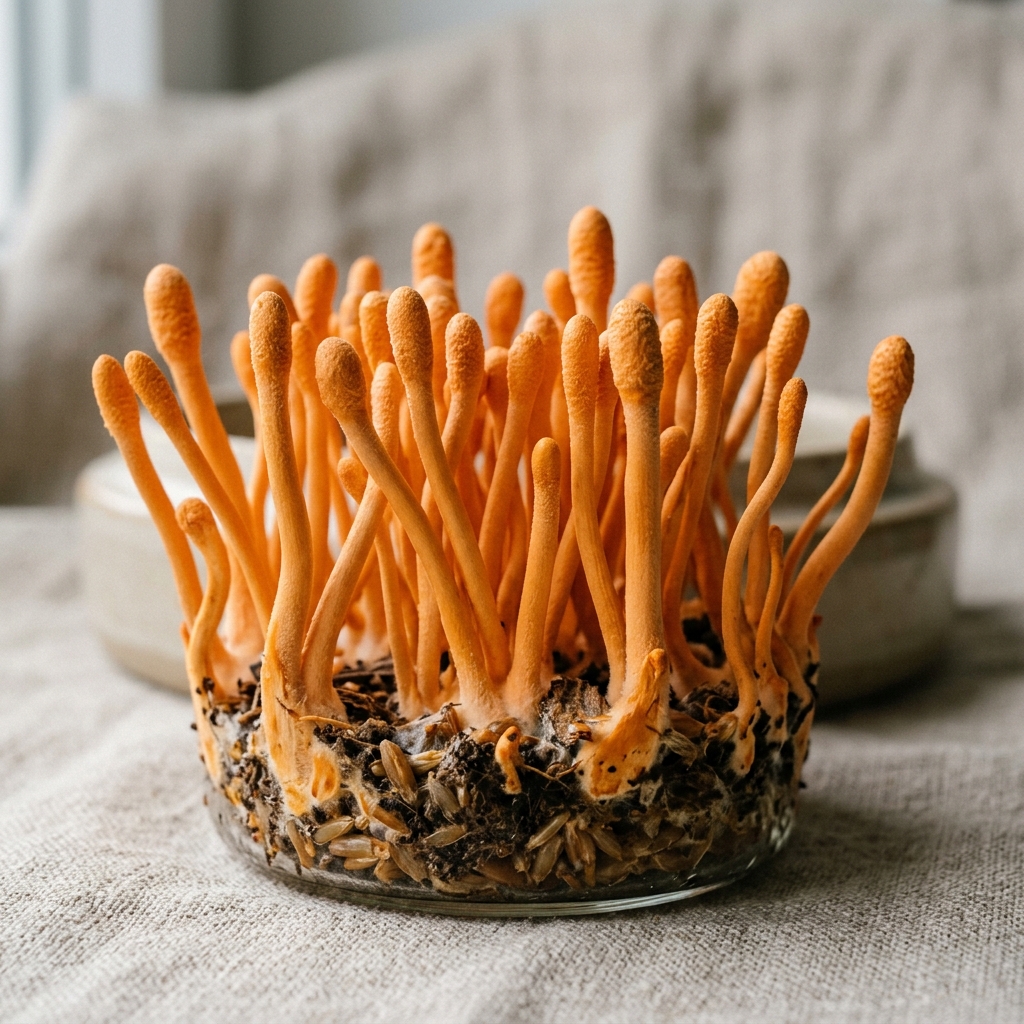
If you searched for cordyceps for energy, you probably want one straight answer: does it work, and is it just another stimulant? Here's the honest version. Cordyceps — the mushroom we use — is studied as a non-stimulant way to support energy, working through how your body uses oxygen and makes cellular fuel (ATP) rather than through a caffeine-style jolt. The human research is genuinely promising, but it's still early, and the single strongest trial tested cordyceps with another herb. So the fair framing is steady, build-it-yourself stamina — not a guaranteed pre-workout punch.
That distinction is the whole point of this post. Plenty of "energy" marketing leans on the same lever: caffeine, taurine, more caffeine. Cordyceps is interesting precisely because it doesn't. Let's walk through what the science actually shows, and where it stops.
Why cordyceps energy is different from caffeine energy
Caffeine works by blocking adenosine, the molecule that builds up and makes you feel tired. It's a brilliant short-term trick — but it's borrowing. The crash and the 2 p.m. slump are the loan coming due.
Cordyceps points at a different system entirely. The proposed mechanism isn't about masking fatigue; it's about supporting the machinery that produces energy in the first place — oxygen utilization and the production of ATP, the cellular fuel your muscles and brain run on. That's why we describe cordyceps as energy you build, not energy you borrow. Nothing about it depends on a stimulant, which is also why it fits a caffeine-free formula by design.
If you want the broader picture of how mushrooms slot into steady, all-day energy without the jitters, our pillar guide to functional mushrooms maps the whole category, and our piece on how the gut quietly fuels energy and focus covers the non-stimulant energy story from another angle.
What the human research on cordyceps shows
Here's the most important specificity in this whole topic: species matters. You'll see "cordyceps" used loosely, but the different species and forms aren't interchangeable in either sourcing or study quality. Our cordyceps species guide walks through the three organisms the word covers and how to tell them apart on a label. Much of the recent human research has been done on the Cordyceps militaris species, which can be grown reliably and verified — so when you weigh the evidence, it's worth knowing which species a given study actually tested.
A 2026 narrative review in Nutrients pulled together the human trials on Cordyceps militaris specifically, and reported ergogenic and post-exercise recovery effects tied to oxygen use and energy metabolism (opens in new tab). In plain terms: across the available human studies, militaris is associated with better exercise capacity and recovery, and the proposed reason is exactly that oxygen-and-ATP pathway. That's the most species-relevant human evidence we have.
The honest caveat, which the authors themselves flag: this is a narrative review, not a single large randomized trial, and the field still needs more standardized studies with clearly defined doses. A narrative review is a helpful map of where the evidence points — it is not the final word. We'd rather you know that than oversell it.
The strongest trial was a combination — and we'll say so
The most frequently cited "cordyceps improves performance" result comes from a 2014 study in High Altitude Medicine & Biology. It found that a supplement combining Rhodiola and Cordyceps improved time to exhaustion and aerobic markers versus placebo (opens in new tab) after short-term high-altitude training. On its face, that's a strong endurance signal.
But read the fine print. That was a combination product — Rhodiola plus cordyceps — so we can't credit the result to cordyceps alone. Rhodiola is itself an adaptogen with its own performance literature, which means the cordyceps-specific contribution is almost certainly milder than the combined number suggests. We present this study as supporting evidence for the oxygen-use/stamina mechanism, not as proof that cordyceps by itself delivers that exact effect. If a brand quotes this trial as a cordyceps slam-dunk, that's the kind of thing worth catching when you read a supplement label and the studies behind it.
Steady stamina for a long day, not just a long run
Most cordyceps research lives in the exercise lab — time to exhaustion, VO2-style markers, treadmill protocols. That's useful, but it's not where most of us spend our days. The more relevant question for real life is whether supporting oxygen use and energy metabolism translates to a steadier afternoon, a clearer third meeting, a workout that doesn't wipe out your evening.
The mechanism is the same either way — the cellular fuel system doesn't know whether you're running intervals or running errands. So we frame cordyceps as stamina for a long day: a non-stimulant nudge toward steadier output, used consistently. It pairs naturally with the rest of a functional-mushroom routine, which is why cordyceps sits alongside lion's mane for focus and reishi for calm in a blend rather than standing alone. You can see how the energy and focus pieces fit together in mushrooms, gut health, focus, and energy.
What has to be true for cordyceps to actually help you
This is the part the hype usually skips. A few conditions have to line up:
- The label is specific about what's in it. "Cordyceps" with no detail at all is a yellow flag — look for a label that names what you're actually getting.
- It's well extracted. The active compounds aren't all water-soluble, so extraction method matters — more on that in dual extraction explained and fruiting body vs mycelium.
- You use it consistently. This isn't an acute stimulant. The benefit, where it exists, builds over weeks — closer to a training adaptation than a coffee.
- The basics are already in place. Sleep, food, movement, hydration. Cordyceps supports a functioning energy system; it can't substitute for one.
Get those right and cordyceps becomes a reasonable, evidence-aware addition. Skip them and even a real ingredient won't have much to work with. (If you're newer to mushroom dosing or wondering about safety, our dosing primer and are functional mushrooms safe cover the practical ground.)
The calm takeaway
Cordyceps for energy is one of the more interesting non-stimulant stories in this category — supporting oxygen use and ATP rather than borrowing against tomorrow's afternoon. The human evidence on cordyceps (much of it on the Cordyceps militaris species) is real and pointed in the right direction, with the honest asterisk that it's still early and the headline endurance trial was a combination. That's exactly why we use it for steady, caffeine-free stamina and let the research speak at its actual volume.
Real energy isn't borrowed from a cup — it's built from the inside out, one consistent day at a time. That's the whole idea behind how we formulate, with every dose printed on the label.
References
Jędrejko M, Jędrejko K, Granda D, et al. Current evidence of ergogenic and post-exercise recovery effects of dietary supplementation with Cordyceps militaris in humans — a narrative review. Nutrients. 2026;18(5):781. PMID: 41829950 (opens in new tab) · doi:10.3390/nu18050781 (opens in new tab)
Chen CY, Hou CW, Bernard JR, et al. Rhodiola crenulata- and Cordyceps sinensis-based supplement boosts aerobic exercise performance after short-term high altitude training. High Altitude Medicine & Biology. 2014;15(3):371–379. PMID: 25251930 (opens in new tab) · doi:10.1089/ham.2013.1114 (opens in new tab)