Reishi for Calm: What the Research Shows
Scientifically reviewed by Dr. Danielle Oncer, PharmD (pharmacology, dosing & safety).
Short answer
Reishi (Ganoderma lucidum) is most often reached for to support a calm, steady stress response rather than to sedate you. It is classed as an adaptogen — a compound studied for helping the body hold its balance under stress — and the calm framing rests on that mechanism plus long traditional use, not on a proven mood effect. It is not a sleep aid, and the honest framing is resilience, not a cure for anything.

If you've looked into reishi for calm, you've probably run into two extremes: pages that treat it like a sedative in a capsule, and pages that wave it away as folklore. The honest answer sits in between. Reishi (Ganoderma lucidum) is best understood as a support for a calm, steady stress response — an adaptogen, in the technical sense — not as a sleep aid and not as a cure for anything. So let's walk through what the research actually shows, where it stops, and how we frame it without overselling.
Here's the short version: reishi belongs to a class of compounds studied for helping the body hold its balance under stress, and a small human trial found daily reishi produced measurable physical-fitness changes over six weeks. That is genuinely encouraging. It is also early, limited, and easy to overstate — which is exactly why we keep the claim to resilience and a healthy stress response, never "relaxation guaranteed" and never "better sleep."
What "reishi for calm" really means
When people say they want reishi for calm, they usually picture a fast, drowsy hush — the way a strong herbal tea might feel. That is not how reishi is studied, and setting that expectation up front saves disappointment.
Reishi is most often categorized as an adaptogen. The clearest definition of that word comes from a 2010 review in Pharmaceuticals on how adaptogens act on the central nervous system (opens in new tab), which describes adaptogens as compounds that help the body resist and adapt to stress by interacting with the stress-response system — including the hypothalamic-pituitary- adrenal (HPA) axis that governs cortisol and the body's reaction to a demanding day. The idea is balance, not sedation: an adaptogen is studied for nudging an overreactive stress response back toward baseline, rather than dampening you down.
One important caveat about that review: it explains how the category may work. It is a mechanism review, not proof that reishi — or any single product — produces a measurable calming effect in you. We treat it as the "here's the plausible why" layer, and we keep it there. That distinction between mechanism and proof is the kind of thing we think a smart buyer deserves to see spelled out, which is also why we wrote a primer on how to read a mushroom supplement label.
The human evidence on reishi and wellbeing
Mechanism is the floor. What about people actually taking reishi?
The most relevant human study is a 2015 randomized controlled trial in Nutrición Hospitalaria (opens in new tab) that gave 64 women 6 grams of reishi per day for six weeks and tracked their physical fitness against an inactive comparator group. The researchers reported improved aerobic endurance, lower-body flexibility, and movement velocity in the reishi group.
Here's the honest read: that trial measured physical fitness, not calm or mood, so it isn't direct proof of a calming effect. What it does show is that a real, daily dose of reishi produced measurable changes in a controlled setting over weeks. That fits the adaptogen story — support that builds with consistent use rather than a single dramatic serving — which is why we lean on the mechanism and tradition for the calm framing, not on a mood result this study didn't measure.
Now the honest caveats, because they're non-negotiable here. This trial was run in a specific disease population (women with fibromyalgia), it was relatively small, and it lasted six weeks. We cite it only as evidence that daily reishi is bioactive and tolerable over weeks, alongside the structure-function mechanism behind it. We do not imply that reishi treats fibromyalgia, or any condition — it doesn't, and saying so would be both wrong and non-compliant. The takeaway we draw is narrow and fair: daily reishi, in a real dose, produced measurable physical-fitness gains in a controlled setting — evidence it's active, not proof it makes you calm.
Why reishi is not a sleep aid (and we won't pretend otherwise)
This is where a lot of reishi marketing quietly crosses a line, so we'll be explicit: reishi is not a sleep aid. There is no solid human sleep-trial data behind it, and absent that data, "take reishi to sleep" is a claim the science can't support.
What reishi is studied for is a calmer, more balanced stress response during your waking hours. If supporting a settled nervous system happens to make winding down easier for you, that's your own physiology responding — not a sleep claim we can make for the mushroom. The difference sounds pedantic, but it's the whole game in a YMYL category: we say what the evidence says, and no more. If you want the practical version of that framing, we wrote a companion piece on building an evening ritual around reishi.
It also fits our broader stance. Our blend is caffeine-free on purpose, so any sense of calm steadiness comes from the formulation rather than from dodging a stimulant crash. If you're curious how stimulants and a settled baseline interact, that thread runs through several of our pieces on the gut-brain axis and a steadier mood and energy.
How reishi fits a multi-mushroom blend
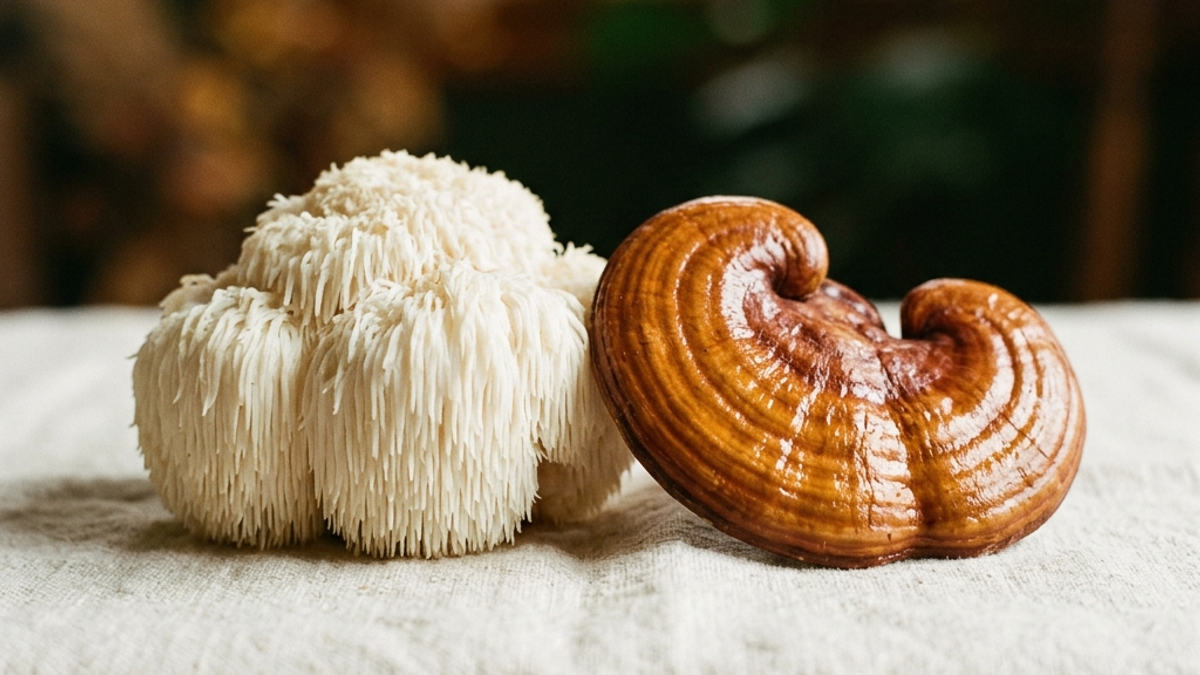
Reishi rarely works as a solo act in a daily mix-in, and that's by design. In our formulation it sits alongside the rest of the seven mushrooms, each with its own lane: cordyceps for steady, non-stimulant energy, lion's mane for focus, turkey tail for beta-glucan-driven immune and gut support, and chaga for its traditional-use, antioxidant story. Reishi's job in that stack is the calm and stress-resilience corner. If you are weighing reishi against lion's mane rather than taking both, we lay out what each one is actually studied for.
A few things have to be true for reishi to earn its place, and we hold ourselves to them:
- A real, disclosed dose. The benefit tracks with actual reishi content, not a pinch hidden inside a proprietary blend. We print every dose on the label.
- Dual-extracted fruiting body. Reishi's active compounds — beta-glucans and triterpenes — need both water and alcohol extraction to come across, and they live in the fruiting body, not mycelium grown on grain. The why is in our explainer on fruiting body versus mycelium.
- Consistency over weeks. Adaptogen-style support builds. The human trial ran six weeks for a reason; a single serving isn't the unit of measurement.
For the full map of where reishi sits among the other mushrooms and how the lanes connect, our complete guide to functional mushrooms is the place to start.
The bottom line
Reishi for calm is a fair, evidence-aware reason to reach for Ganoderma lucidum — as long as "calm" means a steadier, more resilient stress response, not a sedative and not a sleep aid. The adaptogen literature gives us a plausible mechanism, traditional use gives us centuries of context, and a small human trial shows daily reishi is bioactive over weeks.
Calm you can rely on is the kind you build quietly, day after day, with your physiology rather than against it. That's the idea behind how we formulate the blend — a real reishi dose in a caffeine-free, dual-extracted stack, with the fine print printed for you to check. Function, not friction.
References
Panossian A, Wikman G. Effects of adaptogens on the central nervous system and the molecular mechanisms associated with their stress-protective activity. Pharmaceuticals (Basel). 2010;3(1):188–224. PMID: 27713248 (opens in new tab) · doi:10.3390/ph3010188 (opens in new tab)
Collado-Mateo D, Pazzi F, Domínguez-Muñoz FJ, et al. Ganoderma lucidum improves physical fitness in women with fibromyalgia. Nutrición Hospitalaria. 2015;32(5):2126–2135. PMID: 26545669 (opens in new tab) · doi:10.3305/nh.2015.32.5.9601 (opens in new tab)