
5 Ways Mushrooms Support Gut Health, Focus & Energy
Scientifically reviewed by Dr. Danielle Oncer, PharmD (pharmacology, dosing & safety).
Short answer
Functional mushrooms support gut health, focus, and steady energy by feeding your microbiome, supporting how cells make energy, and backing healthy cognition and a calm stress response — caffeine-free. They work with your physiology over weeks, not as an instant jolt.
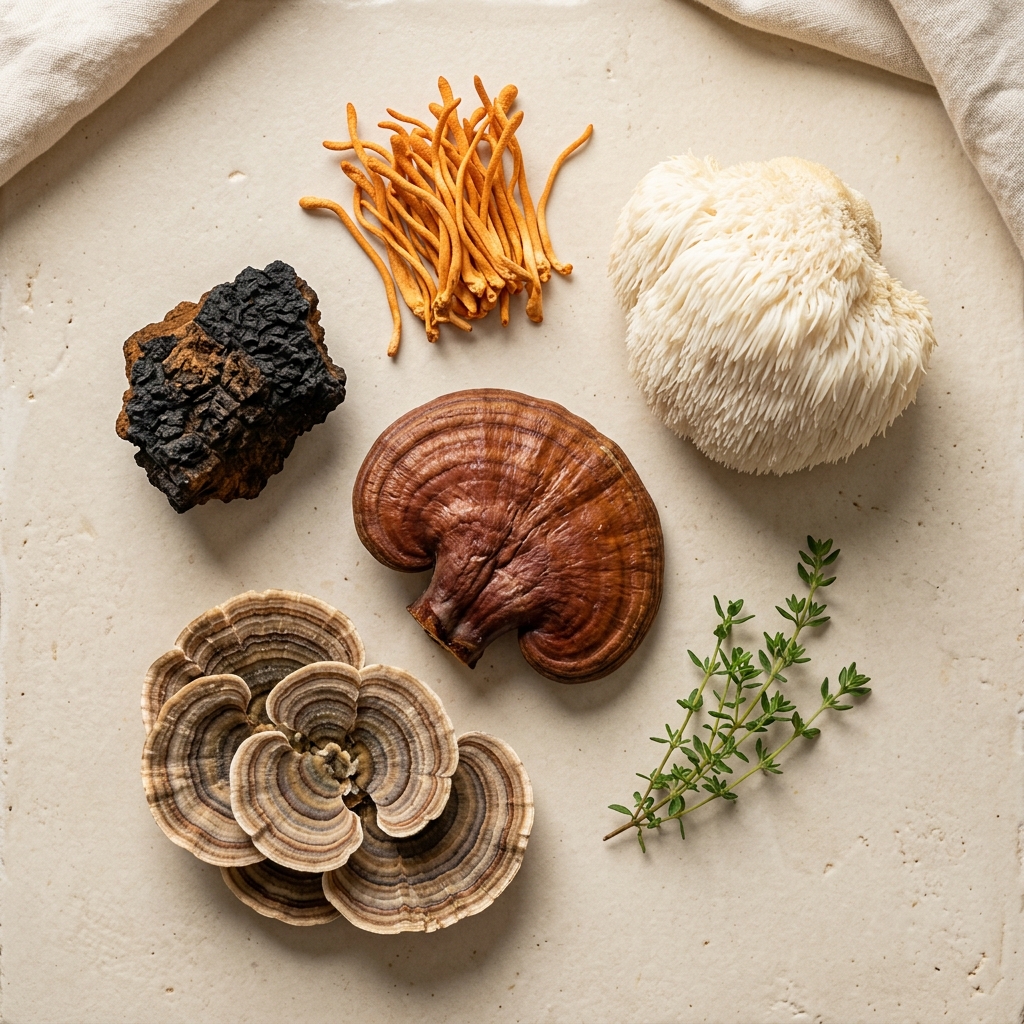
It's 2 p.m., the coffee has worn off, and your focus is gone. The usual fix is a second cup — and the usual result is a wired hour followed by a steeper slump. Functional mushrooms take a different route. They don't override your energy system with a stimulant; they support the systems your body already runs. The interesting part is that modern research has started to explain why, and the explanation runs straight through your gut.
A quick ground rule, since this is a health topic: none of this is medical advice, and none of these mushrooms treat or cure anything. They support normal functions you already have — focus for work and study, steady caffeine-free energy, a calmer response to everyday stress, and a healthier gut. That distinction matters, and it's the one most marketing blurs. Here are five research-backed ways functional mushrooms support how you function through a normal day, and what has to be true for each to actually work.
1. They support the gut–brain axis
Your gut and brain are in constant two-way conversation — a network researchers call the gut–brain axis. The foundational map of that link comes from a 2012 review in Nature Reviews Neuroscience (opens in new tab), which laid out how the trillions of microbes in your gut send signals that reach the brain and influence mood, stress, and how clearly you think. This isn't a fringe idea anymore; it's mainstream physiology.
Here's where mushrooms come in. Several of the ones in our blend — reishi, turkey tail, and chaga — are rich in beta-glucans, a class of fiber-like compounds that double as food for the bacteria already living in your gut. Alongside the prebiotic fibers in the blend, they help feed that community, and a better-supported microbiome is the foundation everything else in this list sits on. If you want the deep version, that's the whole subject of how your gut quietly fuels real energy and focus.
What has to be true for this to work: consistency. The gut–brain axis responds to a steady supply of the fibers and compounds that feed it, not a one-off dose. This is a weeks-and-months story, not an afternoon one.
2. They support clean, caffeine-free energy
Caffeine hands you a jolt and an invoice — the crash comes later. Cordyceps works differently. Rather than stimulating your nervous system, it's been studied for how the body uses oxygen and produces cellular energy. A 2026 narrative review of cordyceps in humans (opens in new tab) gathered the human trials on C. militaris specifically and examined its ergogenic and recovery effects tied to oxygen use, with mixed results and a call for better trials — not a stimulant effect. The review is honest about its limits — it calls for more standardized trials and clearer dosing — and we'll be just as honest: this is support for how you make energy, not a guarantee of a buzz.
We read it as evidence for daily-life stamina — steadier afternoons and a long day that doesn't fall off a cliff at 3 p.m. — rather than treadmill performance. It's not a stimulant; it's support for the way your cells generate energy in the first place. That's the difference between energy you build and energy you borrow.
3. They support focus and cognitive clarity
Lion's mane (Hericium erinaceus) is the most-studied mushroom for cognitive support, and it's the reason "clean focus without caffeine" is more than a slogan. A 2023 placebo-controlled trial on pure lion's mane in healthy young adults (opens in new tab) used 1.8 g/day on its own and reported faster cognitive task performance 60 minutes after a single acute dose, plus a non-significant trend toward reduced stress, versus placebo. That study matters because it's lion's mane solo, in healthy people — not a disease population, not a combination product.
Those numbers — roughly 1,000–3,000 mg/day in the wider research — are the clinical range, not necessarily our serving; we disclose our actual dose on the label. And the catch is exactly that: dose and extraction decide whether lion's mane does anything at all, which is why so much of what's on the shelf is underdosed. I wrote up the full pharmacology of lion's mane for anyone who wants to understand how it works on neurons and why the fine print on the label is the whole game.
4. They help your body adapt to everyday stress
Reishi (Ganoderma lucidum) is a classic adaptogen — traditionally used to help the body cope with everyday stress and stay calm and settled. On the human side, an RCT of reishi reported improved endurance, flexibility, and movement velocity (opens in new tab) — useful context for the resilience angle, with the honest caveat that the trial was run in a specific clinical population, so we read it for the fitness findings, not as a promise.
One thing we won't do is oversell it. Reishi serves the calm and stress-resilience lane — a steadier nervous system through a demanding day. We don't call it a sleep cure, because we don't have sleep-outcome data to back that claim. Because it's non-stimulating, it's the kind of thing you can take in the evening without it working against you — but "settling" is the honest word, not "sedating."
5. They work better with pre-, pro-, and postbiotics
This is the part most blends ignore, and it's where the whole list comes full circle. Prebiotics (fiber) feed your good bacteria, probiotics add live beneficial bacteria, and postbiotics are the beneficial compounds those bacteria produce — sometimes delivered in a heat-treated, shelf-stable form.
We don't leave that to chance. The blend includes acacia fiber as a prebiotic; a 12-week fiber-supplement RCT in healthy adults (opens in new tab) found it shifted gut microbiome composition, while the metabolic and inflammatory resilience markers were unchanged (the study used acacia combined with carrot powder, so we credit the fiber supplement, not acacia in isolation). For the probiotic, Bacillus subtilis DE111® is a heat-stable spore that survives a hot drink; a double-blind clinical trial on DE111® in healthy adults (opens in new tab) found it shifted the systemic immune profile toward more anti-inflammatory immune cells over four weeks, while gut microbiota and GI markers were largely unchanged. And Bifidobacterium animalis subsp. lactis CECT 8145 (BPL1® HT) rounds it out as a heat-treated postbiotic for gut and metabolic support.
Paired with functional mushrooms, this pre/pro/postbiotic stack supports digestion and a healthy microbiome — which loops right back to point 1, the gut–brain axis, and from there to focus, energy, and calm. The gut isn't one item on the list; it's the thread running through all five.
The bottom line
Real, durable energy and focus come from supporting your body's own systems, not overriding them with a stimulant. That's the daily-life angle these five points share: lion's mane for focus, cordyceps for steady energy, reishi for a calmer response to stress, beta-glucans and biotics for the gut underneath all of it — caffeine-free, and built to work over weeks of consistent use rather than in a single afternoon. This post is part of our broader complete guide to functional mushrooms, if you want the full picture of how the category works and what the research does and doesn't show.
It's also why we built the Shroombiosis blend the way we did: seven dual-extracted, fruiting-body mushrooms plus superfoods and a full pre/pro/postbiotic stack, with every dose printed on the label so you can check the fine print yourself. Function, not friction — built with your physiology, not against it.
References
Cryan JF, Dinan TG. Mind-altering microorganisms: the impact of the gut microbiota on brain and behaviour. Nature Reviews Neuroscience. 2012;13(10):701–712. PMID: 22968153 (opens in new tab) · doi:10.1038/nrn3346 (opens in new tab)
Jędrejko M, Jędrejko K, Granda D, et al. Current evidence of ergogenic and post-exercise recovery effects of dietary supplementation with Cordyceps militaris in humans — a narrative review. Nutrients. 2026;18(5):781. PMID: 41829950 (opens in new tab) · doi:10.3390/nu18050781 (opens in new tab)
Docherty S, Doughty FL, Smith EF. The acute and chronic effects of lion's mane mushroom supplementation on cognitive function, stress and mood in young adults: a double-blind, parallel groups, pilot study. Nutrients. 2023;15(22):4842. PMID: 38004235 (opens in new tab) · doi:10.3390/nu15224842 (opens in new tab)
Collado-Mateo D, Pazzi F, Domínguez-Muñoz FJ, et al. Ganoderma lucidum improves physical fitness in women with fibromyalgia. Nutrición Hospitalaria. 2015;32(5):2126–2135. PMID: 26545669 (opens in new tab) · doi:10.3305/nh.2015.32.5.9601 (opens in new tab)
Eveleens Maarse BC, Eggink HM, Warnke I, et al. Impact of fibre supplementation on microbiome and resilience in healthy participants: a randomized, placebo-controlled clinical trial. Nutrition, Metabolism & Cardiovascular Diseases. 2024;34(6):1416–1426. PMID: 38499450 (opens in new tab) · doi:10.1016/j.numecd.2024.01.028 (opens in new tab)
Freedman KE, Hill JL, Wei Y, et al. Examining the gastrointestinal and immunomodulatory effects of the novel probiotic Bacillus subtilis DE111. International Journal of Molecular Sciences. 2021;22(5):2453. PMID: 33671071 (opens in new tab) · doi:10.3390/ijms22052453 (opens in new tab)