Decaf Mushroom Coffee Still Has Caffeine
Scientifically reviewed by Dr. Danielle Oncer, PharmD (pharmacology, dosing & safety) and Jon Klipstein (supplement formulation expert, Die Tryin Co.).
Short answer
Decaf mushroom coffee is real coffee with most of the caffeine removed and mushroom extracts added — but "decaf" doesn't mean zero. Lab analyses of decaf coffee have found anywhere from none to about 14 mg of caffeine per cup. If you want to be certain there's no caffeine, a coffee-free mushroom mix-in is the only way to know for sure, because there are no coffee beans in it to begin with.
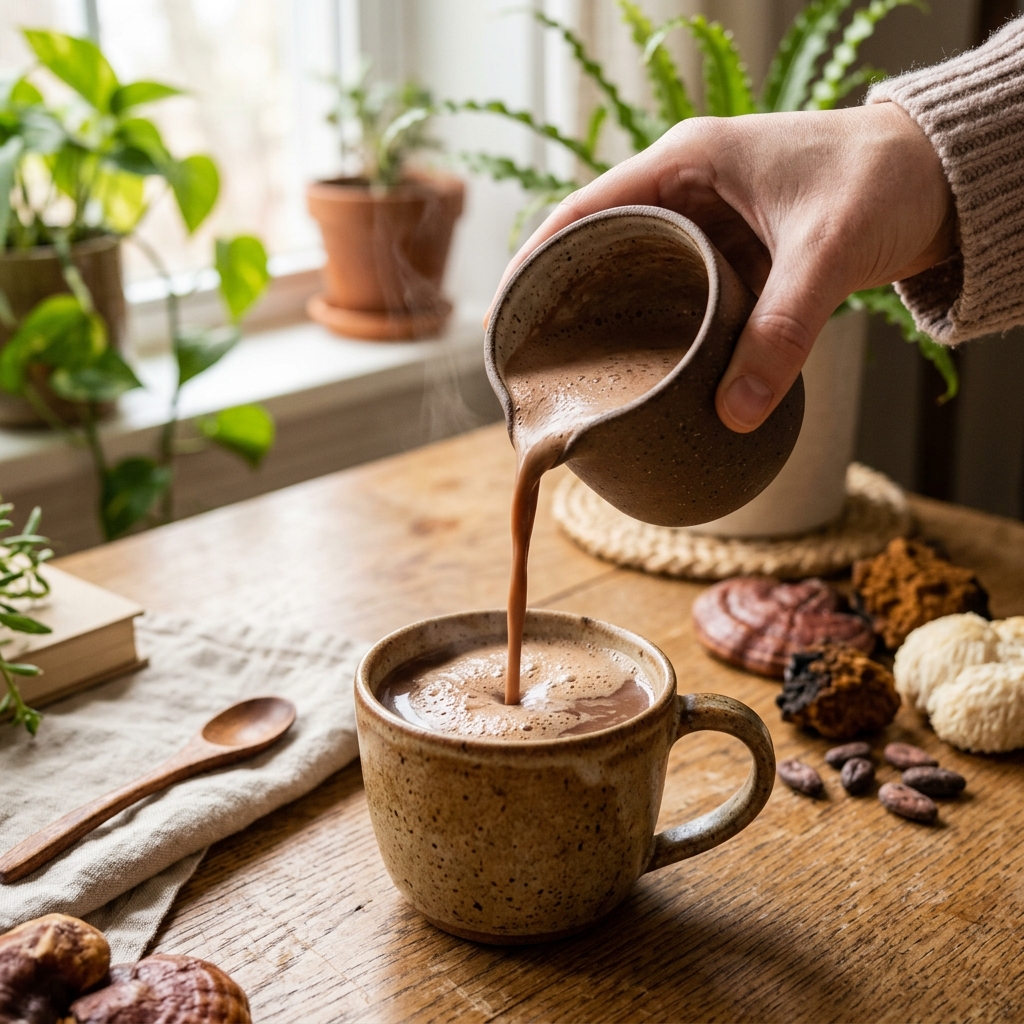
If you've searched for "decaf mushroom coffee," you're probably trying to get the benefits people talk about with functional mushrooms while keeping caffeine out of the picture — to avoid the afternoon jitters, to protect your sleep from late-day caffeine, for sensitivity, or just because you'd rather not. That's a sensible instinct. But there's one detail the category rarely says out loud, and it changes the answer: decaf isn't zero.
Here's the short version. Decaf mushroom coffee is real coffee with most of its caffeine removed and mushroom extracts added. "Most" is the operative word — decaffeination is a reduction, not an elimination. If your goal is less caffeine, decaf does that well. If your goal is no caffeine, the only way to be certain is to drink something that never had coffee in it at all.
What is decaf mushroom coffee?
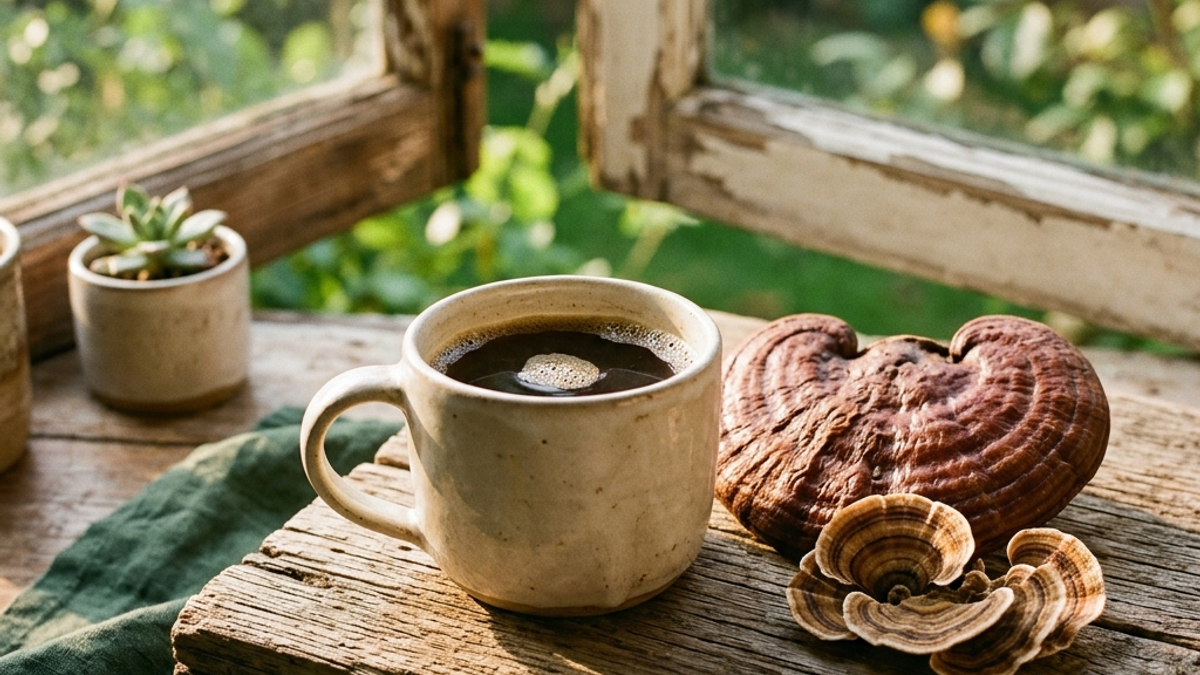
Decaf mushroom coffee starts as ordinary coffee that's been put through a decaffeination process — often the Swiss Water Process, which uses water and filtration rather than solvents — and then has functional mushroom extracts blended in, usually some mix of lion's mane, chaga, reishi, or cordyceps. The base is still coffee. The mushrooms ride along on top of it.
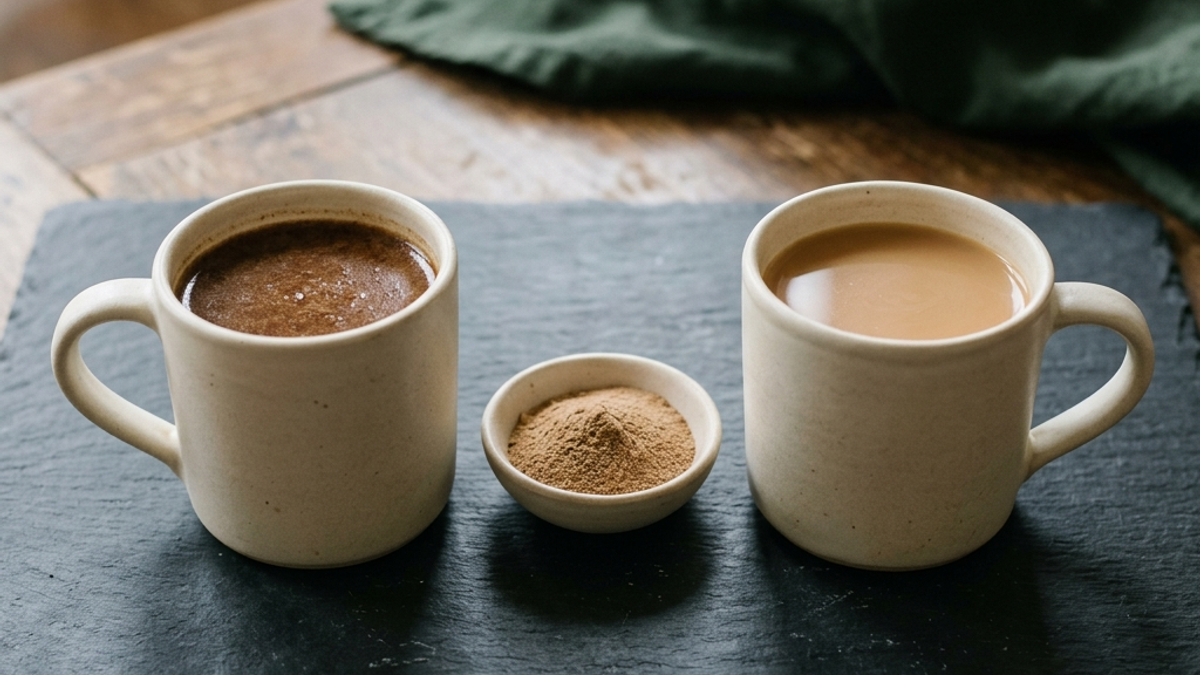
That's the key distinction from a mushroom mix-in, which is a coffee-free powder you stir into whatever you're already drinking. One is decaffeinated coffee plus mushrooms; the other is mushrooms (and, in our case, more) with no coffee involved. That difference is exactly what determines whether "caffeine-free" is true or just close.
Does decaf mushroom coffee have caffeine?
Yes — almost always a little. Decaffeination is defined by how much it removes, not by reaching zero. In the United States, coffee sold as "decaffeinated" generally has to have around 97% of its caffeine taken out, which leaves a residual amount behind.
How much? A 2006 analysis in the Journal of Analytical Toxicology measured the caffeine in decaf coffees pulled from real cafés. The decaf samples ranged from 0 to 13.9 mg of caffeine per 16-ounce serving, and decaf espresso shots came in at 3.0 to 15.8 mg per shot. For context, a regular 8-oz cup of coffee usually carries somewhere around 95 mg — so decaf is dramatically lower, but not none, and the exact amount varies cup to cup and shop to shop.
Why this matters: a few milligrams is nothing for most people. But if you're deliberately avoiding caffeine — because caffeine that late disrupts your sleep, because you're sensitive to even small amounts, or because you simply want a clean break in the afternoon and evening — "a few milligrams, sometimes more, and you can't tell which" is a different proposition than zero. The honest framing is that decaf is a low-caffeine drink, and the label is the only place that distinction lives.
Decaf mushroom coffee vs. a caffeine-free mushroom mix-in
So how do the two options actually stack up? Here's a side-by-side, written to be fair to both — because they genuinely suit different people.
| Decaf mushroom coffee | Caffeine-free mushroom mix-in | |
|---|---|---|
| Caffeine | Reduced, not zero (≈0–14 mg per cup) | None — there's no coffee in it |
| Is it coffee? | Yes — decaffeinated coffee at its base | No — a powder you add to any drink |
| Coffee taste & ritual | Tastes and brews like coffee | Earthy / cocoa notes; not a coffee stand-in for flavor |
| When you can drink it | Best earlier in the day (still has some caffeine) | Any time, morning or evening |
| Mushrooms | Varies — often a few species, sometimes mycelium-on-grain | 7 fruiting-body mushrooms |
| Pre / pro / postbiotics | Rarely included | Yes — acacia prebiotic, DE111® probiotic, BPL1® postbiotic |
| What's on the label | Often a single proprietary-blend total | Per-ingredient milligrams + a published Certificate of Analysis |
Decaf has a real advantage here, too. If the coffee ritual is the part you love — the taste, the warmth, the morning routine built around a mug — a good decaf mushroom coffee keeps that intact while trimming the caffeine. A mix-in doesn't try to be coffee, so it won't scratch that particular itch.
So which one is actually caffeine-free?
Only the option with no coffee in it. That's not a technicality — it's the whole point of the search. Decaf removes most of the caffeine but leaves a variable little behind; a coffee-free mushroom mix-in starts with no caffeine, so there's nothing to remove and nothing to leave behind.
That's the lane we built Shroombiosis for. It isn't a decaf coffee and it isn't a "mushroom coffee" — it's a caffeine-free powder you mix into whatever you're already drinking, whether that's water, milk, a smoothie, or, yes, your own cup of coffee if you still want the caffeine on your terms. The steady-energy idea behind it leans less on a stimulant and more on the gut, which is a rabbit hole worth following in how your gut shapes focus and energy.
How to choose between them
There's no universal winner here, just a fit. A simple way to decide:
- Pick decaf mushroom coffee if you love coffee as a ritual and a flavor, you're fine with a small, variable amount of caffeine, and you mostly drink it earlier in the day.
- Pick a caffeine-free mushroom mix-in if you want to be certain there's no caffeine, you'd like the freedom to drink it any time (including the evening), and you want functional mushrooms plus pre-, pro-, and postbiotics in a single scoop rather than coffee with mushrooms added.
If part of what drew you to mushroom coffee was steady focus without the spike, it's worth knowing that focus doesn't have to come from caffeine at all — see lion's mane and the pharmacology of focus for what the research actually examines, and why dose and extraction matter more than the delivery format.
What to look for on either label
Whichever direction you go, the same handful of details separate a thoughtful product from a marketing exercise — and they apply to decaf coffee and mix-ins alike:
- Per-ingredient doses, not just a single blend total, so you can tell how much of each mushroom you're actually getting.
- Fruiting body vs. mycelium — the label should say which, because mycelium-on-grain can carry starchy filler.
- A third-party Certificate of Analysis you can open and read, not just a "tested" stamp.
- Reasonable, structure/function claims — "supports focus," "supports healthy gut flora" — rather than promises to treat or cure anything.
We walk through all of this in detail in how to read a mushroom supplement label, and the reason we include dedicated prebiotics, probiotics, and postbiotics — not just mushrooms — is laid out in the difference between prebiotics, probiotics, and postbiotics.
The honest bottom line
Decaf mushroom coffee is a fine choice if you want most of the caffeine gone and the coffee experience kept. But "decaf" and "caffeine-free" aren't the same word, and the research bears that out — decaf still carries a small, unpredictable amount of caffeine. If zero is what you're after, choose something that never contained coffee in the first place.
That's what we make: a caffeine-free, 7-mushroom mix-in with real pre-, pro-, and postbiotics and the full dose of every ingredient on the label. You can see exactly what's in it on the science behind the blend, or read the wider guide to functional mushrooms for the whole category in one place.
References
- McCusker RR, Fuehrlein B, Goldberger BA, Gold MS, Cone EJ. Caffeine content of decaffeinated coffee. Journal of Analytical Toxicology. 2006;30(8):611–613. PMID: 17132260. DOI: 10.1093/jat/30.8.611. https://pubmed.ncbi.nlm.nih.gov/17132260/ (opens in new tab)