Which Mushrooms Are Best for Gut Health?
Scientifically reviewed by Dr. Danielle Oncer, PharmD (pharmacology, dosing & safety).
Short answer
For gut health, the standout mushrooms are turkey tail, reishi, and chaga — all rich in beta-glucans that act as prebiotic fiber for the bacteria you already have. They feed your microbiome rather than adding live cultures, so think of them as food for your gut, not probiotics.
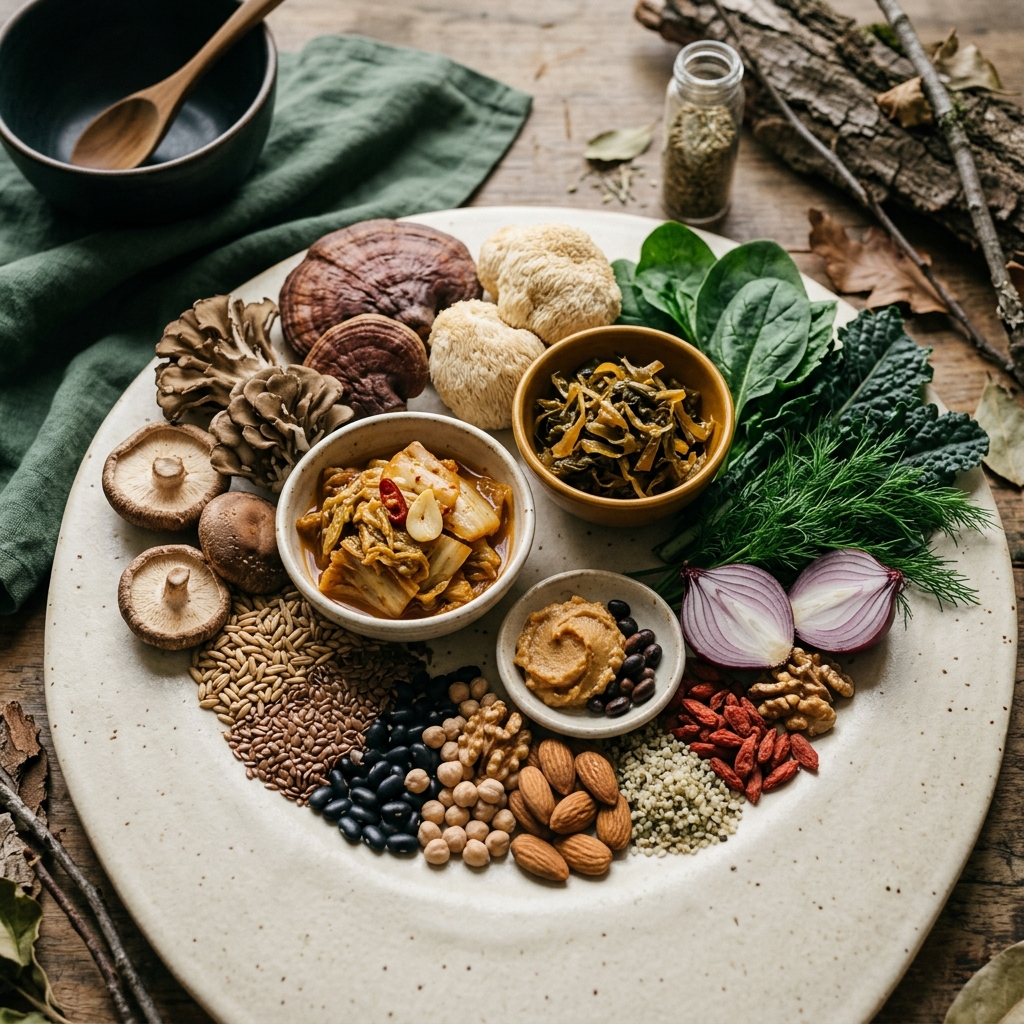
If you've searched for the best mushrooms for gut health, you've probably noticed the answers get vague fast — a list of names, a few buzzwords, and not much about why any of them belong on a gut list. So let's be specific. A handful of mushrooms genuinely earn the "gut" label, a few don't, and the reason comes down to one class of compound and one distinction most marketing skips.
Here's the short version: the gut stars are turkey tail, reishi, and chaga, because they're rich in beta-glucans — fiber-like compounds that act as prebiotics, feeding the bacteria you already have. That word matters. Mushrooms are food for your gut bacteria, not the bacteria themselves. If you came here wondering whether mushrooms are probiotics, the full prebiotic, probiotic, and postbiotic breakdown lives in how your gut quietly fuels real energy and focus — this post ranks the mushrooms.
Why beta-glucans are the whole gut story
Almost everything good a mushroom does for your gut traces back to beta-glucans. These are long-chain, fiber-like polysaccharides in the cell walls of functional mushrooms, and your own digestive enzymes can't break them down — which is the point. Like other prebiotic fibers, they reach the lower gut intact and become food for the beneficial bacteria living there.
Beta-glucans also have a well-documented relationship with the immune system, which is why "gut and immune support" show up together for these mushrooms. A 2007 review of how beta-glucans interact with immune-cell receptors (opens in new tab) describes them as biologic response modifiers — compounds that bind specific receptors on immune cells (Dectin-1, CR3) and help prime the body's normal defenses. That's a mechanism review, not a product trial, so read it as the how it could work layer.
The takeaway: the more beta-glucan-rich a mushroom is, the more it offers your gut as prebiotic fiber. That single yardstick separates the gut mushrooms from the rest of the blend.
The ranking: which mushrooms actually serve the gut
Turkey tail — the top pick
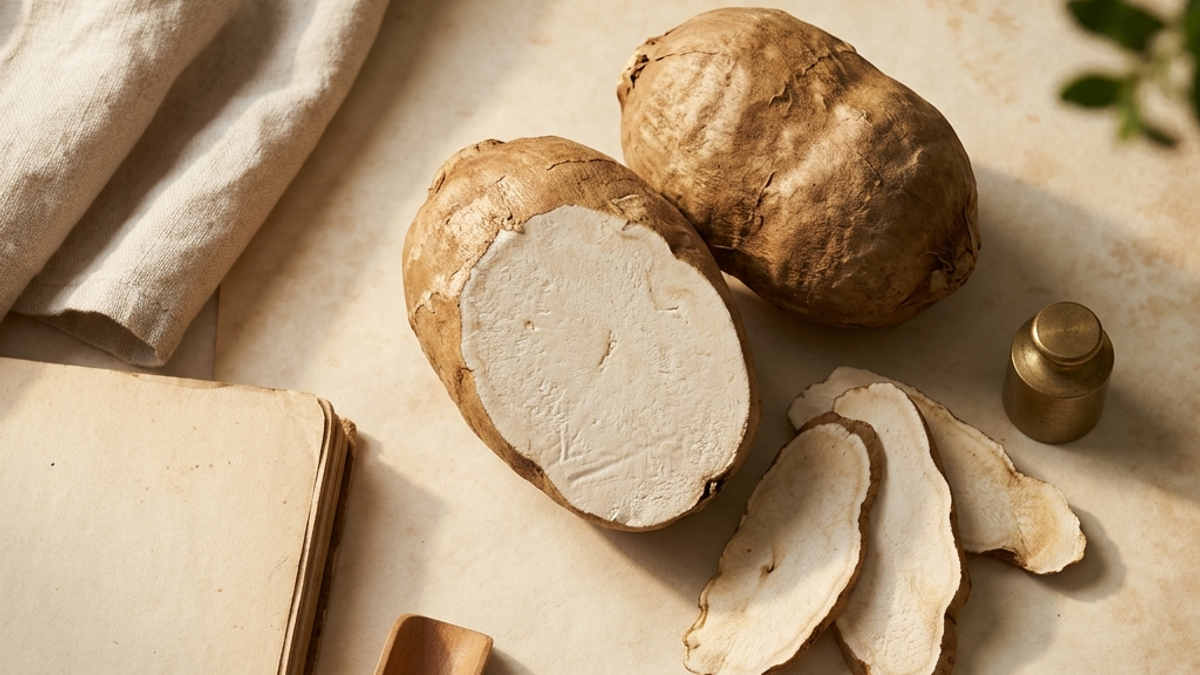
Turkey tail (Trametes versicolor) is the one I'd put first. It's among the most beta-glucan-rich mushrooms there is, and its beta-glucans include a well-known fraction called PSP. Those compounds do double duty: prebiotic fiber for your gut flora, and the fraction most studied for immune support.
On the human side, a 2012 Phase 1 clinical trial of turkey tail (opens in new tab) found it safe and well tolerated, with faster lymphocyte recovery and increased natural-killer-cell activity — an immune-support signal tied to those same beta-glucans. One honest caveat: that trial was run in a specific recovery population, so we cite it strictly for the immune-function mechanism and nothing beyond that. Turkey tail's job here is bounded — it supports gut flora and immune balance. That's the whole claim.
Reishi and chaga — strong supporting beta-glucan sources
Reishi (Ganoderma lucidum) is best known for the calm and stress-resilience lane, but it's also a meaningful beta-glucan source, so it contributes to the same prebiotic, gut-feeding effect. We keep reishi's headline where the evidence is — a healthy stress response and immune support.
Chaga (Inonotus obliquus) belongs here as another beta-glucan-rich mushroom that's traditionally used to support immune health and vitality. I'll be careful, though: there are no high-quality human trials on chaga, so the honest framing is "traditionally used," with preclinical studies pointing to high antioxidant capacity. It rounds out the beta-glucan content but doesn't carry a human gut-health claim on its own.
The rest of the blend has other jobs
Lion's mane sits in the focus lane, cordyceps in the steady-energy lane, and Poria and Tiger's Milk bring traditional-use stories of their own. They're not the gut headliners, and pretending every mushroom does everything is overreach we'd rather avoid. For the full map of what each mushroom is for, see our complete guide to functional mushrooms; for the gut deep-dive specifically, see our complete guide to gut health.
Mushrooms are prebiotic, not probiotic — and why that matters
This is the distinction that should change how you shop. A prebiotic is food for the beneficial bacteria you already have. A probiotic is live beneficial bacteria you add. A postbiotic is the helpful compounds those bacteria produce, sometimes in a heat-treated, non-live form.
Mushrooms — through their beta-glucans — sit firmly in the prebiotic column. They feed your microbiome; they don't seed it with new cultures. So if a label calls a mushroom a "probiotic," that's a red flag worth noticing, and a good reason to learn how to read a mushroom supplement label before you buy. It also explains why a mushroom alone is an incomplete gut strategy: feeding your bacteria is one link in the chain; the bacteria themselves and their byproducts are the others.
Why gut health is worth getting right
It's tempting to file "gut health" under digestion and move on, but the gut earns its keep beyond the stomach. Your gut and brain are in constant two-way conversation through the gut-brain axis. The foundational map of that link comes from a 2012 review in Nature Reviews Neuroscience (opens in new tab), which laid out how the trillions of microbes in your gut send signals that reach the brain and influence mood, stress, and how clearly you think.
That's why a balanced, well-fed microbiome is foundational rather than niche — it sits underneath energy, focus, and a steady mood. We dug into the daily-life version in five science-backed ways mushrooms support gut health, focus, and energy.
How we build a complete gut stack, not just a mushroom
Knowing mushrooms are prebiotic shaped how we formulated the blend. Rather than lean on beta-glucans alone, we pair the gut mushrooms with all three links.
- More prebiotic fiber. Alongside the mushrooms' beta-glucans, the blend includes acacia fiber (gum arabic). A 12-week fiber-supplement RCT in healthy adults (opens in new tab) found it shifted the composition of the gut microbiome, though the study's metabolic and inflammatory resilience markers were unchanged. (That study combined acacia with carrot powder, so we credit the fiber supplement, not acacia alone.)
- A live probiotic. Bacillus subtilis DE111® is a heat-stable spore that survives a hot drink. In a double-blind clinical trial on DE111® in healthy adults (opens in new tab), the researchers reported that "we observed an increase in anti-inflammatory immune cell populations in response to ex vivo LPS stimulation of PBMCs in the DE111 intervention group." In the same study they were candid about the limits: "Overall perceived gastrointestinal health, microbiota, and circulating and fecal markers of inflammation (Il-6, sIgA) and gut barrier function (plasma zonulin) were largely unaffected by DE111 intervention, although the study may have been underpowered to detect these differences." We read that as an immune-modulating signal in a small pilot — not overstated.
- A postbiotic. Bifidobacterium animalis subsp. lactis CECT 8145 (BPL1® HT) is the heat-treated postbiotic form. In a randomized trial, "in abdominally obese individuals, consumption of Ba8145, both as viable and mainly as heat-killed cells, improves anthropometric adiposity biomarkers, particularly in women" — which is why we frame the BPL1® strain as gut and metabolic support, kept to structure and function. The trial studied the live strain, so we present its research as supporting evidence and stay precise that ours is the postbiotic (HT) form.
Mushroom beta-glucans, dedicated prebiotic fiber, a heat-stable probiotic, and a postbiotic — a gut stack with every link covered, not one ingredient asked to do everything.
The bottom line
The best mushrooms for gut health are the beta-glucan-rich ones — turkey tail first, then reishi and chaga — and the honest framing is that they're prebiotic food for your bacteria, not probiotics. A mushroom is a strong first link, but the gut runs on the whole chain: fiber, beneficial bacteria, and the compounds they make. That's why we built the Shroombiosis blend around all three, with every dose printed on the label so you can check the fine print yourself. Function, not friction — built with your physiology, not against it.
References
Akramiene D, Kondrotas A, Didziapetriene J, Kevelaitis E. Effects of beta-glucans on the immune system. Medicina (Kaunas). 2007;43(8):597–606. PMID: 17895634 (opens in new tab)
Torkelson CJ, Sweet E, Martzen MR, et al. Phase 1 clinical trial of Trametes versicolor in women with breast cancer. ISRN Oncology. 2012;2012:251632. PMID: 22701186 (opens in new tab) · doi:10.5402/2012/251632 (opens in new tab)
Cryan JF, Dinan TG. Mind-altering microorganisms: the impact of the gut microbiota on brain and behaviour. Nature Reviews Neuroscience. 2012;13(10):701–712. PMID: 22968153 (opens in new tab) · doi:10.1038/nrn3346 (opens in new tab)
Eveleens Maarse BC, Eggink HM, Warnke I, et al. Impact of fibre supplementation on microbiome and resilience in healthy participants: a randomized, placebo-controlled clinical trial. Nutrition, Metabolism & Cardiovascular Diseases. 2024;34(6):1416–1426. PMID: 38499450 (opens in new tab) · doi:10.1016/j.numecd.2024.01.028 (opens in new tab)
Freedman KE, Hill JL, Wei Y, et al. Examining the gastrointestinal and immunomodulatory effects of the novel probiotic Bacillus subtilis DE111. International Journal of Molecular Sciences. 2021;22(5):2453. PMID: 33671071 (opens in new tab) · doi:10.3390/ijms22052453 (opens in new tab)
Pedret A, Valls RM, Calderón-Pérez L, et al. Effects of daily consumption of the probiotic Bifidobacterium animalis subsp. lactis CECT 8145 on anthropometric adiposity biomarkers in abdominally obese subjects: a randomized controlled trial. International Journal of Obesity (Lond). 2019. PMID: 30262813 (opens in new tab)