How to Make Mushroom Coffee Taste Better (and Mix Smoothly)
Scientifically reviewed by Dr. Danielle Oncer, PharmD (pharmacology, dosing & safety).
Short answer
Most mushroom coffee problems get fixed in the liquid, not the scoop. Make a paste, or shake a cold drink, so the powder doesn't clump, and add milk to soften bitter notes. If a pre-sweetened mix tastes too sweet, use more liquid or stir it into black coffee.
You made the first cup and it came out lumpy, or sweeter than you expected, or it had a flat earthy note sitting under everything. Nearly every one of those problems gets fixed by changing the liquid, the temperature or what goes in with the powder, and none of the fixes asks you to change the scoop. Don't toss the tub yet.
I'll use our own blend as the worked example, since every ingredient is on its label. Most of the fixes travel to other mushroom powders. For full recipes, start with our mushroom latte recipes.
Mushroom coffee is the name the whole category goes by, ours included, but there's no coffee in our tub and no added caffeine, on purpose. That's why our product page calls it a mix-in.
Find your problem first.
- Clumps. Make a paste first, or froth it.
- Powder floating on a cold drink. Make the paste before the ice goes in.
- Sediment or grit. Shake a cold drink or froth a hot one, stir again halfway down, and finish the last mouthful.
- Too thick. Go up to 10 oz.
- Too sweet. Water or black coffee, no lactose-free milk, no salt.
- Earthy. Milk, or a smoothie.
What does mushroom coffee taste like?
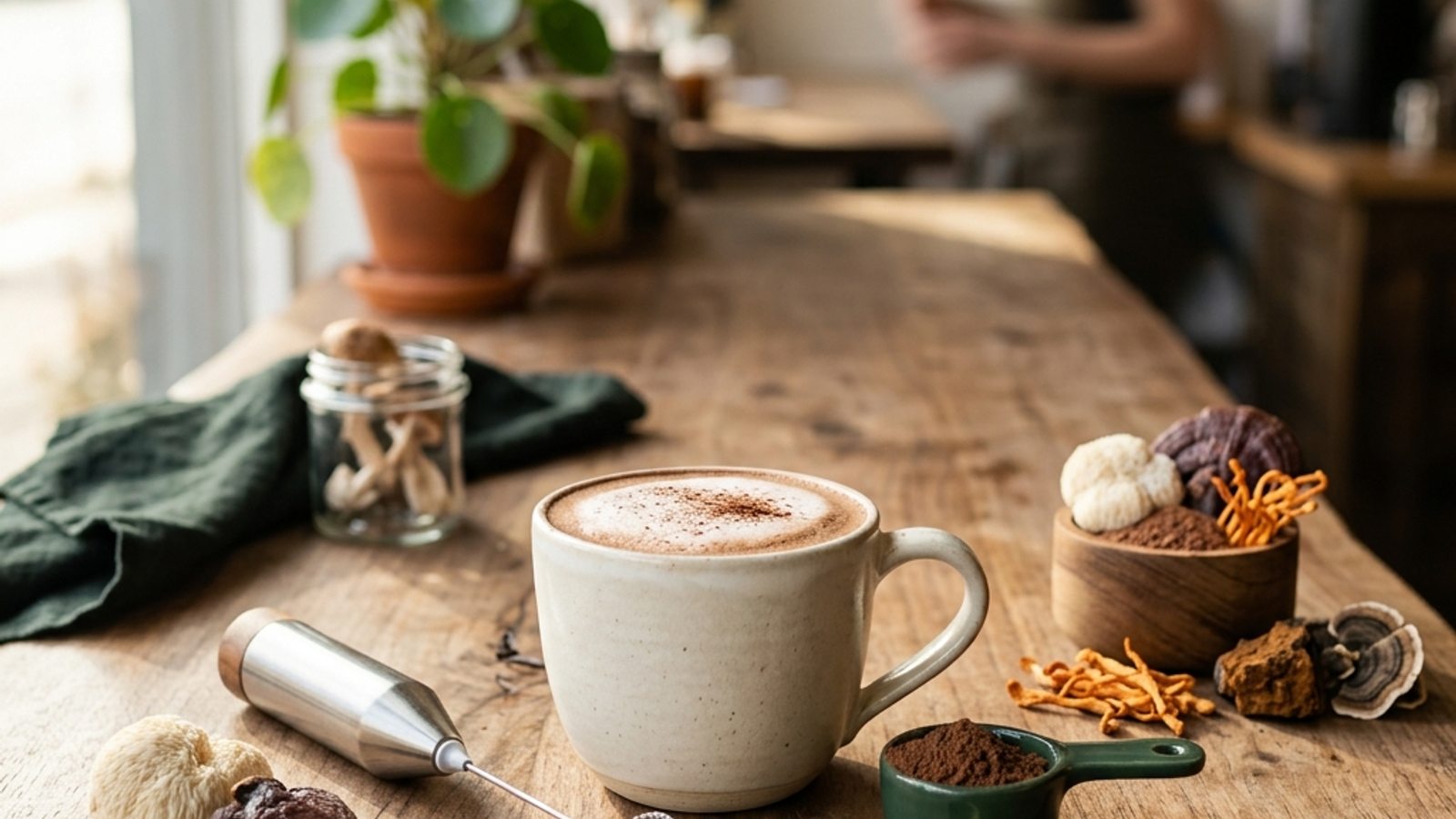
Like its flavor first, with the mushrooms underneath. Ours is White Chocolate Mocha, and the ingredients that shape the taste are cocoa, Ceylon cinnamon, coconut milk powder and natural flavors, sweetened with monk fruit extract and stevia leaf extract. We chose alkalized (Dutch-process) cocoa for a smooth, low-bitterness chocolate flavor that mixes easily. Seven mushrooms sit under that.
On its own it tastes like a white chocolate mocha drink, not like coffee, with the mushrooms underneath rather than up front. Most people who write to us say they don't get the gritty, earthy taste they expected from a mushroom drink, though a sharp palate may still catch an earthy note under the chocolate. What some do notice is a little sediment at the bottom of the cup. That's the mushroom and cocoa solids settling, and it's normal.
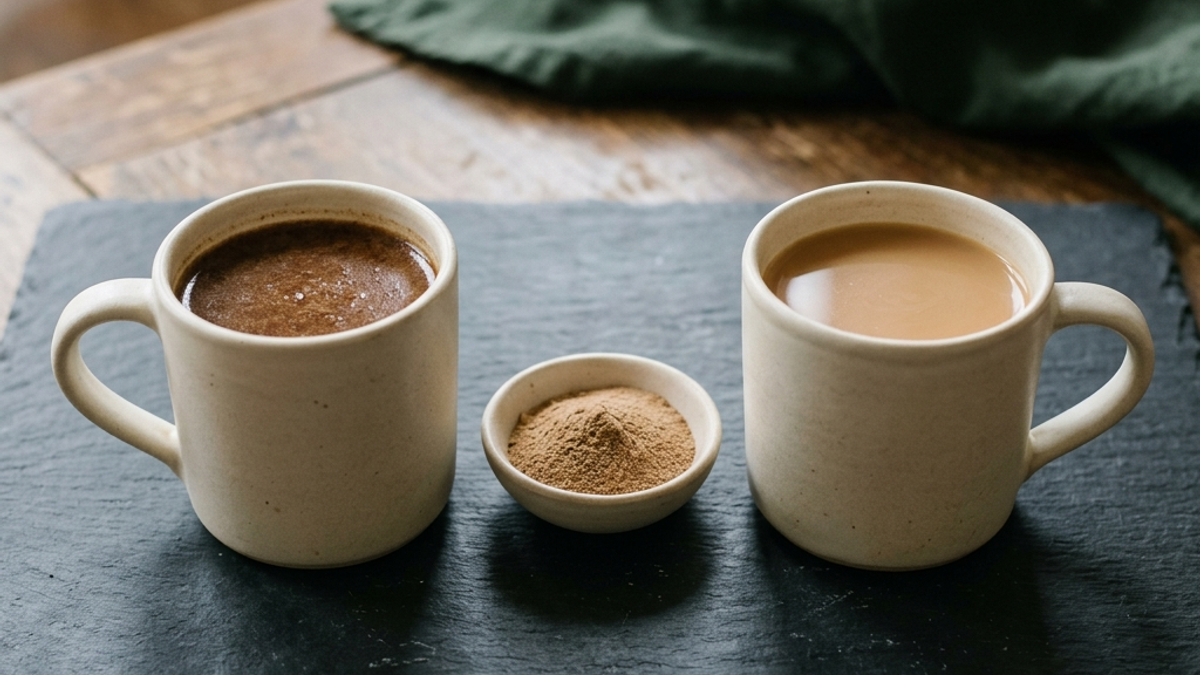
Here's how I drink it. I find ours on the sweeter side, so I stir it into dark coffee with a scoop of collagen, add no sugar, and go heavier on the liquid. I like it best warm, but I also drink it cold in a big glass of water. Plenty of people prefer it the other way: with milk, whipped up with a frother.
The powder has no coffee in it. Your cup might, the way mine does, and then the coffee brings its own caffeine. Our product page describes the blend as behaving "like a flavored creamer" and calls stirring it into morning coffee "what most of us do." So mushroom coffee here means any mushroom powder in a cup, ours stirred into yours included.
Why is my mushroom coffee clumpy?
Because the outside of the powder got wet before the inside did. Some powders form a gel skin as they wet, and that skin seals dry powder inside a pocket (opens in new tab), leaving lumps that are wet outside and dry inside, a 2025 review of instant-powder research explains (Jiang et al., 2025).
Fat makes it worse. It collects on the particle surface as a thin oil film that water struggles to get past (Jiang et al., 2025). Our blend carries coconut milk powder and cocoa, with 0.5 g of fat per scoop on the panel.
Heat isn't the culprit for most powders. High heat can trigger that gel skin in starchy ones such as arrowroot, but moderate warmth helps most powders wet faster, since warmer liquid has lower surface tension and viscosity (Jiang et al., 2025). The trouble is a whole scoop landing dry on a full cup.
Force breaks those pockets open, because hard stirring supplies the shear that tears clumps apart.
- Make a paste first. Add about 2 oz of liquid, stir it smooth, then top up. The latte post walks through it. No study has tested the paste method head to head, but it does what the mechanism asks for, wetting every particle under concentrated stirring before there's enough liquid for a dry pocket to float.
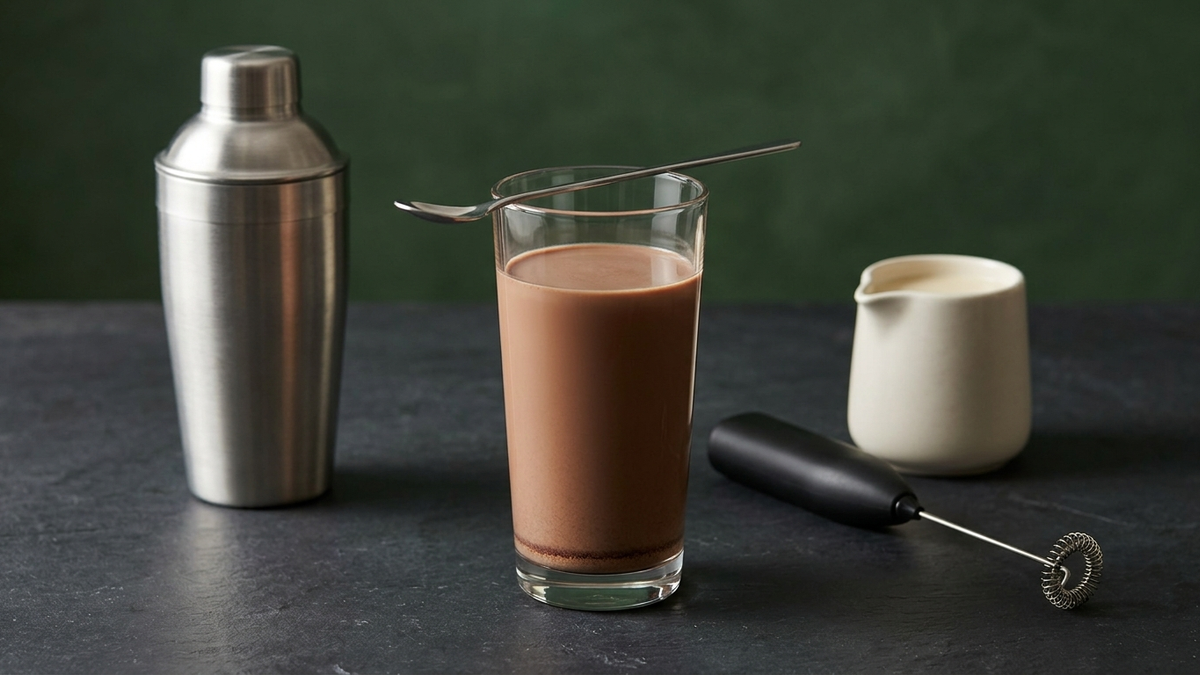
- Shake it if it's cold. Our label's own direction is "Shake well for the best consistency and flavor." For a cold or room-temperature drink, ten seconds in a shaker bottle beats a spoon. Keep hot and warm drinks out of a sealed shaker. Warm liquid can build pressure and spray the cap open (opens in new tab), BlenderBottle warns.
- Froth it if it's hot. A handheld milk frother does the shaker's job in a mug, with no lid to pop.
How do you mix mushroom powder into cold water or milk?
Shake it, and give it longer. Cold works fine. It "just wants a few more seconds of stirring," as our product page puts it. Temperature and stirring trade off against each other more than you'd guess. Warming the water by 4 °C sped rehydration about as much as doubling the stirring speed from 400 to 800 rpm, in one casein-powder study the instant-powder review summarizes (Jiang et al., 2025). Cold liquid gives up the first lever. Lean on the second.
If dry powder floats on top, surface tension is holding up particles that haven't wetted yet, and cold liquid has more of it. Floating sits beside clumping as the usual trouble with powders not built for instant mixing (Jiang et al., 2025). Don't pour the scoop onto ice.
- Start with a little warm liquid. Stir the scoop into about 2 oz of warm water or milk with a spoon or frother until smooth, then add cold milk and ice.
- For a fully cold drink, use a shaker, not a spoon. Cold liquid needs the extra force. Shake it before the ice goes in.
Why is there sediment at the bottom of my cup?
Because some of the scoop is fine solids, and solids settle. Cocoa is the clearest example. Even factory-made cocoa milk drinks have to be engineered against it. More of the stabilizer carrageenan meant less cocoa sediment (opens in new tab) in a 2025 test, while changing the homogenization pressure made no significant difference (Öztürk et al., 2025). A home cup has no stabilizer. Fiber and mushroom solids settle too.
- Shake it for ten seconds if it's cold, or froth it if it's hot.
- Stir again halfway down.
- Finish the last mouthful. It's part of the scoop you measured.
If it feels gritty, those same particles are landing on your tongue instead of at the bottom of the cup. Agitate it harder, move toward the top of the liquid range, or, for a cold drink, blend it.
If there's more foam than you want, you shook in too much air, which the rehydration review lists as the cost of over-vigorous stirring (Jiang et al., 2025). Stir it down with a spoon. Letting it sit works too, but the solids settle while you wait.
How much liquid should one scoop go in?
Our label says 6 to 10 oz, and where you land in that range is the first thing to adjust. Too thick or rich? Go to 10 oz. Thin or watery? Come down toward 6 oz, or swap the water for milk.
Change the liquid before the scoop. One scoop is the serving every dose on our label is measured on, so a half scoop to tame the flavor halves everything else in it too.
Why does my mushroom coffee taste too sweet?
In a pre-sweetened mix, the sweetener is landing stronger than your palate wants, and strength is something you control. Ours uses monk fruit extract and stevia leaf extract, both plant-derived (why those two), and they share a signature. Stevia and monk fruit both produced prominent, long-lasting bitter, metallic and chemical side tastes (opens in new tab) for a panel of 20 tasters trying each sweetener on its own. Their sweetness also registered less often than sugar's, even with every sample pitched to taste equally sweet (Tan et al., 2019). That's the aftertaste.
Stevia gets worse as it concentrates. It tasted more bitter as concentration rose (opens in new tab) for 16 trained tasters (Schiffman et al., 1995), and its sweetness topped out markedly lower than sugar's (opens in new tab) in a 40-person panel (Wee et al., 2018). Stevioside's sweetness even fell once concentration passed its peak (opens in new tab) in a third study (Hellfritsch et al., 2012). Put together, past a point a stronger cup buys more aftertaste than sweetness. So add liquid.
- Go back to water. It's the liquid on our label, and it adds nothing sweet.
- Use the full 10 oz. More liquid lowers the sweetness and the bitter edge together.
- Stir it into black coffee. Coffee adds volume and its own bitterness, though sweetness tends to be the least suppressed taste in a mixture (opens in new tab), according to tests of sugar, salt, acid and quinine combinations (Green et al., 2010). Don't expect the bitterness alone to cancel it.
- If you use milk, make it unsweetened. Many oat and almond milks are sweetened, so check the carton. Lactose-free milk tastes sweeter, too. In chocolate milk, lactose hydrolysis boosted sweetness (opens in new tab) enough to cut the sweetener needed by about a third (Nakamura et al., 2026). If you need lactose-free, an unsweetened soy or almond milk skips that boost. Fat may push the same way, though the evidence is thin. Cutting the fat in a chocolate milk from 4.5% to 0.1% lowered sweetness slightly (opens in new tab) for a trained panel (Pedersen et al., 2023), and the same paper notes two dairy studies where fat masked sweetness instead. Treat cream as a maybe.
- Count ice as extra liquid, not as cold. Temperature had little effect on sweetness when a trained panel tested 16 sweeteners, stevia's among them, at 50 °C and 6 °C (opens in new tab) (Schiffman et al., 2000). Cooling to 5 to 12 °C did reduce sweetness directly (opens in new tab) in another study, but that one tested sugars and artificial sweeteners, not stevia or monk fruit (Green & Nachtigal, 2015). What ice does reliably is dilute the cup as it melts. That lowers sweetness like extra liquid.
- Skip the salt. Sodium suppresses bitterness, and in a drink that's both bitter and sweet, taking the bitterness down left the mix tasting sweeter (opens in new tab) in lab tests (Keast et al., 2001).
Why does stevia leave a bitter aftertaste?
Because stevia's sweet compounds also switch on two of your bitter-taste receptors, TAS2R4 and TAS2R14. Those two stood out in a screen of 25 human bitter receptors (opens in new tab), run in cell assays alongside human tasting (Hellfritsch et al., 2012).
How much of it you notice is personal. Reb A and Reb D, two of stevia's sweet compounds, varied widely in bitterness from person to person (opens in new tab) across 122 genotyped tasters (Allen et al., 2013). Genetics plays a part. How big a part is unsettled. One TAS2R4 variant tracked stevioside bitterness (opens in new tab) in an Italian sample (Risso et al., 2014), yet the same variant did not explain Reb A or Reb D bitterness in those 122 tasters. Strong aftertaste isn't in your head.
Two things soften it.
- More liquid. It dilutes the bitter edge along with the sweetness.
- A chocolate backdrop. Ours already has one. Sweeteners in one panel tasted furthest from sugar in yogurt, and closer in black tea and chocolate milk (opens in new tab), though stevia and monk fruit stayed among the least sugar-like in all three (Tan et al., 2020). Chocolate flavoring cut the bitterness, bitter aftertaste and astringency (opens in new tab) of stevia sweeteners in milk and soymilk, in a small descriptive panel of eight to nine tasters (Kim & Hong, 2023). The effect vanished when the panelists wore nose clips, so it works through smell. Chocolate also made the stevia taste sweeter, so it helps the aftertaste, not a cup that's already too sweet. That study used a flavoring, not cocoa powder, and cocoa brings bitterness and astringency of its own (opens in new tab) (Lesschaeve & Noble, 2005). Don't stir in extra.
How do I hide the earthy mushroom taste?
Milk has early evidence from coffee behind it, a few grains of salt are worth a try, and a smoothie hides it almost completely.
We found no study of a home fix for a mushroom drink's taste. The mushroom-specific research is factory-side. Encapsulating a reishi extract cut its off-flavor and bitterness (opens in new tab) (Chuensun et al., 2024), and blending reishi with yellow tea partly offset its strong fungal note (opens in new tab) (Yan et al., 2026). So each tip below is borrowed.
Milk. Adding cow or oat milk at 30% to medium and dark roast coffee decreased tasters' perception of the coffee's flavors (opens in new tab), which were bitter, roasted and burnt (Cleve et al., 2025). Coffee isn't mushrooms, and earthy isn't the same as bitter. The milks brought flavors of their own while muting the coffee's. Use milk in place of water.
Salt. Salts suppressed bitterness in most of the combinations tested (opens in new tab), with bitter compounds including quinine, urea and caffeine, though the degree varied, and sodium was the active part (Breslin & Beauchamp, 1995). Not every bitter taste responds. In cell tests on four human bitter receptors, salt dampened only one of them (opens in new tab) (Kumar & Behrens, 2024). TAS2R14, one of stevia's two bitter receptors, was largely unaffected, though it was tested with a different bitter compound. The human tests used salt at levels that tasted salty, and there's no human evidence on stevia, cocoa or mushrooms. A few grains, below the point where you taste salt, is an untested kitchen trick. Skip it if the cup already tastes too sweet. Otherwise, try it.
A smoothie. This is where the blend "disappears completely," in our product page's words. Banana, nut butter or frozen fruit bring their own strong flavor and body, which is kitchen logic, not a study.
Coffee. If the earthy note bothers you in water or milk, the creamer route hands the job to the coffee.
Or skip tasting it. If you'd prefer to taste nothing at all, a capsule is the cleaner answer, at the cost of how much fits in one, which our format comparison lays out.
What makes mushroom coffee taste worse?
Three habits, mostly. Each has a one-line fix.
- Boiling it. Heat milk to just below a simmer, not a boil. Boiled milk scorches, and if you're wondering what heat does to the biotics, that question has its own page.
- Sweetening before you taste. Our blend is already sweetened, so try it before reaching for syrup or a sweetened creamer.
- Dry scooping. Our label's direction is one scoop mixed into 6 to 10 oz.
References
- Jiang H, Zhang N, Xie L, Li G, Chen L, Liao Z. A comprehensive review of the rehydration of instant powders: mechanisms, influencing factors, and improvement strategies. Foods. 2025;14(16):2883. PMID: 40870794. https://pubmed.ncbi.nlm.nih.gov/40870794/ (opens in new tab) · doi:10.3390/foods14162883 (opens in new tab)
- BlenderBottle. FAQ: "Can I mix hot liquids in my BlenderBottle® products?" https://www.blenderbottle.com/pages/faq (opens in new tab) (accessed 2026-09-30).
- Öztürk SA, Icyer NC, Karaca AC, Bekiroglu H, Sagdic O, Toker OS. Determination of stabilizer concentration and process effect on the stability of milk-based cocoa beverage. Journal of Food Science. 2025;90(4):e70173. PMID: 40193104. https://pubmed.ncbi.nlm.nih.gov/40193104/ (opens in new tab) · doi:10.1111/1750-3841.70173 (opens in new tab)
- Tan VWK, Wee MSM, Tomic O, Forde CG. Temporal sweetness and side tastes profiles of 16 sweeteners using temporal check-all-that-apply (TCATA). Food Research International. 2019;121:39–47. PMID: 31108762. https://pubmed.ncbi.nlm.nih.gov/31108762/ (opens in new tab) · doi:10.1016/j.foodres.2019.03.019 (opens in new tab)
- Schiffman SS, Booth BJ, Losee ML, Pecore SD, Warwick ZS. Bitterness of sweeteners as a function of concentration. Brain Research Bulletin. 1995;36(5):505–513. PMID: 7712215. https://pubmed.ncbi.nlm.nih.gov/7712215/ (opens in new tab) · doi:10.1016/0361-9230(94)00225-p (opens in new tab)
- Wee M, Tan V, Forde C. A comparison of psychophysical dose-response behaviour across 16 sweeteners. Nutrients. 2018;10(11):1632. PMID: 30400167. https://pubmed.ncbi.nlm.nih.gov/30400167/ (opens in new tab) · doi:10.3390/nu10111632 (opens in new tab)
- Hellfritsch C, Brockhoff A, Stähler F, Meyerhof W, Hofmann T. Human psychometric and taste receptor responses to steviol glycosides. Journal of Agricultural and Food Chemistry. 2012;60(27):6782–6793. PMID: 22616809. https://pubmed.ncbi.nlm.nih.gov/22616809/ (opens in new tab) · doi:10.1021/jf301297n (opens in new tab)
- Green BG, Lim J, Osterhoff F, Blacher K, Nachtigal D. Taste mixture interactions: suppression, additivity, and the predominance of sweetness. Physiology & Behavior. 2010;101(5):731–737. PMID: 20800076. https://pubmed.ncbi.nlm.nih.gov/20800076/ (opens in new tab) · doi:10.1016/j.physbeh.2010.08.013 (opens in new tab)
- Nakamura RP, Meletharayil H, Keefer HRM, Barbano DM, Drake MA. The role of sugar reduction on flavor and acceptance of school lunch chocolate milk. Journal of Dairy Science. 2026;109(5):4988–5003. PMID: 41651348. https://pubmed.ncbi.nlm.nih.gov/41651348/ (opens in new tab) · doi:10.3168/jds.2025-27716 (opens in new tab)
- Pedersen L, Bertelsen AS, Byrne DV, Kidmose U. Sensory interactions between sweetness and fat in a chocolate milk beverage. Foods. 2023;12(14):2711. PMID: 37509802. https://pubmed.ncbi.nlm.nih.gov/37509802/ (opens in new tab) · doi:10.3390/foods12142711 (opens in new tab)
- Schiffman SS, Sattely-Miller EA, Graham BG, Bennett JL, Booth BJ, Desai N, Bishay I. Effect of temperature, pH, and ions on sweet taste. Physiology & Behavior. 2000;68(4):469–481. PMID: 10713286. https://pubmed.ncbi.nlm.nih.gov/10713286/ (opens in new tab) · doi:10.1016/s0031-9384(99)00205-x (opens in new tab)
- Green BG, Nachtigal D. Temperature affects human sweet taste via at least two mechanisms. Chemical Senses. 2015;40(6):391–399. PMID: 25963040. https://pubmed.ncbi.nlm.nih.gov/25963040/ (opens in new tab) · doi:10.1093/chemse/bjv021 (opens in new tab)
- Keast RSJ, Breslin PAS, Beauchamp GK. Suppression of bitterness using sodium salts. CHIMIA. 2001;55(5):441. Not indexed in PubMed. doi:10.2533/chimia.2001.441 (opens in new tab)
- Allen AL, McGeary JE, Hayes JE. Rebaudioside A and rebaudioside D bitterness do not covary with acesulfame K bitterness or polymorphisms in TAS2R9 and TAS2R31. Chemosensory Perception. 2013;6(3):109–117. PMID: 24187601. https://pubmed.ncbi.nlm.nih.gov/24187601/ (opens in new tab) · doi:10.1007/s12078-013-9149-9 (opens in new tab)
- Risso D, Morini G, Pagani L, et al. Genetic signature of differential sensitivity to stevioside in the Italian population. Genes & Nutrition. 2014;9(3):401. PMID: 24705770. https://pubmed.ncbi.nlm.nih.gov/24705770/ (opens in new tab) · doi:10.1007/s12263-014-0401-y (opens in new tab)
- Tan VWK, Wee MSM, Tomic O, Forde CG. Rate-All-That-Apply (RATA) comparison of taste profiles for different sweeteners in black tea, chocolate milk, and natural yogurt. Journal of Food Science. 2020;85(2):486–492. PMID: 31968393. https://pubmed.ncbi.nlm.nih.gov/31968393/ (opens in new tab) · doi:10.1111/1750-3841.15007 (opens in new tab)
- Kim YH, Hong JH. Effects of aroma-taste interaction on the sensory attributes of rebaudiosides in soymilk and milk. Journal of the Science of Food and Agriculture. 2023;103(15):7445–7454. PMID: 37400952. https://pubmed.ncbi.nlm.nih.gov/37400952/ (opens in new tab) · doi:10.1002/jsfa.12824 (opens in new tab)
- Lesschaeve I, Noble AC. Polyphenols: factors influencing their sensory properties and their effects on food and beverage preferences. American Journal of Clinical Nutrition. 2005;81(1 Suppl):330S–335S. PMID: 15640499. https://pubmed.ncbi.nlm.nih.gov/15640499/ (opens in new tab) · doi:10.1093/ajcn/81.1.330S (opens in new tab)
- Chuensun T, Chewonarin T, Laopajon W, Samakradhamrongthai RS, Chaisan W, Utama-Ang N. Evaluation of the phytochemical, bioactive compounds and descriptive sensory of encapsulated lingzhi (Ganoderma lucidum) extracts with combined wall materials for masking effect on the perception of off-flavour and bitterness. Heliyon. 2024;10(21):e40094. PMID: 39559201. https://pubmed.ncbi.nlm.nih.gov/39559201/ (opens in new tab) · doi:10.1016/j.heliyon.2024.e40094 (opens in new tab)
- Yan A, Kong W, Feng X, et al. Blend-brewing optimization of Ganoderma lucidum yellow tea: improving palatability by regulating compound release and nanoparticle assembly. Foods. 2026;15(16):2876. PMID: 42650570. https://pubmed.ncbi.nlm.nih.gov/42650570/ (opens in new tab) · doi:10.3390/foods15162876 (opens in new tab)
- Cleve N, Gonzalez-Estanol K, Khomenko I, et al. Effects of roasting level and milk addition on in vivo aroma release and perception of coffee. Journal of Agricultural and Food Chemistry. 2025;73(22):13792–13808. PMID: 40392949. https://pubmed.ncbi.nlm.nih.gov/40392949/ (opens in new tab) · doi:10.1021/acs.jafc.4c12852 (opens in new tab)
- Breslin PA, Beauchamp GK. Suppression of bitterness by sodium: variation among bitter taste stimuli. Chemical Senses. 1995;20(6):609–623. PMID: 8788095. https://pubmed.ncbi.nlm.nih.gov/8788095/ (opens in new tab) · doi:10.1093/chemse/20.6.609 (opens in new tab)
- Kumar P, Behrens M. Influence of sodium chloride on human bitter taste receptor responses. Journal of Agricultural and Food Chemistry. 2024;72(18):10531–10536. PMID: 38663860. https://pubmed.ncbi.nlm.nih.gov/38663860/ (opens in new tab) · doi:10.1021/acs.jafc.3c08775 (opens in new tab)