Prebiotics vs. Probiotics vs. Postbiotics, in Plain English
Scientifically reviewed by Onur Oncer, B.S. (B.S. Physiology, published researcher).
Short answer
Prebiotics are fibers that feed the good bacteria you already have. Probiotics are live beneficial bacteria you add. Postbiotics are the beneficial compounds those bacteria make, often delivered in a heat-treated, non-live form. They are three links in one chain, and a complete approach supports all three.
If you've ever stood in the supplement aisle squinting at three near-identical words — prebiotic, probiotic, postbiotic — you're not alone. They sound like marketing variations on one idea. They aren't. They're three genuinely different things that do three different jobs, and the confusion is exactly why so many gut products only deliver one piece of the puzzle and call it complete.
As a pharmacist, the gut is the system I keep coming back to, so let me sort these out the way I would for a friend over coffee. A quick ground rule first: this is general education, not medical advice, and nothing here treats or cures a condition. We're talking about supporting normal functions your body already performs.
The one-sentence version
Here's the whole taxonomy in a single mental image. Picture your gut as a garden:
- Prebiotics are the fertilizer — fibers that feed the beneficial bacteria already living in you.
- Probiotics are the gardeners — live beneficial bacteria you add to the soil.
- Postbiotics are the harvest — the beneficial compounds those bacteria produce, which you can also take directly.
Same garden, three different roles. Now let's walk through each one properly, because the details are where the label-reading gets interesting.
Prebiotics: the food
A prebiotic is, simply, food for your good bacteria. Most prebiotics are specific fibers your own body can't digest — they pass through to your large intestine intact, where your resident microbes ferment them and flourish. You don't add any new bacteria with a prebiotic; you feed the community you already have so the helpful members can outcompete the rest.
The everyday version is eating more plants — onions, garlic, oats, legumes. The supplement version is a measured dose of a well-studied fiber. Ours is acacia fiber (gum arabic), a gentle, soluble fiber that tends to be easier on sensitive stomachs than some of the more aggressive prebiotics. In a 2024 randomized, placebo-controlled fiber trial in healthy adults (opens in new tab), a fiber supplement shifted the composition of the gut microbiome over twelve weeks, though the metabolic and inflammatory resilience markers were unchanged. One honest note: that supplement combined acacia with carrot powder, so I read it as support for the prebiotic-fiber principle, not proof of acacia working in isolation. That's the kind of fine print I'd rather show you than hide.
Probiotics: the live bacteria
A probiotic is the part most people already know: live beneficial bacteria you take to add to your gut community. The catch with live cultures is fragility. Heat, stomach acid, and time on a shelf can all reduce how many organisms actually arrive alive and active — which is why "billions of CFU" on a label means less than it sounds if those organisms can't survive the trip.
This is where the strain matters. Ours is the spore-forming Bacillus subtilis DE111®, and the spore form is the point: it's heat-stable, so it can ride out the heat of your morning coffee instead of dying in the cup. In a double-blind, placebo-controlled pilot trial in healthy adults (opens in new tab), the researchers' finding was specific, and because DE111® is a trademarked strain I'll quote them directly rather than paraphrase: "We observed an increase in anti-inflammatory immune cell populations in response to ex vivo LPS stimulation of PBMCs in the DE111 intervention group."
I want to be equally precise about what the same study didn't show, in their own words: "Overall perceived gastrointestinal health, microbiota, and circulating and fecal markers of inflammation (Il-6, sIgA) and gut barrier function (plasma zonulin) were largely unaffected by DE111 intervention, although the study may have been underpowered to detect these differences." So the honest read is an immunomodulatory signal in a small pilot of healthy adults — maintenance and support, not a treatment, and not a sweeping digestion claim.
A common question lands right here: are mushrooms probiotics? They aren't. Mushrooms aren't live bacteria, so they can't be probiotics. Their fiber-like beta-glucans behave more like a prebiotic, feeding the bacteria you already have — so mushrooms and probiotics sit on opposite ends of this chain, not in the same box. (More on exactly where mushrooms fit in a moment.)
Postbiotics: the byproducts
Postbiotics are the newest term of the three and the one that trips people up most — partly because the name sounds like it should mean "after probiotics," and in a sense it does. A postbiotic is a beneficial compound that bacteria produce, or a non-living bacterial cell, often delivered in a heat-treated form. The liberating part, especially for anyone who's been burned by a dead probiotic: a postbiotic doesn't have to be alive to be active. Stability stops being a worry.
Ours is Bifidobacterium animalis subsp. lactis CECT 8145 (BPL1® HT). The "HT" stands for heat-treated — it's the postbiotic, non-live form, which is why we call it a postbiotic and not a probiotic. The research behind this strain is in the metabolic and gut-health lane. In a randomized, double-blind, placebo-controlled trial (opens in new tab), the authors reported — and again, because the BPL1® strain is trademarked, I'll quote them verbatim: "In abdominally obese individuals, consumption of Ba8145, both as viable and mainly as heat-killed cells, improves anthropometric adiposity biomarkers, particularly in women."
Two things are worth pinning down there. First, that "heat-killed" form in the study is precisely our HT postbiotic form — a nice example of the postbiotic idea doing real work. Second, that the effect was strongest in women, which is one of the reasons the microbiome is such an under-served lane for women's health. To stay honest and compliant, I'll be clear about the framing: this is structure/function support for gut and metabolic health, in a specific study population. It is not a weight-loss claim, and we'd never present it as one.
Why all three, working together, matter
This is the formulation point I care about most, and it's where the chain analogy earns its keep. A probiotic alone is one link. Feed it nothing, and even a great strain has less to work with. Skip the postbiotic, and you leave shelf-stable, byproduct-level support on the table. Pre-, pro-, and postbiotics aren't competitors — they're sequential:
- Prebiotic fiber feeds your existing good bacteria.
- Probiotics add live reinforcements.
- Postbiotics deliver the beneficial compounds directly, no survival required.
Support all three and you're covering the food, the gardeners, and the harvest — instead of tossing in a single strain and calling it a gut formula. That's the reasoning behind building the Shroombiosis blend around a full pre/pro/postbiotic stack rather than one fashionable ingredient. The label word for that combination is tri-biotic, and since nobody regulates it, telling a real one from the word comes down to three checks on the panel.
And here's why this chain matters beyond digestion. Your gut and brain are in constant two-way conversation through what researchers call the gut–brain axis; the foundational map of that link is a 2012 review in Nature Reviews Neuroscience (opens in new tab), which describes how the microbes in your gut send signals that reach the brain and influence mood, stress, and how clearly you think. A well-fed, balanced gut is the foundation a lot of daily function quietly sits on — the deeper version is in how your gut fuels real energy and focus, and the lighter five-point version is in five ways mushrooms support gut health, focus, and energy.
Where mushrooms fit (and where they don't)
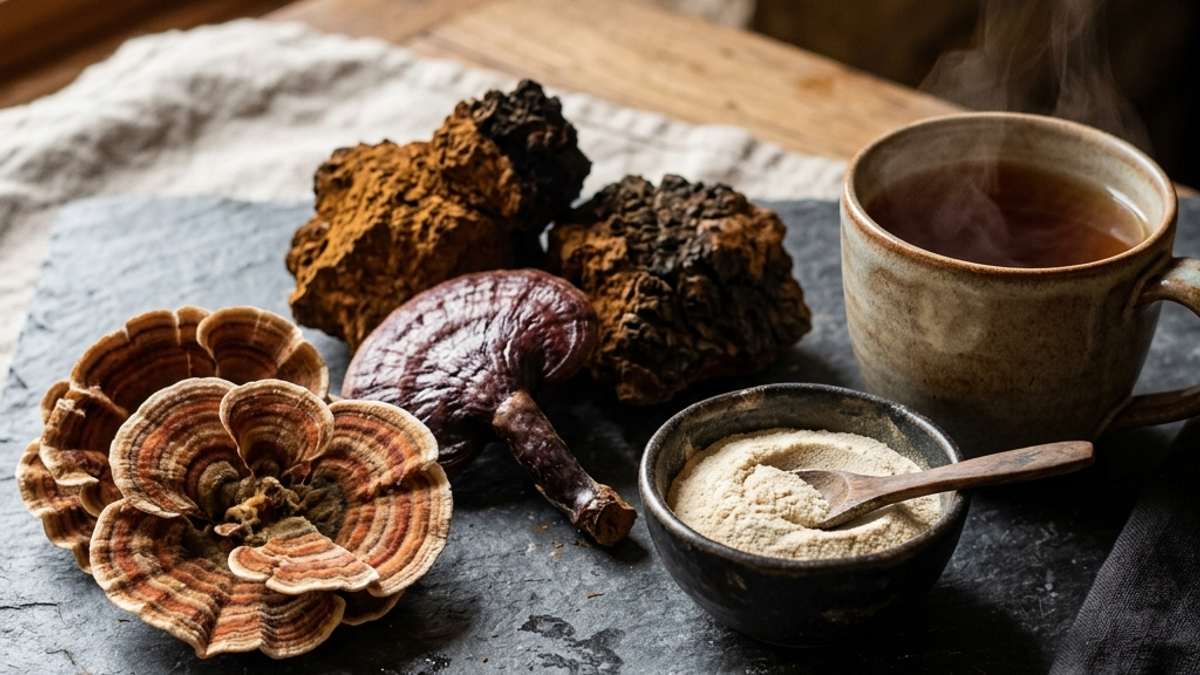
Since this is a mushroom brand, it's fair to ask where the mushrooms land on this map. The answer: they're prebiotic-acting, not probiotic. The beta-glucans in mushrooms like turkey tail and reishi are fiber-like compounds that can feed your resident bacteria — the same end of the chain as acacia fiber, not the live-bacteria end. They complement the biotics; they don't replace them. (If you're curious how a single mushroom is studied at the mechanism level, the pharmacology of lion's mane is a good window into how much dose and extraction decide whether anything works at all.)
How to read this on a label
Now that the three tiers are clear, you can read a gut-supplement label the way a pharmacist does:
- Is the prebiotic a named, dosed fiber — not just "fiber blend"?
- Is the probiotic named to the strain level (a name and a code, like Bacillus subtilis DE111®), and is it heat-stable if you'll add it to a hot drink?
- Is there a postbiotic at all — and if it's heat-treated, does the label say so (often "HT")?
- Is every dose actually printed, or hidden inside a "proprietary blend"?
If label-reading is the part you find genuinely useful, that's a whole skill of its own — how to read a mushroom supplement label goes deeper.
The bottom line
Prebiotics feed, probiotics add, postbiotics deliver — three links in one chain, not three names for the same thing. A complete gut approach supports all three, which is why we built Shroombiosis around the whole chain instead of a single strain. This post is part of our complete guide to gut health, with the broader functional mushrooms guide alongside it, and the full formulation reasoning lives on our science page and in why a probiotic survives a hot cup. Function, not friction — built with your physiology, not against it.
References
Eveleens Maarse BC, Eggink HM, Warnke I, et al. Impact of fibre supplementation on microbiome and resilience in healthy participants: a randomized, placebo-controlled clinical trial. Nutrition, Metabolism & Cardiovascular Diseases. 2024;34(6):1416–1426. PMID: 38499450 (opens in new tab) · doi:10.1016/j.numecd.2024.01.028 (opens in new tab)
Freedman KE, Hill JL, Wei Y, et al. Examining the gastrointestinal and immunomodulatory effects of the novel probiotic Bacillus subtilis DE111. International Journal of Molecular Sciences. 2021;22(5):2453. PMID: 33671071 (opens in new tab) · doi:10.3390/ijms22052453 (opens in new tab)
Pedret A, Valls RM, Calderón-Pérez L, et al. Effects of daily consumption of the probiotic Bifidobacterium animalis subsp. lactis CECT 8145 on anthropometric adiposity biomarkers in abdominally obese subjects: a randomized controlled trial. International Journal of Obesity (Lond). 2019. PMID: 30262813 (opens in new tab) · doi:10.1038/s41366-018-0220-0 (opens in new tab)
Cryan JF, Dinan TG. Mind-altering microorganisms: the impact of the gut microbiota on brain and behaviour. Nature Reviews Neuroscience. 2012;13(10):701–712. PMID: 22968153 (opens in new tab) · doi:10.1038/nrn3346 (opens in new tab)