Your Gut and Your Immune System: The Real Connection
Scientifically reviewed by Onur Oncer, B.S. (B.S. Physiology, published researcher).
Short answer
A large share of your immune system lives in the tissue around your gut, in constant contact with your microbiome. Feeding that microbiome — with prebiotic fiber, live and heat-treated biotics, and the beta-glucans in functional mushrooms — is one of the most direct everyday ways to support healthy immune function. It works over weeks, not in a single dose.
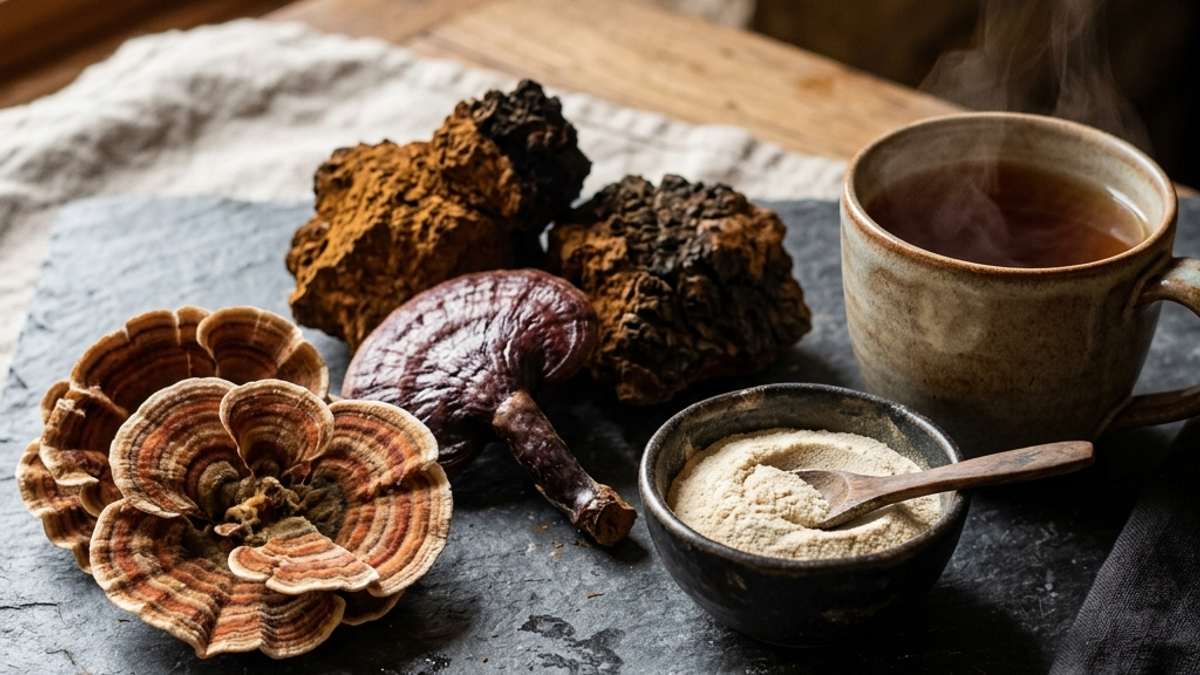
Ask most people where their immune system is, and they'll point to their blood or their glands. The more accurate answer is lower down: a large share of the body's immune tissue sits in and around the gut, in constant conversation with the trillions of microbes living there. Which means one of the most direct, everyday ways to support your immune system isn't a mega-dose of anything — it's taking care of your gut.
A ground rule first, because this is a health topic: nothing here treats, prevents, or cures any illness, and supporting your immune system is not the same as "boosting" it to fight off a specific bug. What the research below describes is structure and function — how a well-fed microbiome and the compounds that support it help your immune system do its normal, everyday job. That's the honest version, and it's the one worth understanding.
Your immune system mostly lives next to your gut
The lining of your gut is one of the busiest immune sites in the body. It's home to gut-associated lymphoid tissue (GALT) — a network of immune cells packed into the gut wall, sampling everything that passes through. A 2024 review in Trends in Immunology (opens in new tab) describes GALT as a hub kept in a constant state of readiness by the resident gut microbiota: the microbes there help sustain the immune structures that produce antibodies like IgA and, in humans, help diversify the body's wider immune cells.
In plain terms, your gut bacteria and your immune system are in a daily working relationship — and the health of one is tied to the health of the other. That's the whole reason "support your gut" and "support your immune system" end up being closer to the same sentence than most people realize.
A well-fed microbiome is the foundation
If the gut is where the action happens, the microbiome is the workforce — and like any workforce, it needs feeding. That's what prebiotic fiber does. The acacia fiber (gum arabic) in our blend is a prebiotic: a fiber your body can't digest but your beneficial bacteria can. A dose-response trial in healthy adults (opens in new tab) found that gum arabic significantly increased beneficial Bifidobacteria and Lactobacilli, with an optimal effect around 10 g a day. Feeding those populations is step one, because they're the same community sitting against all that immune tissue. For scale, the acacia in our blend is 750 mg per 8.3 g scoop, well under that 10 g figure, so count it as a prebiotic top-up to the fiber in your food, not a trial-level dose.
Does feeding the microbiome connect back to immune function? The honest answer is that the bridge is real but built from more than one study. A 2022 review and meta-analysis (opens in new tab) found that prebiotic and synbiotic fiber can modulate immune function — increasing natural-killer-cell activity, one marker of a healthy immune response. We frame that carefully: it's evidence that fiber-fed microbiome support and immune function travel together, not proof that any single scoop does a specific thing.
The biotics: adding and finishing the job
Prebiotic fiber feeds the bacteria you have; probiotics add more, and postbiotics deliver the beneficial compounds bacteria produce. Our blend includes all three. The probiotic, Bacillus subtilis DE111®, is a heat-stable spore that survives a hot drink and stomach acid. In a double-blind trial in healthy adults (opens in new tab), DE111® shifted the immune profile toward more anti-inflammatory immune cells over four weeks — the study was honest that broader gut-microbiota markers were largely unchanged in that small pilot, so we read it as an immune-support signal, not a gut-overhaul claim.
Zoom out to the category and a meta-analysis of 26 randomized trials (opens in new tab) found that probiotics support a healthy intestinal barrier and help modulate immune activity — the barrier being the literal wall between your gut contents and that immune tissue. Rounding out the trio, the postbiotic Bifidobacterium animalis subsp. lactis CECT 8145 (BPL1® HT) delivers beneficial compounds in a heat-treated form built to survive the cup. Together they're the full pre/pro/postbiotic story we break down here.
Where the mushrooms come in: beta-glucans
Here's the part that makes a mushroom blend, rather than a plain fiber supplement, interesting for this topic. Several of our mushrooms — turkey tail, reishi, and chaga — are rich in beta-glucans, compounds that pull double duty. First, they act like prebiotic fiber, feeding the microbiome we just talked about. Second, beta-glucans are recognized directly by receptors on your immune cells. A review of how beta-glucans interact with the immune system (opens in new tab) describes them as "biological response modifiers" that bind receptors such as Dectin-1 and CR3 on macrophages and natural-killer cells — in effect, a molecule your immune system is built to notice.
Turkey tail is the most-studied of the three: a Phase 1 human trial (opens in new tab) found its extract was well tolerated and associated with faster lymphocyte recovery and increased natural-killer-cell activity — we cite that strictly for the immune-function signal, nothing more. Reishi has its own human data: a 2023 placebo-controlled trial in healthy adults (opens in new tab) gave a reishi beta-glucan for 84 days and measured higher T-cell and natural-killer-cell counts, plus higher IgA, versus placebo. That "in healthy adults" matters — it's exactly the everyday, structure-and-function context this whole post is about, not a study in a sick population. For the molecule itself, we wrote a full primer on beta-glucans in mushrooms, and a deeper look at turkey tail and immunity. For the whole picture — which mushrooms, what beta-glucans do, and where the gut fits — see our complete guide to mushrooms for immune support.
What has to be true for any of this to matter
Two honest caveats. First, consistency: the gut–immune relationship responds to a steady daily supply of fiber and the compounds that feed it, over weeks — not a one-time dose. Second, framing: "supports a healthy immune system" is a real, defensible thing; "boosts your immunity to fight off colds and flu" is not, and any brand that tells you a mushroom does that is selling past the evidence. We won't. Dose and quality also decide whether any of this does anything — which is why we publish every milligram on the label instead of hiding it in a proprietary blend.
The bottom line
Your immune system and your gut aren't two separate projects — a large part of your immune tissue lives against your microbiome, and feeding that microbiome is one of the most direct daily ways to support healthy immune function. That's the logic behind the Shroombiosis blend: prebiotic acacia fiber, a spore probiotic and a heat-treated postbiotic, and seven beta-glucan-rich, dual-extracted fruiting-body mushrooms — the gut and the immune angle built into the same cup, caffeine-free. If you want the wider category picture, this is part of our complete guide to functional mushrooms; for the mushroom-by-mushroom view, start with our guide to which mushrooms support the immune system.
References
Bemark M, Pitcher MJ, Dionisi C, Spencer J. Gut-associated lymphoid tissue: a microbiota-driven hub of B cell immunity. Trends in Immunology. 2024;45(3):211–223. PMID: 38402045 (opens in new tab) · doi:10.1016/j.it.2024.01.006 (opens in new tab)
Calame W, Weseler AR, Viebke C, Flynn C, Siemensma AD. Gum arabic establishes prebiotic functionality in healthy human volunteers in a dose-dependent manner. British Journal of Nutrition. 2008;100(6):1269–1275. PMID: 18466655 (opens in new tab) · doi:10.1017/S0007114508981447 (opens in new tab)
Williams LM, Stoodley IL, Berthon BS, Wood LG. The effects of prebiotics, synbiotics, and short-chain fatty acids on respiratory tract infections and immune function: a systematic review and meta-analysis. Advances in Nutrition. 2022;13(1):167–192. PMID: 34543378 (opens in new tab) · doi:10.1093/advances/nmab114 (opens in new tab)
Freedman KE, Hill JL, Wei Y, et al. Examining the gastrointestinal and immunomodulatory effects of the novel probiotic Bacillus subtilis DE111. International Journal of Molecular Sciences. 2021;22(5):2453. PMID: 33671071 (opens in new tab) · doi:10.3390/ijms22052453 (opens in new tab)
Zheng Y, Zhang Z, Tang P, et al. Probiotics fortify intestinal barrier function: a systematic review and meta-analysis of randomized trials. Frontiers in Immunology. 2023;14:1143548. PMID: 37168869 (opens in new tab) · doi:10.3389/fimmu.2023.1143548 (opens in new tab)
Akramiene D, Kondrotas A, Didziapetriene J, Kevelaitis E. Effects of beta-glucans on the immune system. Medicina (Kaunas). 2007;43(8):597–606. PMID: 17895634 (opens in new tab)
Torkelson CJ, Sweet E, Martzen MR, et al. Phase 1 clinical trial of Trametes versicolor in women with breast cancer. ISRN Oncology. 2012;2012:251632. PMID: 22701186 (opens in new tab) · doi:10.5402/2012/251632 (opens in new tab)
Chen SN, Nan FH, Liu MW, Yang MF, Chang YC, Chen S. Evaluation of immune modulation by β-1,3;1,6 D-glucan derived from Ganoderma lucidum in healthy adult volunteers, a randomized controlled trial. Foods. 2023;12(3):659. PMID: 36766186 (opens in new tab) · doi:10.3390/foods12030659 (opens in new tab)