What Is a Functional Mushroom Blend? A Plain-English Primer
Scientifically reviewed by Dr. Danielle Oncer, PharmD (pharmacology, dosing & safety).
Short answer
A functional mushroom blend is a supplement built from mushrooms studied for how they support the body — focus, stamina, calm, gut and immune health — rather than mushrooms grown for the dinner plate. A good one uses dual-extracted fruiting body, lists every dose on the label, and often pairs the mushrooms with superfoods and pre/pro/postbiotics so the whole system works together.
A quick note before we start: this is education, not medical advice, and nothing here is meant to diagnose, treat, or cure anything. The goal is simpler — to give you the vocabulary of this category so you can shop it with clear eyes.
If you have spent any time in the wellness aisle lately, you have seen the phrase functional mushroom blend on everything from lattes to gummies to powders like ours. It sounds technical, a little buzzy, and not very specific. So let's define it properly, in plain English, and then walk through what is actually inside a well-built one — one honest line per ingredient, no hype.
This post is the front door to our complete guide to functional mushrooms. If you want the category map before the deep dives, you are in the right place.
Functional vs. culinary mushrooms
Start with the split that the whole category rests on.
- Culinary mushrooms are grown to be eaten — white buttons, creminis, portobellos, shiitake on a plate. You choose them for flavor, texture, and a bit of nutrition, the same way you choose any vegetable.
- Functional mushrooms are grown and processed for their bioactive compounds and taken in concentrated doses for a specific kind of support. The compounds doing the work — beta-glucans, triterpenes, and others — sit locked inside tough fungal cell walls, which is why functional mushrooms are usually extracted rather than just dried and milled.
The line isn't a wall. Lion's mane, for instance, is a genuine gourmet mushroom you can sauté and a studied extract you can dose. "Culinary vs. functional" is about intent and preparation, not two separate kingdoms of fungus.
What "functional" actually means
"Functional" is doing real work in that phrase, and it is worth being precise. It is short for studied for how it supports a normal function of the body — focus, energy, calm, digestion, immune balance. That is a structure/function idea: supporting systems you already run, not acting on a disease.
This matters for honesty as much as for the law. A functional mushroom is a food-derived ingredient, not a drug. It will not cure anything, and any brand telling you a mushroom treats a named condition has left the evidence — and the rules — behind. The accurate framing is always supports, promotes, helps maintain. If that sounds modest, good: modest and true beats bold and false.
How the compounds get out: extraction and the fruiting body
Two words separate a real functional extract from expensive mushroom dust, and you will see them all over our label.
Fruiting body is the mushroom you would recognize above ground — the part where many of the studied compounds concentrate. The common alternative is mycelium grown on grain: the root-like network cultivated on a grain substrate, then dried and milled with that grain, which can leave a lot of starchy filler in the finished powder. Neither is evil, but the label should tell you which one you are buying. (We go deep on this in fruiting body vs. mycelium supplements.)
Dual extraction is how you actually liberate the compounds. Many functional molecules — the beta-glucans especially — are trapped in fungal cell walls, and a review of how beta-glucans interact with immune-cell receptors (opens in new tab) (Akramiene et al., 2007) treats them as exactly the kind of active fractions worth freeing. Water pulls the water-soluble compounds; alcohol pulls the alcohol-soluble ones. Do both and you capture more of what you came for. (That review is general background on the mechanism, not a clinical trial — I want to be precise about which evidence does which job. More on the method in dual extraction explained.)
Our stance, stated plainly: dual-extracted fruiting body, with every dose on the label. That second half is the one most brands skip, and it is the heart of how to read a mushroom supplement label.
The 7 mushrooms — one honest line each
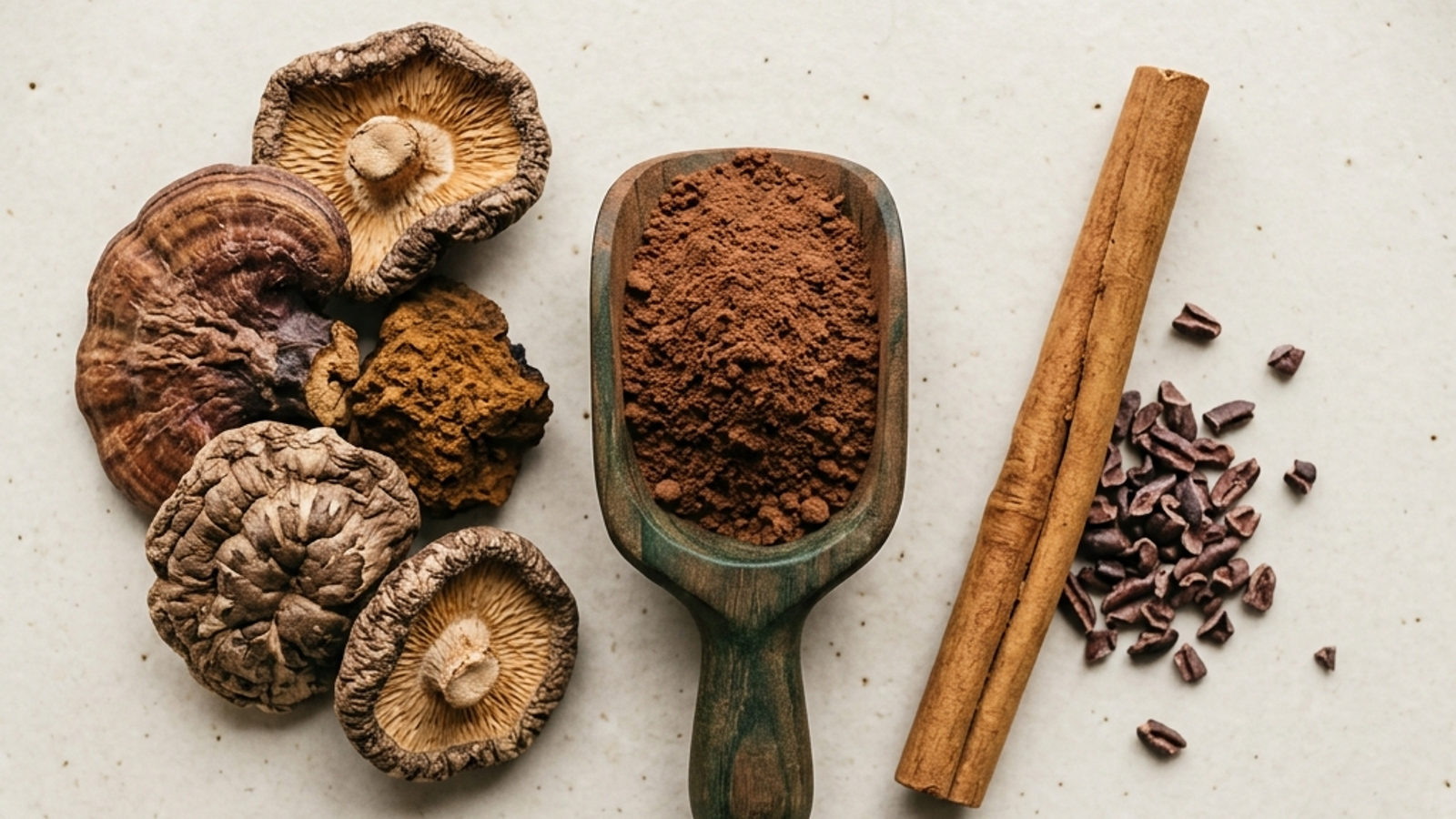
Here is the core of the blend, with the real per-serving dose and a single, sober sentence about what each is studied for. Human evidence and animal/lab (preclinical) evidence are flagged separately, because that distinction is the whole game.
- Lion's mane — 1,000 mg. Studied in humans for focus and memory support: a 2009 placebo-controlled trial (opens in new tab) (Mori et al., 2009) used 3,000 mg/day and a 2023 pilot in healthy young adults (opens in new tab) (Docherty et al., 2023) used 1.8 g/day, so the clinical range sits around 1,000–3,000 mg/day. (The full mechanism is in lion's mane pharmacology, and the work-and-study angle in lion's mane for focus at work.)
- Cordyceps — 1,000 mg. Studied for stamina and endurance: a randomized, double-blind trial (opens in new tab) (Hirsch et al., 2016) found that several weeks of a Cordyceps militaris–containing blend improved tolerance to high-intensity exercise. (More in cordyceps for energy.)
- Reishi — 500 mg. Traditionally used to support a sense of calm and a healthy stress response. Reishi is the classic "evening" mushroom; we frame it on its long traditional use rather than overstating the human trial evidence. (See reishi for calm and stress.)
- Turkey tail — 500 mg. Studied for gut flora: a randomized clinical trial in healthy volunteers (opens in new tab) (Pallav et al., 2014) found that its polysaccharopeptide acts as a prebiotic, shifting the gut microbiome's composition. (More in turkey tail's beta-glucans.)
- Chaga — 500 mg. Valued for its antioxidant compounds; a 2023 analysis of chaga sclerotia (opens in new tab) (Zhang et al., 2023) measured its polyphenols and antioxidant capacity — useful background, but lab work, not a human trial. (We separate the lore from the data in chaga: traditional claims vs. what's studied.)
- Poria — 500 mg. A staple of traditional formulas, used to support digestion and a calm, balanced mood; the modern human evidence is thin, so we keep this one squarely in the traditional-use lane. (More in what poria actually is.)
- Tiger's milk — 300 mg. A traditionally used, beta-glucan-rich functional mushroom; like poria, it earns its place on heritage and composition rather than a stack of human trials, and we say so. (Two unrelated fungi share that common name, so here is which tiger's milk is actually in the blend.)
Notice what these doses make possible. Because each milligram is printed, you can check lion's mane against its studied range yourself — something a "2,000 mg proprietary blend" can never let you do. That is the difference between a number you can evaluate and one you can only admire, and it is why underdosed mushroom supplements are so common and so hard to spot.
The 3 superfoods — flavor and fats
Mushrooms don't work in a vacuum, so the blend adds three food-based ingredients that earn their spots (the prebiotic fiber sits with the biotics in the next section, where it belongs).
- Cacao — 500 mg. This is a flavor and ritual choice — the smooth cocoa base of the drink. Ours is alkalized for taste, so we let it carry the experience, not a health claim, and let the mushrooms and biotics carry the function.
- Ceylon cinnamon — 500 mg. A warm, aromatic spice that supports healthy glucose metabolism as part of a balanced routine — and, honestly, makes the cup taste better.
- Coconut milk powder — 1,000 mg. Healthy fats that round out the texture and help with the absorption of fat-soluble mushroom compounds — a small pharmacology decision hiding in a creamy mouthfeel.
The pre/pro/postbiotic layer — why the gut is in the formula
Here is the part that makes this a system rather than a pile of mushrooms. Some mushroom compounds are processed by your gut microbiota before they reach circulation, which means the state of your gut quietly shapes how much you actually get from the mushrooms. So the blend supports that gut directly with three layers:
- A prebiotic — acacia fiber, 750 mg. A gentle fiber that feeds the beneficial bacteria you already have.
- A probiotic — DE111® (Bacillus subtilis), 1 Billion CFU. A spore-forming probiotic; spore-forming strains are generally more robust to heat, which helps it hold up in a hot drink. Laboratory work on the DE111® strain (opens in new tab) (Mazhar et al., 2023) characterizes how it withstands gastric (stomach-acid) transit. (That is in-vitro and in-silico work, not a clinical outcome trial — preclinical, and labeled as such.) DE111® is a registered trademark of Deerland Probiotics & Enzymes, used under license.
- A postbiotic — BPL1® HT (Bifidobacterium animalis subsp. lactis CECT 8145), 10 Billion cells. A heat-treated postbiotic included for gut support. BPL1® is a registered trademark used under license.
Prebiotic feeds, probiotic populates, postbiotic supports — three roles, one gut. That is the logic behind building the mushrooms and the biotics into the same scoop, which we unpack in mushrooms, gut health, focus, and energy.
So what is a functional mushroom blend, really?
Strip away the marketing and it is this: a curated set of mushrooms studied for how they support normal body functions, extracted properly, dosed transparently, and paired with the superfoods and biotics that help your body actually use them. Seven mushrooms, three superfoods, three biotic layers — caffeine-free, dual-extracted fruiting body, every milligram on the label.
The category has earned some skepticism, mostly from blend totals that hide underdosing and "mushroom" labels that don't say fruiting body or mycelium. The fix isn't outrage; it's literacy — and now you have the vocabulary for it. If you want to put it to work, start with how to read a mushroom supplement label, or see how we built the blend with every dose in plain sight.
References
- Akramiene D, Kondrotas A, Didziapetriene J, Kevelaitis E. Effects of beta-glucans on the immune system. Medicina (Kaunas). 2007;43(8):597–606. PMID: 17895634 (opens in new tab)
- Mori K, Inatomi S, Ouchi K, Azumi Y, Tuchida T. Improving effects of the mushroom Yamabushitake (Hericium erinaceus) on mild cognitive impairment: a double-blind placebo-controlled clinical trial. Phytotherapy Research. 2009;23(3):367–372. PMID: 18844328 (opens in new tab) · doi:10.1002/ptr.2634 (opens in new tab)
- Docherty S, Doughty FL, Smith EF. The acute and chronic effects of lion's mane mushroom supplementation on cognitive function, stress and mood in young adults: a double-blind, parallel groups, pilot study. Nutrients. 2023;15(22):4842. PMID: 38004235 (opens in new tab) · doi:10.3390/nu15224842 (opens in new tab)
- Hirsch KR, Smith-Ryan AE, Roelofs EJ, Trexler ET, Mock MG. Cordyceps militaris improves tolerance to high-intensity exercise after acute and chronic supplementation. Journal of Dietary Supplements. 2017;14(1):42–53. PMID: 27408987 (opens in new tab) · doi:10.1080/19390211.2016.1203386 (opens in new tab)
- Pallav K, Dowd SE, Villafuerte J, et al. Effects of polysaccharopeptide from Trametes versicolor and amoxicillin on the gut microbiome of healthy volunteers: a randomized clinical trial. Gut Microbes. 2014;5(4):458–467. PMID: 25006989 (opens in new tab) · doi:10.4161/gmic.29558 (opens in new tab)
- Zhang Y, Liu Q, Sun Y, Jiang J. Inonotus obliquus sclerotia epidermis were different from internal tissues in compound composition, antioxidant activity, and associated fungi. FEMS Microbiology Letters. 2023;370:fnad126. PMID: 38017614 (opens in new tab) · doi:10.1093/femsle/fnad126 (opens in new tab)
- Mazhar S, Khokhlova E, Colom J, Simon A, Deaton J, Rea K. In vitro and in silico assessment of probiotic and functional properties of Bacillus subtilis DE111®. Frontiers in Microbiology. 2023;13:1101144. PMID: 36713219 (opens in new tab) · doi:10.3389/fmicb.2022.1101144 (opens in new tab)