How to Choose a Transparent Mushroom Supplement
Scientifically reviewed by Dr. Danielle Oncer, PharmD (pharmacology, dosing & safety).
Short answer
A transparent mushroom supplement prints the dose of every mushroom on the label, not one combined blend total. Look for four things: per-mushroom milligrams, the part used, a beta-glucan figure, and a third-party Certificate of Analysis you can open. Those four let you do the math yourself.
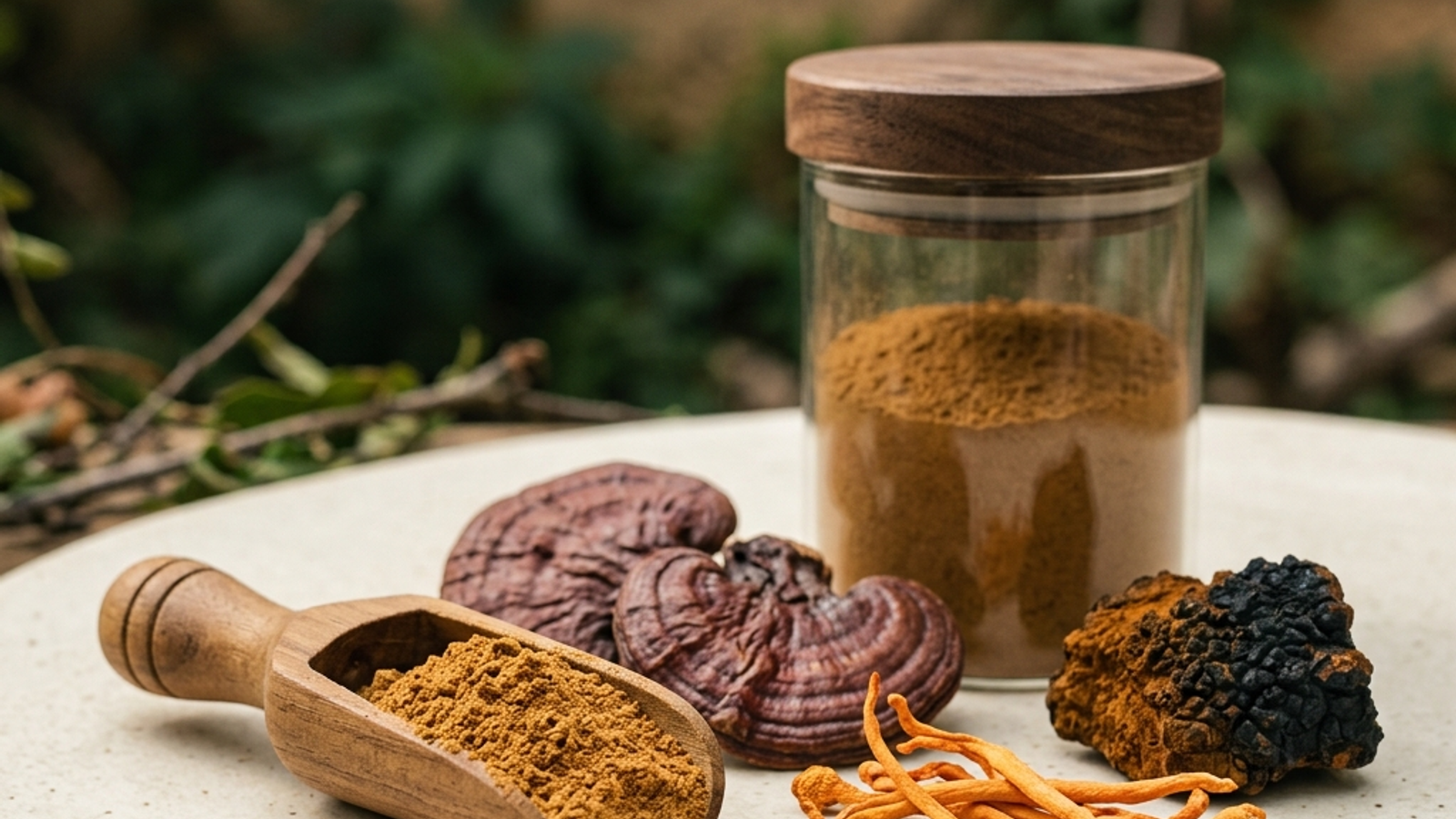
If you've shopped for a functional mushroom product, you've met two kinds of label. One lists every ingredient with its own milligram amount. The other lists an impressive roster of mushrooms under a single combined number — "Proprietary Blend, 2,000 mg" — and asks you to assume the split is sensible. The first label hands you a calculator. The second hands you a feeling.
This post is about why the first kind matters, what specifically to look for, and how to vet a brand in a couple of minutes. It's also, honestly, the promise this company is built on: every dose on the label. So let me show you the reasoning rather than just asserting it — because if the argument is good, you should be able to apply it to anyone, including us.
The proprietary-blend math
When a product discloses only a blend total, the brand isn't required to tell you how much of each ingredient is inside. That one rule is the root of most label confusion. Picture a "2,000 mg, 7-mushroom blend." It could be a thoughtfully balanced formula — or it could be roughly 1,880 mg of the cheapest mushroom and about 20 mg each of the other six. Both versions print the same on the label.
Ingredients are listed in descending order by weight, so the order hints at what's most abundant. But "hints at" is doing a lot of work. The order tells you which mushroom is biggest; it tells you nothing about whether the second, third, or seventh ingredient is present in an amount that could plausibly do anything.
Here's why that's not an abstract worry. Lion's mane is the cleanest example we have, because there's a human trial with a stated dose. In a 2009 double-blind, placebo-controlled clinical trial (opens in new tab) in Phytotherapy Research, older adults took 3,000 mg per day of lion's mane fruiting-body powder, and the broader clinical range for lion's mane sits around 1,000–3,000 mg per day (Mori et al., 2009). Now hold that against a "1,500 mg proprietary blend" that lists lion's mane among six other mushrooms. Even if the entire 1,500 mg were lion's mane, it would barely reach the bottom of that range — and it isn't, because six other ingredients are sharing the jar.
The point isn't that anyone is lying. It's a math problem, and you can only solve it when the brand gives you the inputs. For comparison, our own label lists lion's mane at 1,000 mg and cordyceps at 1,000 mg per serving as their own line items — numbers you can check against the literature instead of infer. (We walk through the underdosing trap in detail in how to spot an underdosed mushroom supplement, and the broader label-reading skill in how to read a mushroom supplement label.)
Per-ingredient milligrams: the number that actually matters
A blend total answers "how much powder is in here?" A per-ingredient breakdown answers the question you actually care about: "how much of the thing I want is in here?"
Those are different questions, and only one of them helps you. A transparent label prints the milligrams of each mushroom, so you can line each one up against what the research used. It's the difference between a number you can evaluate and a number you can only admire.
This is also where dosing literacy pays off. Doses aren't one-size-fits-all — they vary by mushroom and by goal — so the value of a per-ingredient label is that it lets you judge, rather than asking you to trust a single sum. If you want the practical ground rules, the functional mushroom dosing primer covers it, and what a functional mushroom blend actually is sets the category context.
Beta-glucan disclosure: proof the active fraction is really there
Milligrams tell you how much material is in the jar. They don't, by themselves, tell you how much of the studied compound came along for the ride. That's the next layer of transparency, and it's the one most brands skip.
Beta-glucans are the polysaccharides most consistently associated with functional mushrooms' studied activity. A widely cited review of how beta-glucans interact with the immune system (opens in new tab) describes them binding specific immune-cell receptors — dectin-1 and complement receptor 3 among them — which is why formulators treat beta-glucan as the fraction worth measuring rather than guessing at (Akramiene et al., 2007). That's a mechanism review, so we hold it at that level: it explains why beta-glucan is the number to watch, not a promise about any single product.
Here's the catch that makes disclosure matter. A label can advertise "polysaccharides," and that figure can be inflated by starchy filler — especially in mycelium grown on grain, where the grain's own starch is a polysaccharide too. Beta-glucan content is the more honest number, because it points at the active fraction specifically rather than at "carbohydrates, broadly." A brand that publishes beta-glucan is telling you the good stuff was measured. A brand that quotes only total polysaccharides, or stays quiet entirely, is leaving you to hope. (For the chemistry of why these compounds need to be liberated from the cell wall at all, see what beta-glucans are and why they matter and dual extraction explained.)
Fruiting body vs. mycelium: what's physically in the jar
The next detail changes the actual contents of the powder, not just how it's described.
- Fruiting body is the mushroom you'd recognize above ground — the part where many of the studied compounds concentrate.
- Mycelium is the root-like network the fungus grows through its substrate. Grown on grain (a common, low-cost method) and then dried and milled with that grain, the finished powder can carry meaningful starchy filler. The mushroom content is real; so is the grain riding along with it.
Neither is automatically wrong, and mycelium has legitimate uses. But the composition genuinely differs. A 2025 study comparing the two parts noted the higher beta-glucan content of fruiting bodies compared with vegetative mycelium as a defining difference between them (Schäfer et al., 2025 (opens in new tab)) — that particular paper is an animal feeding study, so we cite it only for the chemical comparison, not for any human effect. The takeaway is narrow and fair: the part of the mushroom you buy affects how much active fraction you get, which is exactly why the label should say which part it is.
The real problem is silence. If a label doesn't tell you fruiting body, mycelium, or a mix, that absence is itself information. Our blend is dual-extracted fruiting body, with no mycelium-on-grain filler — and we say so plainly, because the word "mushroom" on the front of a package can mean two quite different things in the powder. The full breakdown lives in fruiting body vs. mycelium, and the related question of extract strength is covered in mushroom extract ratios and "10:1," explained.
A Certificate of Analysis you can actually open
If you only check one thing, check this. A Certificate of Analysis (COA) is an independent lab report on a specific batch. A good one confirms the mushroom is what it claims to be (identity), how much active compound is present (potency), and that it passed screening for heavy metals and other contaminants.
That last part isn't paranoia. Mushrooms are efficient accumulators of whatever is in their growing environment, metals included. Analytical work on wild edible mushrooms — measured, fittingly, by the same kind of spectroscopy our founder published in — has found species that bioaccumulate cadmium and mercury from their substrate (opens in new tab), sometimes to levels worth flagging (Širić et al., 2017). Cultivated, controlled production is a different and cleaner situation than wild foraging — but the principle is exactly why batch-specific testing exists, and why a published COA isn't a luxury.
The operative phrase is you can actually open it. "Third-party tested" printed on a carton is a claim. A COA you can read is evidence. One honest nuance: testing and certification aren't the same thing. A brand can be diligently batch-testing while formal certification is still in progress — both are fine, as long as the brand tells you which is which. (Ours is exactly that situation, and we say so.) For the full picture, see third-party testing and COAs, explained.
Claims that stay reasonable
The last thing to read is the language itself. Reasonable products use structure/function claims — "supports focus," "supports a healthy stress response," "supports gut flora" — describing how an ingredient supports a normal function of the body. What should make you pause is disease language: anything promising to treat, cure, prevent, or reverse a named condition. That phrasing isn't permitted for a dietary supplement, and seeing it tells you how carefully (or carelessly) the rest of the label was written.
The tone of the claims previews the tone of the formulation. A brand that overpromises in words is, in our experience, more likely to have cut corners in milligrams. Calm, specific claims tend to travel with calm, specific doses.
How to vet a brand in two minutes
Put it together and you have a fast, repeatable checklist. For any functional mushroom product, look for:
- Per-ingredient milligrams — the dose of each mushroom, not a blend total.
- Beta-glucan content — the active fraction stated, not just "polysaccharides."
- A third-party COA you can open — batch-specific, covering identity, potency, and contaminants.
- Fruiting body or mycelium, stated — so you know what's physically in the jar.
- Reasonable structure/function claims — support language, not cure-all promises.
If a product answers all five, you're looking at a brand that respects your ability to evaluate it. If it hides behind a blend total and bold health claims, put it back down.
One extra habit worth adding, since so many of these products are sold as "mushroom coffee": check for caffeine. Many mushroom coffees are exactly what they sound like — real coffee with mushroom extracts added — so they carry caffeine and, often, the afternoon crash with it. Ours is a deliberate departure: a caffeine-free mix-in you add to whatever you're already drinking, designed to support steady energy without a stimulant rather than borrow it. If that distinction is new to you, built energy vs. borrowed energy and a caffeine-free mushroom coffee alternative are the right next reads.
Why we made this the brand promise
None of this requires a chemistry degree — just five questions and the willingness to put a jar down when it can't answer them. We built the whole company around making those five answers easy: every mushroom listed with its own milligram amount, fruiting-body sourcing stated, beta-glucan treated as the number that matters, and a batch test we'd rather complete properly than rush.
That isn't a marketing flourish. It's the only version of this business worth running — because the alternative is asking you to trust a sum you can't check. If you want to see what "every dose on the label" looks like in practice, that's how we built the blend. This post is part of our broader mushroom supplement buyer's guide, and mushrooms for immune support goes deeper on why the beta-glucan question matters in the first place.
References
- Mori K, Inatomi S, Ouchi K, Azumi Y, Tuchida T. Improving effects of the mushroom Yamabushitake (Hericium erinaceus) on mild cognitive impairment: a double-blind placebo-controlled clinical trial. Phytotherapy Research. 2009;23(3):367–372. PMID: 18844328 (opens in new tab) · doi:10.1002/ptr.2634 (opens in new tab)
- Akramiene D, Kondrotas A, Didziapetriene J, Kevelaitis E. Effects of beta-glucans on the immune system. Medicina (Kaunas). 2007;43(8):597–606. PMID: 17895634 (opens in new tab)
- Schäfer L, Grundmann SM, Hepp V, et al. Influence of Pleurotus sapidus fruiting bodies on the performance, cecal microbiome, and gene expression in the liver and breast muscle of broilers. Poultry Science. 2025;104(10):105517. PMID: 40618567 (opens in new tab) · doi:10.1016/j.psj.2025.105517 (opens in new tab)
- Širić I, Kasap A, Bedeković D, Falandysz J. Lead, cadmium and mercury contents and bioaccumulation potential of wild edible saprophytic and ectomycorrhizal mushrooms, Croatia. Journal of Environmental Science and Health, Part B. 2017;52(3):156–165. PMID: 28121267 (opens in new tab) · doi:10.1080/03601234.2017.1261538 (opens in new tab)