Reishi for Calm and Restful Evenings: An Honest Look
Scientifically reviewed by Onur Oncer, B.S. (B.S. Physiology, published researcher).
Short answer
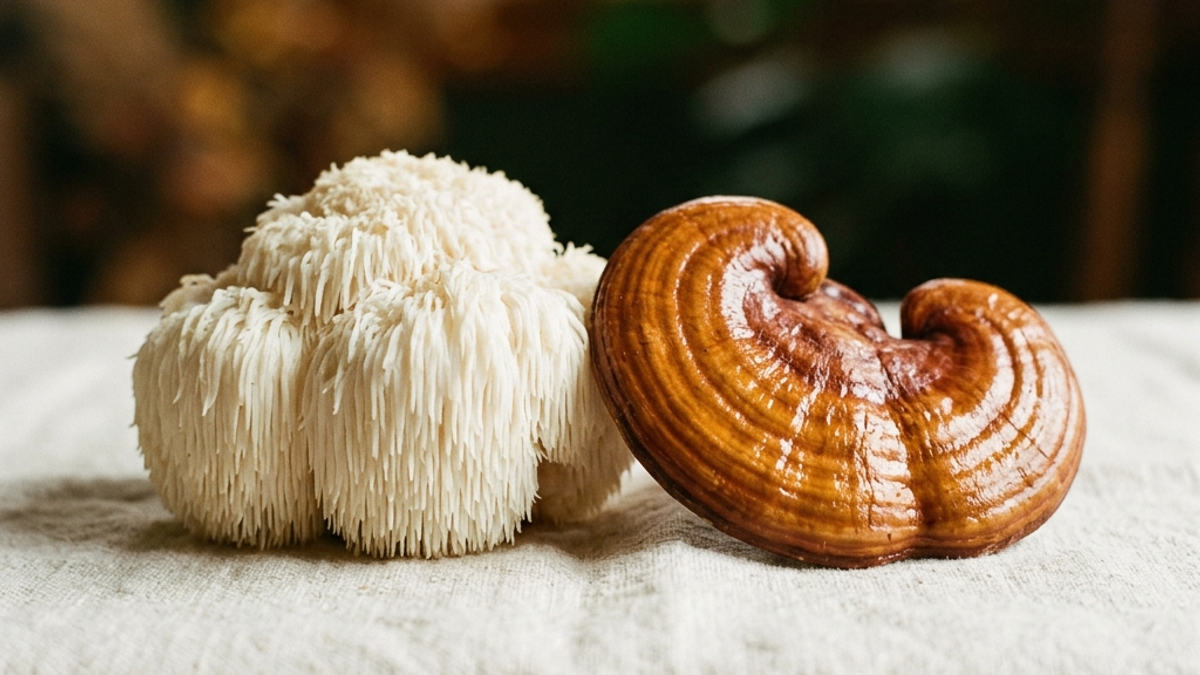
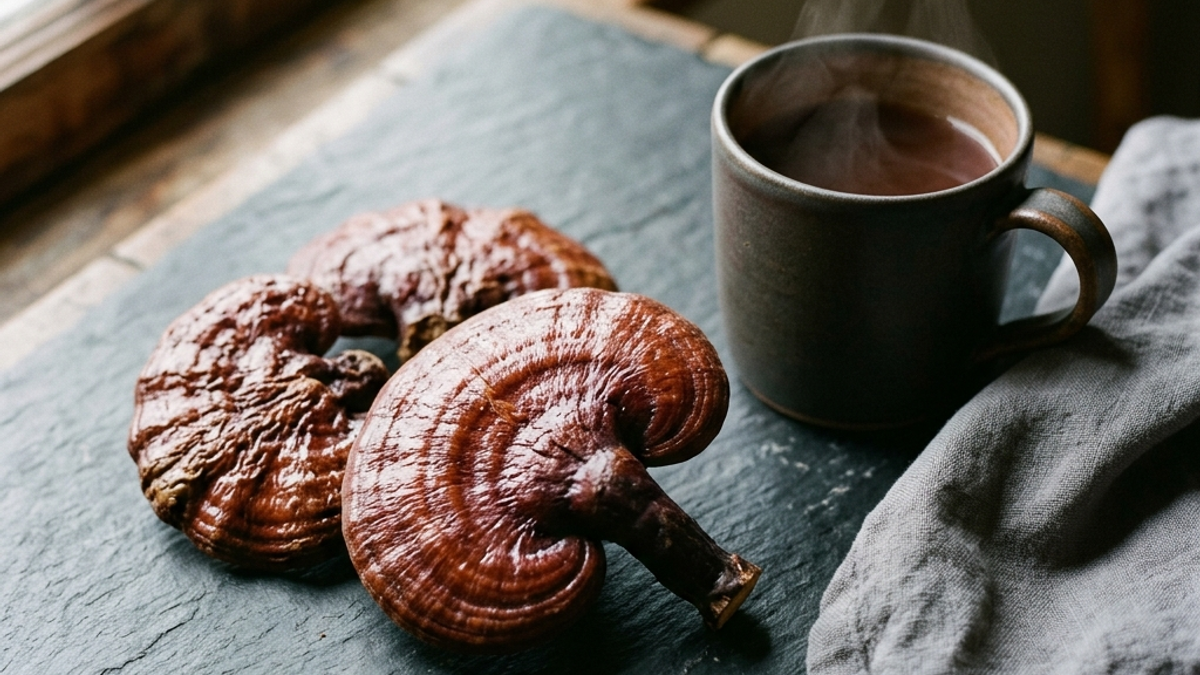
Reishi (Ganoderma lucidum) is studied as an adaptogen — support for a calm, balanced stress response, not a sedative. The honest evening angle is a ritual one: a warm, caffeine-free cup with a real reishi dose can anchor a calmer wind-down, while feeling settled is your physiology, not a sleep-aid claim we make for the mushroom. Our blend carries 500 mg of dual-extracted reishi as part of a seven-mushroom stack.

A quick note before we start: this is education, not medical advice. The right amount of any supplement for you depends on your physiology, your other medications, and your goals.
There's a particular kind of evening most people recognize. The work is more or less done, but your head hasn't gotten the memo — you're still a little wound up, still scrolling, still reaching for one more coffee out of habit. The search history that follows ("reishi for sleep," "calming mushroom for evening") is huge, and most of what it turns up either oversells reishi as a sedative in a cup or dismisses it as folklore. Neither is honest.
So let's do the honest version. This post is the evening-ritual companion to our deeper explainer on what the research actually shows about reishi for calm and stress. That piece walks through the mechanism and the human evidence in detail; this one is about a narrower, more practical question — how a calm-leaning, caffeine-free cup fits a wind-down ritual, and where the line sits between what reishi can support and what it can't.
First, the line we don't cross
Let's be explicit, because this is exactly where reishi marketing tends to drift: reishi is not a sleep aid, not a sedative, and not a treatment for anything. There is no solid human sleep-trial data behind it, and absent that data, "take reishi to fall asleep" is a claim the science can't support.
What reishi is studied for is a calmer, more balanced stress response. Reishi (Ganoderma lucidum) is most often categorized as an adaptogen — a class of compounds studied for helping the body resist and adapt to stress rather than forcing a drowsy hush. The clearest definition comes from a 2010 review of how adaptogens act on the central nervous system (opens in new tab) (Panossian & Wikman, 2010), which describes them as working through the stress-response machinery — including the hypothalamic-pituitary-adrenal (HPA) axis that governs cortisol and your reaction to a demanding day. That's a mechanism review explaining how the category may work, not proof that any single product produces a measurable calming effect. We treat it as the plausible why, and we keep it there.
The practical translation: if a settled stress response makes it easier for you to wind down in the evening, that's your physiology responding — not a sleep claim we get to make for the mushroom. The distinction sounds pedantic. In a health category, it's the whole game.
Why the ritual is doing real work
Here's the part that's easy to miss when you're focused on the ingredient: a lot of "evening calm" is behavioral, not pharmacological. A consistent, warm, screen-free cup at roughly the same time each night is a wind-down anchor — the act of deliberately slowing down signals to your body that the day is closing. Reishi is the calm-leaning ingredient that fits that moment honestly; the ritual around it is half the point.
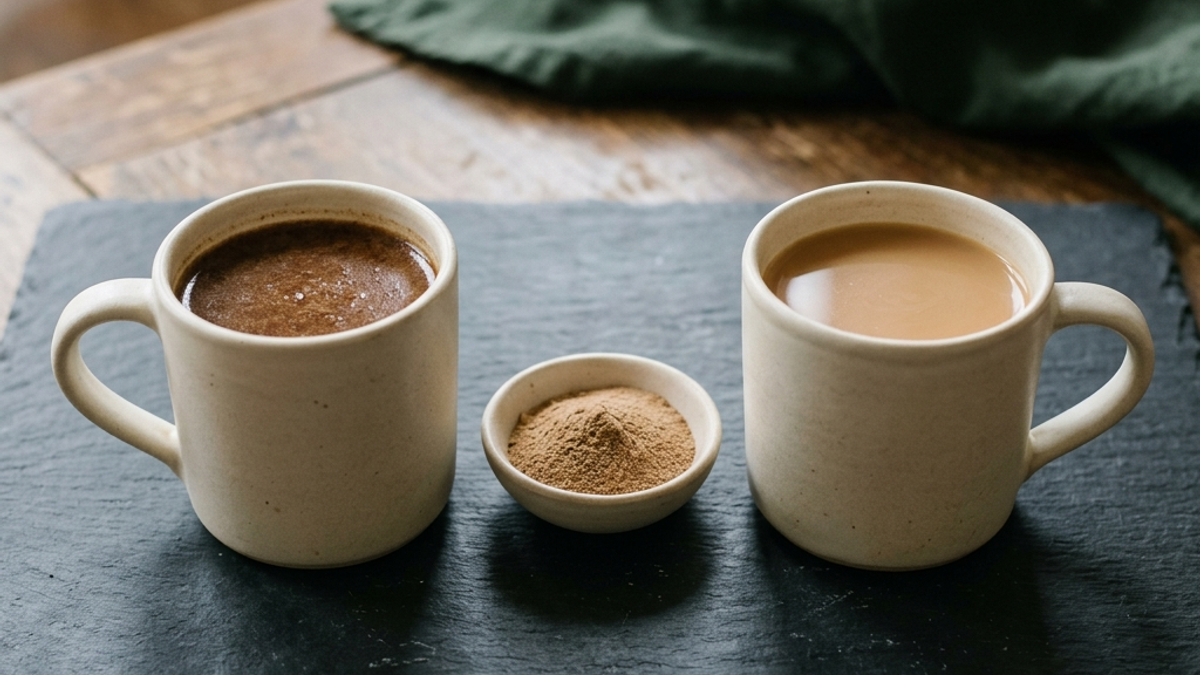
This is also why the caffeine-free part isn't a footnote — it's the reason an evening cup makes sense at all. Caffeine lingers far longer than most people assume. A randomized, placebo-controlled trial on caffeine timing (opens in new tab) (Drake et al., 2013) found that a moderate dose (400 mg) taken even six hours before bed measurably reduced total sleep time, which is why standard sleep-hygiene advice is to cut caffeine well before evening. A reishi-and-coffee product quietly works against the exact wind-down it's marketed for. Ours doesn't, because it's a caffeine-free mix-in, not coffee — you stir it into warm water, a mushroom-coffee alternative, or decaf, and it adds calm-leaning support without a stimulant. If you've ever felt the evening jitter from an afternoon cup, that's the same mechanism we wrote about in why the coffee crash happens.
What the human evidence does — and doesn't — say
Mechanism is the floor. What about people actually taking reishi?
The most relevant direct human signal is an 8-week randomized, double-blind, placebo-controlled trial (opens in new tab) (Tang et al., 2005) in which 132 adults took a Ganoderma lucidum polysaccharide extract and the reishi group reported significantly lower subjective fatigue and a higher sense of well-being versus placebo over the eight weeks. That's genuinely encouraging for a calm-and-steadiness framing — it's a real, placebo-controlled measure of how people felt, not just a lab marker.
Now the honest caveats, because they're non-negotiable here. That trial was run in a specific clinical population (adults diagnosed with neurasthenia, a fatigue-and-stress condition), it used a concentrated polysaccharide extract, and it measured fatigue and well-being — not evening calm or sleep. So I read it as evidence that daily reishi is bioactive and tolerable over weeks, with a plausible effect on how depleted people feel — not as proof it calms your evenings, and certainly not as a treatment for any condition. A separate 6-week randomized controlled trial (opens in new tab) (Collado-Mateo et al., 2015) measured physical fitness rather than mood and points to the same theme: reishi's effects, where they show up, build with consistent daily use over weeks. The honest read across both is "well-supported tradition plus a developing, weeks-long evidence base" — encouraging, early, and easy to overstate.
We separate it deliberately:
- Human evidence: daily reishi, over weeks, has produced measurable changes in subjective fatigue and well-being and in physical fitness — in clinical populations, at doses larger than a single blend serving.
- Mechanism (structure/function): the adaptogen literature gives a plausible stress-protective rationale via the HPA axis.
- What we will not say: that reishi sedates you, treats anxiety or insomnia, or improves sleep. The data don't support it.
For the full walkthrough of that evidence and how we weigh it, the companion piece on reishi for calm and stress is the deeper read.
What's actually in the cup
Reishi's studied activity is attributed mainly to two compound classes: beta-glucans (a type of polysaccharide) and triterpenes, both cataloged in a 2023 review of medicinal-mushroom bioactive components (opens in new tab) (Łysakowska et al., 2023). Two practical consequences follow from that chemistry, and they're the difference between a reishi that does something and a reishi that's just powder:
- Dual extraction matters. Triterpenes are largely alcohol-soluble and beta-glucans largely water-soluble, so capturing both takes both water and alcohol extraction. Our reishi is dual-extracted fruiting body, not mycelium grown on grain. The why is in our explainer on fruiting body versus mycelium.
- The dose has to be real and disclosed. Our blend carries 500 mg of reishi per scoop — printed on the label, not buried in a proprietary blend. We're candid that 500 mg in a seven-mushroom daily stack is not the same as the larger solo doses used in the human trials above; it's reishi taking its lane in a blend, not a clinical reproduction. How to judge whether any reishi dose is meaningful is exactly what our functional mushroom dosing primer is for.
Building a calmer evening, honestly
If you want to actually use reishi for a calmer evening, here's the framing I'd stand behind as a pharmacist:
- Make it a ritual, same time most nights. Consistency is what turns a drink into a wind-down cue — and adaptogen-style support builds over weeks, not in a single serving.
- Keep it caffeine-free. That's the non-negotiable for an evening cup, for the sleep-hygiene reason above. A warm, stimulant-free drink is the point, and an evening cocoa made with the blend is one easy way to make it.
- Expect steadiness, not sedation. The honest experience reishi is studied for is feeling a little less reactive and depleted — not drowsy. If you set the "knock-me-out" expectation, you'll be disappointed, and you'll have been sold a claim no one can back.
- Let the ritual, not the milligram, carry the evening. The calm you can rely on is the kind you build quietly — the same idea behind why we favor energy and calm you build rather than borrow.
Reishi sits in the calm and stress-resilience corner of our seven-mushroom blend, where lion's mane handles focus and cordyceps handles steady, non-stimulant energy. For the full map of where reishi fits among the others, our complete guide to functional mushrooms is the place to start.
The bottom line
"Reishi for restful evenings" is a fair reason to reach for Ganoderma lucidum — as long as "restful" means a calmer, more balanced stress response inside a deliberate, caffeine-free ritual, not a sedative and not a sleep aid. The adaptogen literature gives a plausible mechanism, tradition gives centuries of context, and human trials show daily reishi is bioactive over weeks. None of that licenses an overpromise, so we don't make one.
A genuinely restful evening is mostly something you build — a slower pace, a warm cup, a stimulant you've left out on purpose. Reishi is a reasonable, honest part of that ritual, and that's the standard we hold the formula to: how we built the blend is a disclosed 500 mg of dual-extracted reishi in a caffeine-free stack, every milligram on the label for you to check.
References
- Panossian A, Wikman G. Effects of adaptogens on the central nervous system and the molecular mechanisms associated with their stress-protective activity. Pharmaceuticals (Basel). 2010;3(1):188–224. PMID: 27713248 (opens in new tab) · doi:10.3390/ph3010188 (opens in new tab)
- Tang W, Gao Y, Chen G, et al. A randomized, double-blind and placebo-controlled study of a Ganoderma lucidum polysaccharide extract in neurasthenia. Journal of Medicinal Food. 2005;8(1):53–58. PMID: 15857210 (opens in new tab) · doi:10.1089/jmf.2005.8.53 (opens in new tab)
- Drake C, Roehrs T, Shambroom J, Roth T. Caffeine effects on sleep taken 0, 3, or 6 hours before going to bed. Journal of Clinical Sleep Medicine. 2013;9(11):1195–1200. PMID: 24235903 (opens in new tab) · doi:10.5664/jcsm.3170 (opens in new tab)
- Collado-Mateo D, Pazzi F, Domínguez-Muñoz FJ, et al. Ganoderma lucidum improves physical fitness in women with fibromyalgia. Nutrición Hospitalaria. 2015;32(5):2126–2135. PMID: 26545669 (opens in new tab) · doi:10.3305/nh.2015.32.5.9601 (opens in new tab)
- Łysakowska P, Sobota A, Wirkijowska A. Medicinal mushrooms: their bioactive components, nutritional value and application in functional food production — a review. Molecules. 2023;28(14):5393. PMID: 37513265 (opens in new tab) · doi:10.3390/molecules28145393 (opens in new tab)