Functional Mushrooms for Men: Energy & Focus, No Stimulants
Scientifically reviewed by Dr. Danielle Oncer, PharmD (pharmacology, dosing & safety).
Short answer
For steady energy and focus without stimulants, two mushrooms carry the load: cordyceps for stamina and lion's mane for focus. Cordyceps is studied for supporting energy metabolism and endurance rather than jolting you, and lion's mane is studied for a slow, weeks-long lift in focus and memory. Neither contains caffeine, so there's no 2 p.m. crash to plan around — but both reward consistency, not a single scoop.
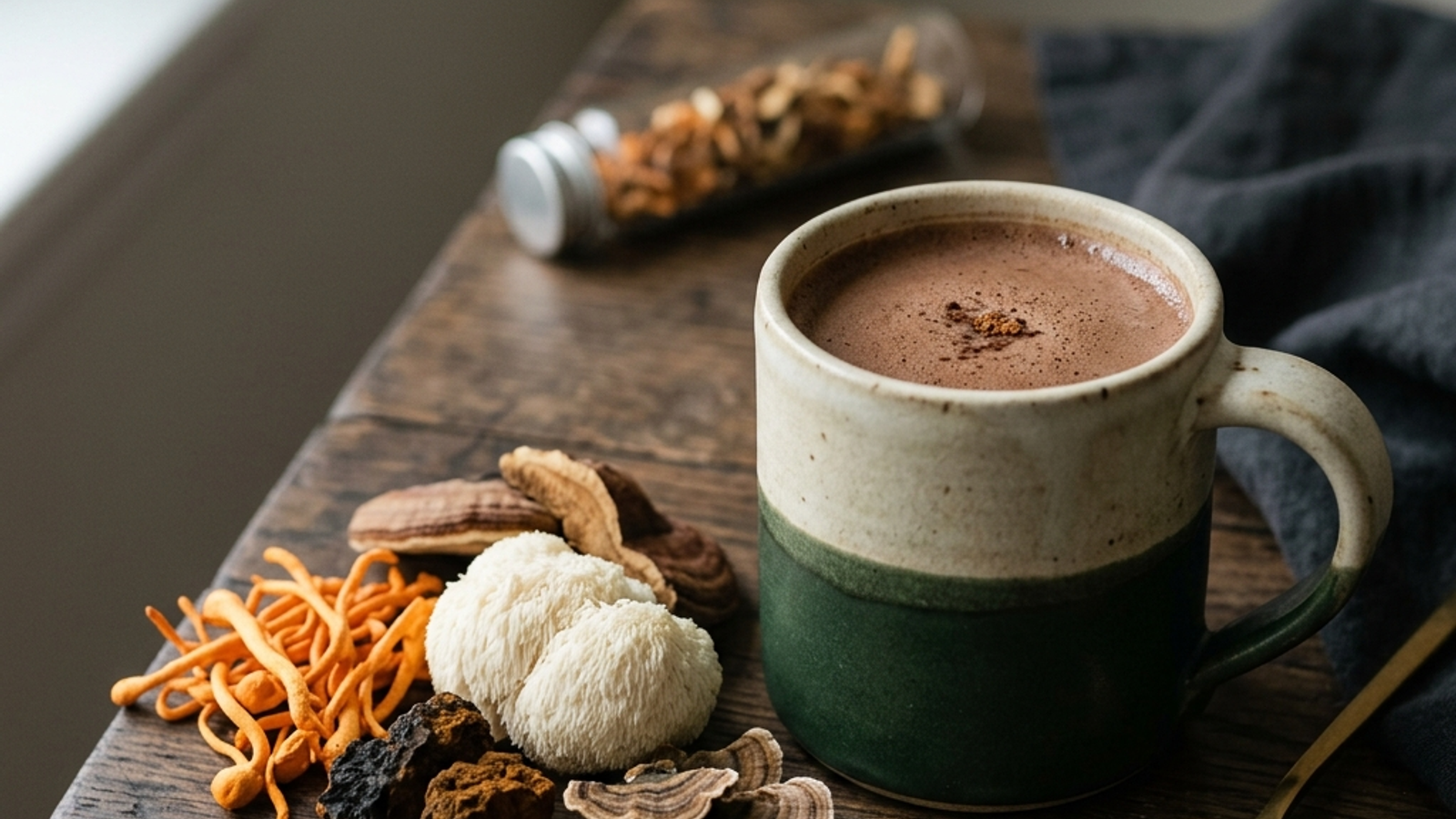
If you searched for mushrooms for energy and focus for men, you've probably already run the caffeine experiment. The lift is real, but it's borrowed — and the bill comes due in the afternoon, usually right when you need a second wind for the gym, the kids, or the last two hours of work. This post is the men's-health hub for a different approach: steady, caffeine-free energy and focus, built by supporting the systems that produce them rather than whipping them with a stimulant.
A quick note on tone first, because the men's-supplement aisle runs hot. This is not a testosterone post, a libido post, or a "peak male performance" post. We make no hormonal or performance-enhancement claims — there's no evidence we'd stand behind, and the honest version of this category doesn't need them. What the research actually supports is more useful anyway: steady stamina and sustained focus, the two things a long day quietly demands. This post is part of our broader men's health guide and our guide to functional mushrooms.
Built energy vs. borrowed energy
Start with the mechanism, because it's the whole reason this works without a stimulant. Caffeine doesn't create energy — it blocks adenosine, the molecule that builds up and signals tiredness. You feel more alert without having changed your underlying fuel supply, which is exactly why it works fast and why it rebounds: when the caffeine clears, the tiredness signal comes back, sometimes louder. We've unpacked that pattern in why the coffee crash happens.
Non-stimulant energy is a different lever. Instead of masking fatigue, the goal is to support the machinery that produces energy — your cells' use of oxygen, the metabolism of fuel into usable ATP, and the gut that underwrites the whole operation. It's quieter. You don't get a jolt; you get a steadier baseline you don't have to keep re-dosing. That distinction — energy you build, not energy you borrow — is the foundation of everything below, and we cover it at length in built energy vs. borrowed energy.
For men specifically, the demand isn't only the gym. It's a long workday, a commute, training, kids, and the stretch between dinner and actually being present in the evening. Steady support across all of that is a more useful frame than a pre-workout stimulant.
Cordyceps: the stamina lane
The mushroom carrying the energy side of this is cordyceps. It's studied in the stamina-and-recovery lane rather than the stimulant lane — the proposed mechanism ties to oxygen use and energy metabolism, not to masking tiredness.
Here's the honest state of the evidence. Much of the human research on cordyceps to date has been on the Cordyceps militaris species — a 2026 narrative review in Nutrients (opens in new tab) gathered those human trials — five intervention studies, 321 participants — and found a thread of ergogenic and post-exercise recovery effects tied to aerobic capacity, time to exhaustion, and oxygen use (Jędrejko et al., 2026). That's the "support the engine, don't whip it" profile that fits a caffeine-free approach. The same authors are candid about the limits: the findings were inconsistent across studies, sample sizes were small, and several used multi-ingredient formulas, so they call for larger, dose-defined randomized trials. A narrative review is a useful map of where the evidence points; it is not the final word, and we'd rather you know that than oversell it.
A good example of why the fine print matters: the most frequently quoted "cordyceps improves endurance" result comes from a 2014 trial in High Altitude Medicine & Biology (opens in new tab), which found improved time to exhaustion after high-altitude training — but the supplement combined Rhodiola and cordyceps, so the cordyceps-alone effect is almost certainly milder than the headline (Chen et al., 2014). When a brand quotes that study as a cordyceps slam-dunk, that's exactly the kind of thing worth catching when you read a supplement label and the studies behind it.
So the line we hold is deliberately modest: cordyceps supports stamina and endurance as a structure/function matter. It is not a stimulant, and it is not a hormonal claim. Our blend lists 1,000 mg of cordyceps per serving on the label — you can see the actual amount there rather than guessing from a blend total. For the full ingredient deep-dive, see cordyceps for energy, and for the lifestyle frame, men's energy without stimulants.
Lion's mane: the focus lane
If cordyceps handles steady output, lion's mane handles sustained attention — and it does it without a stimulant too. The studied mechanism isn't a caffeine-style kick; it runs through nerve growth factor (NGF), a protein your body makes that helps maintain neurons and the connections between them. That's support for the wiring that holds focus, not a borrowed burst of alertness.
The human evidence is more specific than most marketing admits. The most-cited trial is a 2009 double-blind, placebo-controlled study in Phytotherapy Research (opens in new tab), which gave older adults 3,000 mg/day for 16 weeks and measured higher cognitive-scale scores versus placebo (Mori et al., 2009). It's small and ran in a clinical group, so I read it as dose-and-mechanism evidence, not a promise. The fairer study for a busy, healthy man is a 2023 placebo-controlled trial in healthy young adults (opens in new tab), which gave 1.8 g/day of lion's mane for 28 days and reported faster cognitive performance and a trend toward reduced subjective stress (Docherty et al., 2023). It's a small pilot, so hold it loosely — but it's the cleanest "works on its own, in healthy people" signal we have, and it lines up with the same neurotrophic story.
Two honest caveats. First, speed: lion's mane is not a stimulant, and the durable benefit is the slow, weeks-long one — usually noticeable at two to four weeks of consistent use. Second, dose: the clinical range is roughly 1,000–3,000 mg/day of properly extracted fruiting-body powder, and a lot of supplements sit at 500 mg or bury it in a proprietary blend where you can't tell how much you're getting. Our blend lists 1,000 mg of dual-extracted fruiting-body lion's mane per serving on the label. For the mechanism in full, see lion's mane pharmacology, and for the work-and-study angle, lion's mane for focus at work.
Why these two belong together
Cordyceps and lion's mane cover different jobs, which is exactly why they pair well: one supports the energy you run on, the other supports the attention you spend it on. A long day needs both — steady output and a clear head for the third meeting. And because neither is a stimulant, stacking them doesn't stack a crash. You're not borrowing twice; you're supporting two different systems that happen to fail together when you're running on caffeine and four hours of sleep.
That's why we don't sell either one as a solo act. They sit in a blend alongside reishi for the calm-and-resilience side of feeling depleted — covered in reishi for calm and stress — because honesty cuts both ways: not every mushroom belongs in an energy claim, and reishi's job is the stress side, not the stamina side.
The gut is the foundation underneath both
Here's the part that surprises people: a meaningful amount of how energized and focused you feel traces back to the gut. How well you absorb nutrients, how stable your fuel supply is across the day, and the gut–brain signaling that shapes drive and mood all sit underneath the two mushrooms above. Lion's mane is a good illustration — its compounds are fat-soluble and partially handled by your gut microbiota before they reach circulation, so an out-of-balance gut can quietly reduce how much you actually absorb.
That's a formulation decision, not a marketing line. It's why our blend pairs the seven mushrooms with healthy fats from coconut milk powder, 750 mg of acacia prebiotic fiber, and heat-stable pre-, pro-, and postbiotics — the probiotic spore DE111® (1 billion CFU) and the postbiotic BPL1® HT (10 billion cells) — rather than leaning on one "energy" ingredient. We frame this honestly as supporting a healthy gut foundation, not as treating anything. If that connection is new to you, mushrooms, gut health, focus, and energy walks through why the gut keeps showing up in the energy conversation.
How to build steady energy and focus, without a stimulant
The least exciting advice is the most reliable. Non-stimulant support is a foundation you build, not a switch you flip, so the habits around it matter as much as the scoop.
- Treat it as a daily habit, not a rescue. Consistency over days and weeks does more than any single serving, because you're supporting production, not spiking alertness. Both cordyceps and lion's mane reward weeks, not minutes.
- Use it any time. Mid-morning, pre-training, the afternoon dip, or alongside a meal — there's no caffeine clock to obey, and you can take it with your coffee if you like.
- Add a little fat. Lion's mane's compounds are fat-soluble, so taking the blend with cream, coconut milk, or a meal can help absorption — which is partly why the formula already includes coconut milk powder.
- Keep the basics non-negotiable. Sleep, movement, real food, and water are the actual engine. A mix-in supports that engine; it doesn't replace it.
- Judge it on your baseline, not on a jolt. The win is a steadier afternoon and a clearer head, not a buzz.
If you're newer to amounts or want the dose logic in one place, our functional mushroom dosing primer and are functional mushrooms safe cover the practical ground — and as always, talk to a physician or pharmacist before starting anything new if you're taking prescription medications or managing a condition.
The bottom line
Mushrooms for energy and focus for men isn't about finding a stronger jolt — it's about supporting the systems that make your own energy and hold your own attention, then staying consistent. Cordyceps carries the stamina lane and lion's mane carries the focus lane, both caffeine-free, both built on real human research with honest limits, and both dosed where you can actually see them on the label. That's the version we're comfortable standing behind: steady support framed as a foundation, not a promise. Real energy is built from the inside out — which is exactly the idea behind our caffeine-free blend and how we formulate.
References
- Jędrejko M, Jędrejko K, Granda D, Kała K, Pokrywka A, Muszyńska B. Current evidence of ergogenic and post-exercise recovery effects of dietary supplementation with Cordyceps militaris in humans — a narrative review. Nutrients. 2026;18(5):781. PMID: 41829950 · doi:10.3390/nu18050781 (opens in new tab) · https://pubmed.ncbi.nlm.nih.gov/41829950/ (opens in new tab)
- Chen CY, Hou CW, Bernard JR, et al. Rhodiola crenulata- and Cordyceps sinensis-based supplement boosts aerobic exercise performance after short-term high altitude training. High Altitude Medicine & Biology. 2014;15(3):371–379. PMID: 25251930 · doi:10.1089/ham.2013.1114 (opens in new tab) · https://pubmed.ncbi.nlm.nih.gov/25251930/ (opens in new tab)
- Mori K, Inatomi S, Ouchi K, Azumi Y, Tuchida T. Improving effects of the mushroom Yamabushitake (Hericium erinaceus) on mild cognitive impairment: a double-blind placebo-controlled clinical trial. Phytotherapy Research. 2009;23(3):367–372. PMID: 18844328 · doi:10.1002/ptr.2634 (opens in new tab) · https://pubmed.ncbi.nlm.nih.gov/18844328/ (opens in new tab)
- Docherty S, Doughty FL, Smith EF. The acute and chronic effects of lion's mane mushroom supplementation on cognitive function, stress and mood in young adults: a double-blind, parallel groups, pilot study. Nutrients. 2023;15(22):4842. PMID: 38004235 · doi:10.3390/nu15224842 (opens in new tab) · https://pubmed.ncbi.nlm.nih.gov/38004235/ (opens in new tab)