Cacao for Mood and Gentle, Caffeine-Free Alertness
Scientifically reviewed by Onur Oncer, B.S. (B.S. Physiology, published researcher).
Short answer
People reach for cacao for mood because real cocoa has a comforting, gently uplifting quality — and there's a thread of human research on cocoa flavanols and mental clarity. The honest part: those studies use high-flavanol doses, while the cacao in a flavor-forward blend is there for taste, not a clinical flavanol dose. Used that way, cacao supports a calm, caffeine-free moment rather than a stimulant hit.
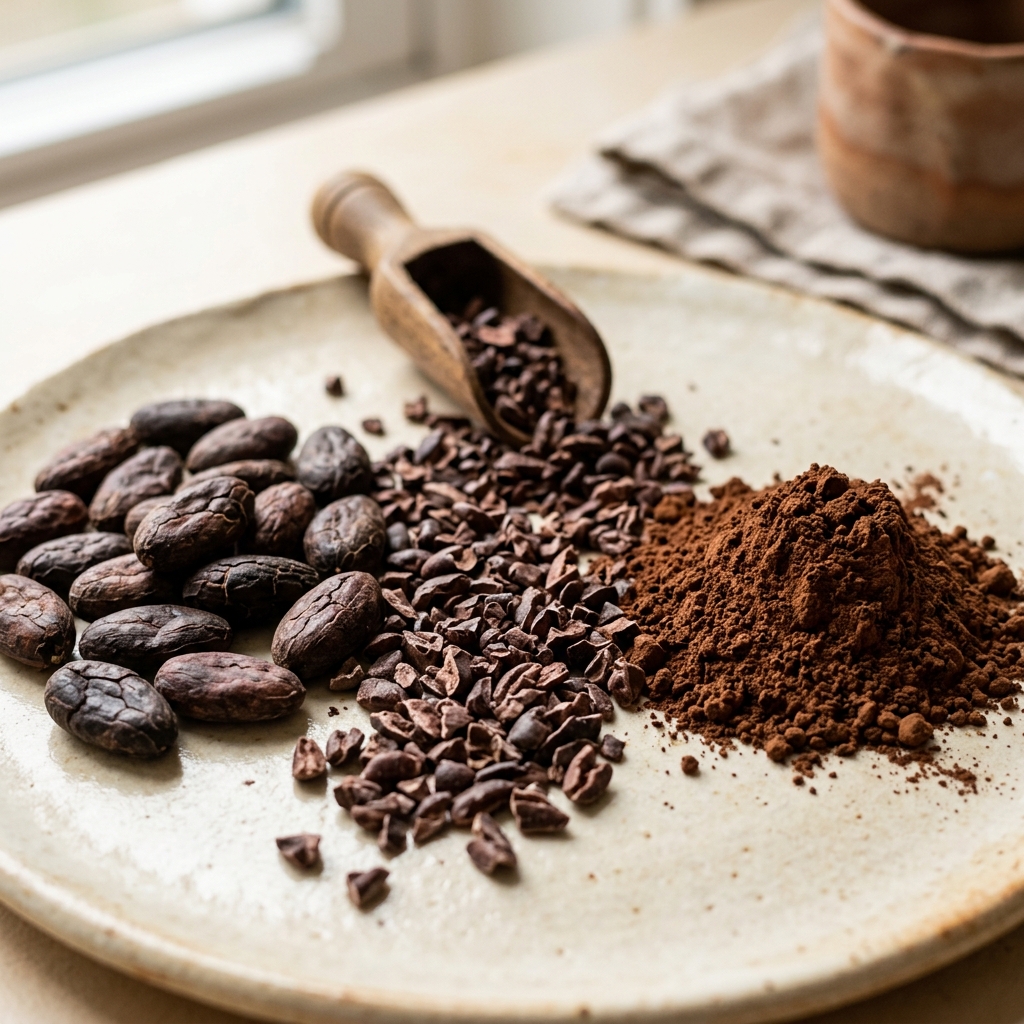
If you've ever wrapped your hands around a warm cup of real cocoa and felt your shoulders drop, you already understand why people search for cacao for mood. There's something genuinely comforting and quietly uplifting about it. The honest question is how much of that is established science, how much is ritual, and what a flavor-level scoop of cacao in a blend can — and can't — claim. Here's the short version: cocoa flavanols have a real, if early, thread of human research behind them, but those studies use concentrated, high-flavanol cocoa. The cacao in a flavor-forward, caffeine-free mix-in is there for taste and a gentle moment, not to deliver a clinical flavanol dose. Used that way, cacao supports a calm, steady lift rather than a stimulant hit.
What the science actually says about cacao and mood
Let's start with what's measured, not what's marketed. The most relevant recent work is a 2025 randomized, double-blind crossover trial on flavanol-rich cocoa (opens in new tab) published in Psychopharmacology. In it, a single intake of high-flavanol cocoa helped preserve one aspect of inhibitory executive function — a slice of mental clarity — when participants were cognitively fatigued during aerobic exercise.
It's a tidy result, and it's worth reading the fine print closely. The study was acute (a single dose, not weeks of use), it was conducted in men, and — most importantly for us — it used flavanol-rich cocoa, the concentrated kind, not a spoonful of cacao for flavor. So it tells us something real about cocoa-flavanol biology: under the right conditions, those compounds can support the brain's ability to stay on task. It does not tell us that any cup of cocoa, at any dose, will lift your mood on demand.
That distinction is the whole point of this post.
Why our cacao is flavor-level — and why we say so
The cocoa-flavanol studies that show cognitive effects rely on high flavanol doses, often hundreds of milligrams in a single serving, and on minimally processed, non-alkalized cocoa (processing strips flavanols). A scoop of cacao chosen primarily for taste in a multi-ingredient blend does not match that pharmacology.
So we won't pretend it does. The cacao in our mix-in is there to make the ritual genuinely pleasant — that warm, grounding, slightly indulgent quality real cocoa brings — and to round out the flavor of seven mushrooms and superfoods. We are not claiming it delivers a clinical flavanol dose or reproduces the trial result above. That's the difference between educating you on cocoa-flavanol science and overselling a flavor ingredient. (If you want our broader philosophy on dose honesty, how we formulate lays it out.)
What cacao does do, reliably, is support the experience: a calm, satisfying moment that feels like a treat without being a stimulant.
Cacao, gentle alertness, and the caffeine question
A fair thing to know: plain cacao isn't entirely stimulant-free. It naturally contains small amounts of caffeine and theobromine — which is why very dark chocolate late at night can keep sensitive people up. That's a feature of cocoa, not a flaw, but it matters for how you frame "alertness."
Because our cacao is at a flavor level, the overall product stays caffeine-free. That's deliberate. The category of "mushroom coffees" is mostly built on a coffee or tea base, so those products contain caffeine. We took the other road: a caffeine-free mix-in you can stir into whatever you're already drinking, at any hour, without a jolt or a 2 p.m. crash to plan around. (We dig into why the afternoon coffee crash happens and what built energy versus borrowed energy actually means in two companion posts.)
So when we say "gentle alertness," we mean exactly that — gentle. The lift cacao contributes here is the kind that comes from pausing with a warm, pleasant cup, not from a chemical push. If you're specifically trying to step off the stimulant treadmill, that's a different and, for many people, better-matched tool than even decaf, which still isn't truly caffeine-free.
The gut connection: where mood quietly begins
There's a deeper reason cacao sits well in a blend built around the gut. Mood isn't made only in the brain — a surprising amount of the relevant chemistry starts lower down. Research in Cell showed that indigenous gut bacteria help regulate the body's serotonin production (opens in new tab), and roughly 90 percent of the body's serotonin is made in the gut. That figure is standard physiology; the study itself was mechanistic, in germ-free mice, so we're describing a foundation, not a finished mood claim.
Why does this matter for cacao? Cocoa's polyphenols are among the dietary compounds gut microbes interact with — they're partly metabolized by your microbiome. That's one reason we pair cacao with pre-, pro-, and postbiotics rather than dropping it in alone: the gut is the soil, and a healthier soil is part of how the whole system, mood included, functions better. We frame this honestly as supporting a healthy gut foundation, never as treating anything. If the gut–mood link is new to you, our piece on the gut–brain axis and how it shapes focus, mood, and energy is the place to go deeper, and the broader caffeine-free energy & focus guide puts cacao in context alongside the seven fruiting-body extracts.
How to actually use cacao for a gentle lift
The least glamorous advice is the most useful: treat cacao as a ritual, not a performance hack. The benefit people consistently describe — a pleasant, grounding break with a soft sense of clarity — comes more from the pause than from any single strong dose.
- Make it a moment you actually take. Mid-morning, the mid-afternoon dip, or winding down all work, because there's no caffeine dictating the clock. The same scoop covers all three as a morning latte, an iced afternoon cup, or an evening cocoa.
- Warm it up. Stir a caffeine-free cacao blend into warm milk or water; the warmth is part of why it feels settling.
- Be consistent. As with most functional ingredients, a daily habit does more than one dramatic cup. Steady beats spiky.
If you want the full picture of what's in the cup, our blend lists every ingredient and dose on the label — cacao included — so you always know exactly what you're getting and at what level.
The bottom line
Cacao earns its place for mood the honest way: it makes a caffeine-free ritual feel warm, comforting, and gently uplifting, while the cocoa-flavanol research that hints at mental-clarity benefits stays clearly labeled as high-dose, early-stage science we don't claim to reproduce at flavor level. That's the version of "cacao for mood" we're comfortable standing behind — a calm, steady moment you can take any time of day. Real support is built from the inside out, which is the whole idea behind how we formulate.
References
- Tsukamoto H, Yoneya S, Koyama T, et al. A single intake of flavanol-rich cocoa improves inhibitory executive process under cognitive fatigue during aerobic exercise in men: a randomized, double-blind, placebo-controlled crossover trial. Psychopharmacology (Berl). 2025;242(12):2713–2724. PMID: 40493074. https://pubmed.ncbi.nlm.nih.gov/40493074/ (opens in new tab)
- Yano JM, Yu K, Donaldson GP, et al. Indigenous bacteria from the gut microbiota regulate host serotonin biosynthesis. Cell. 2015;161(2):264–276. PMID: 25860609. https://pubmed.ncbi.nlm.nih.gov/25860609/ (opens in new tab)