Circulation & Cardiovascular Wellness: An Honest Look
Scientifically reviewed by Dr. Danielle Oncer, PharmD (pharmacology, dosing & safety).
Short answer
The link between cocoa flavanols and circulation is real, but it comes with a big asterisk: the benefits in human trials show up at high flavanol doses — roughly 670 to 710 mg a day — and even then the blood-pressure effect is small (about 2 mmHg). The cacao in our blend is included at a flavor level, so it does not deliver a clinical flavanol dose. We're happy to explain the science; we make no claim that our product improves circulation, lowers blood pressure, or affects any cardiovascular condition.

If you've gone looking into cocoa flavanols and circulation, you've probably seen the exciting headlines and the cautious fine print sitting awkwardly side by side. Here's the honest version up front: yes, there is real human research connecting cocoa flavanols to the body's circulatory chemistry — but the effects show up at high flavanol doses, and even then they're modest. The cacao in our blend is there for flavor, not as a clinical flavanol dose, so this post is education, not a product claim. We'll walk through the mechanism, the actual numbers from the trials, and why we draw a firm line between "interesting science" and "something our mix-in does for your blood vessels."
What cocoa flavanols and circulation actually means
Flavanols are a family of plant compounds found in minimally processed cocoa (among other foods). The reason they keep coming up in cardiovascular research is a fairly well-mapped piece of physiology: the inner lining of your blood vessels, called the endothelium, helps produce nitric oxide, a signaling molecule that tells the smooth muscle in vessel walls to relax. When those walls relax a little, the vessel widens slightly — a process called vasodilation — and blood moves more easily.
Cocoa flavanols appear to support that nitric-oxide pathway. That's the whole mechanistic story in one sentence, and it's genuinely interesting biology. But a plausible mechanism is the beginning of the conversation, not the end of it. The questions that matter are: how big is the effect, how much do you need to take to see it, and what kind of cocoa delivers it? That's where dose honesty has to come in.
What the human research really shows
Two pieces of human evidence are worth knowing, and both come with their numbers attached — which is exactly the point.
The first is a 2017 Cochrane review of cocoa and blood pressure (opens in new tab). Pooling 35 trials, the authors found "moderate-quality evidence that flavanol-rich chocolate and cocoa products cause a small (2 mmHg) blood pressure-lowering effect in mainly healthy adults in the short term." Read that carefully. The effect is real, but it's small — about 2 mmHg — it's short-term, and the mean dose across those trials was roughly 670 mg of flavanols a day. That is a concentrated amount of flavanols, not a casual spoonful of cocoa.
The second is a 2019 dose-response meta-analysis on cocoa flavanols and endothelial function (opens in new tab) in Food & Function. It reported that "cocoa flavanols could significantly improve endothelial function, with an optimal effect observed with 710 mg total flavanols" — measured as a modest improvement in flow-mediated dilation (about 1.17%). Again, note the number: the optimal effect sat at roughly 710 mg of flavanols. The authors themselves flagged "significant risk-of-bias concerns" across most of the included studies, which is the kind of caveat we'd rather surface than bury.
So the picture is consistent. There's a measurable, mechanistically sensible signal linking cocoa flavanols to circulation — and it lives at high flavanol doses, in the neighborhood of 670 to 710 mg a day, using concentrated, minimally processed cocoa.
Why our cacao is flavor-level — and why that matters here
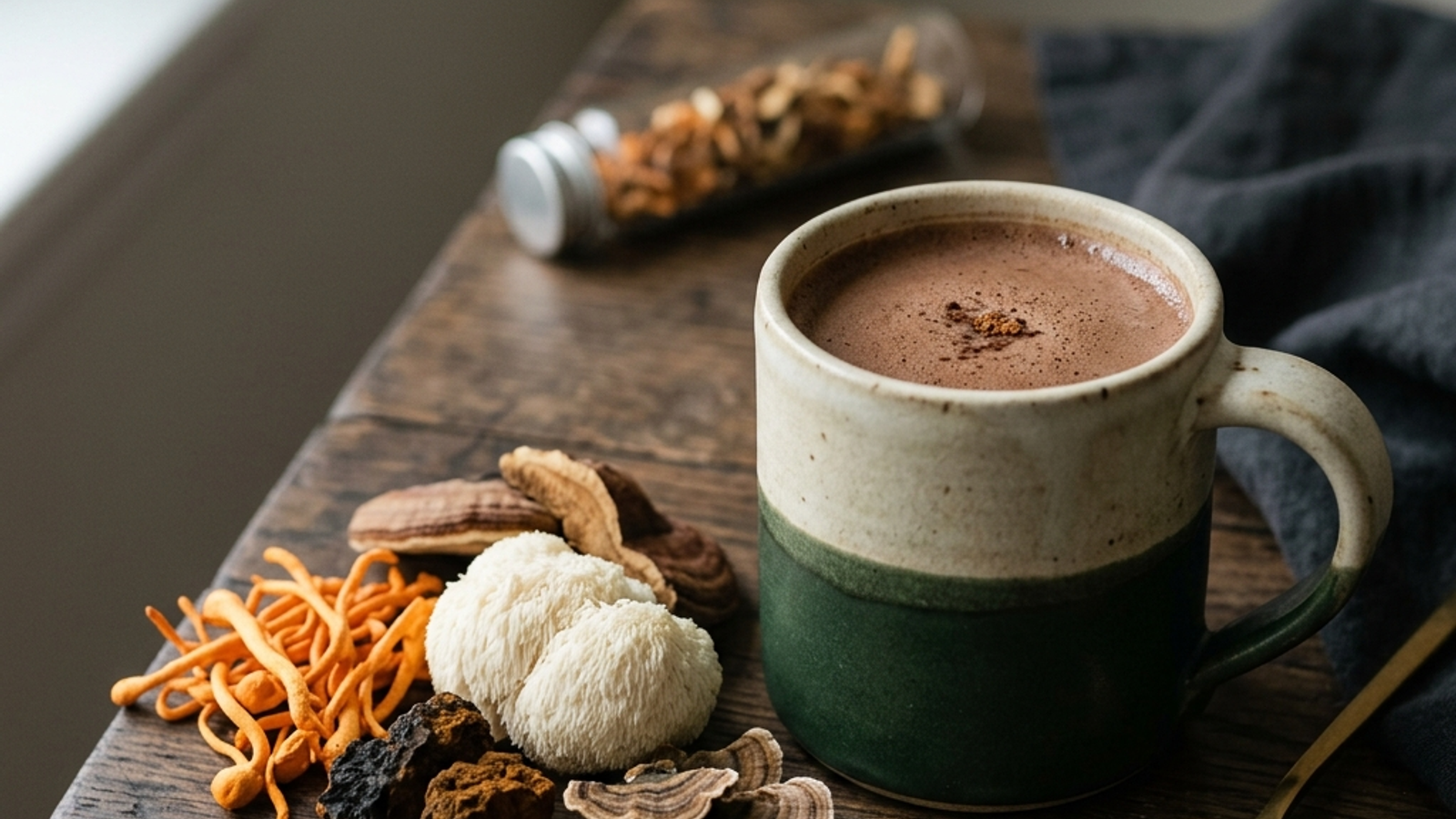
This is the part we won't soften. The cacao in our mix-in is included for flavor — to make a blend of seven mushrooms and superfoods genuinely pleasant to drink. It is not formulated to deliver a clinical flavanol dose, and it doesn't.
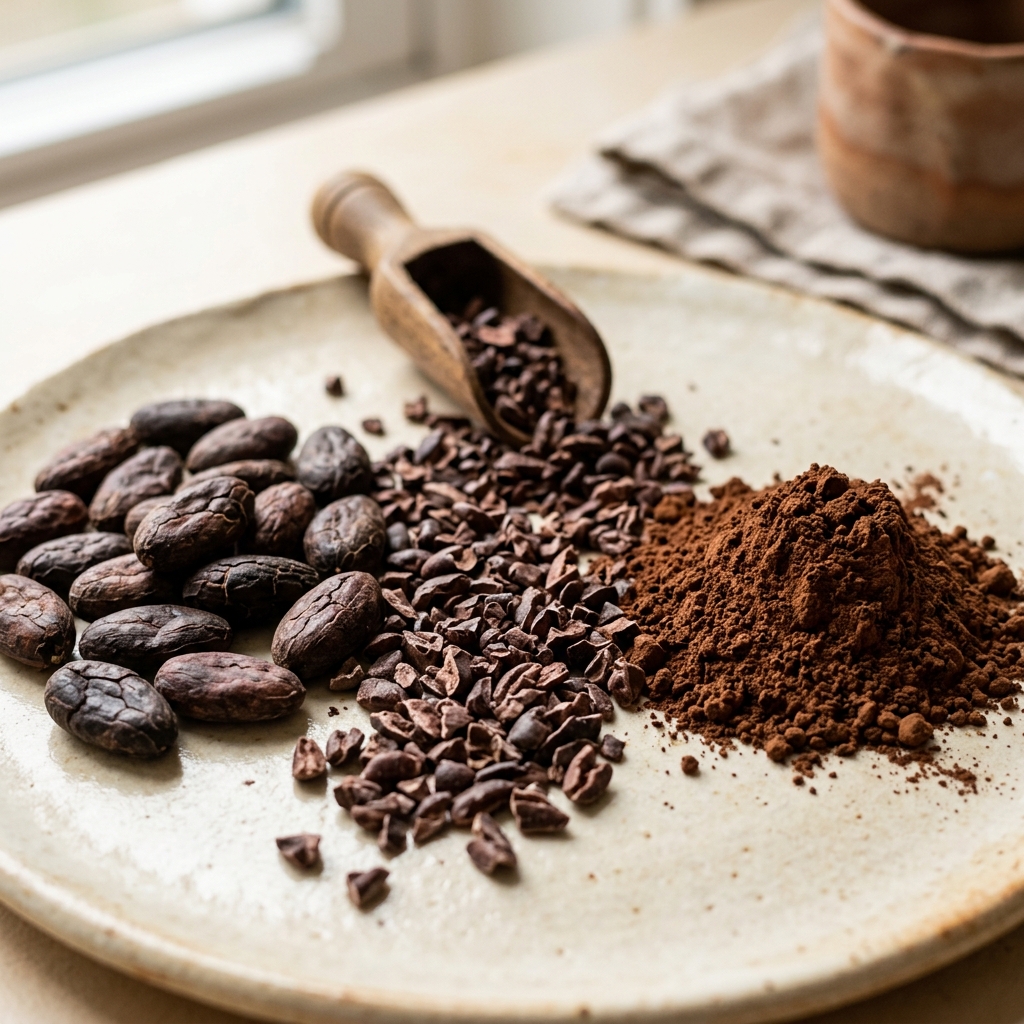
A few reasons that gap is real. The studied doses are large (again, ~670–710 mg of flavanols), and a flavor-level scoop in a multi-ingredient powder isn't designed to hit that. Flavanol content also depends heavily on processing: alkalized ("Dutched") cocoa loses much of its flavanol load, so even the same weight of cocoa can carry wildly different amounts. Stacking those facts together, it would be misleading for us to imply our cacao reproduces the trial results above.
So we don't. We make no claim that our product improves circulation, lowers blood pressure, supports blood flow, or affects any cardiovascular condition. What we'll do instead is tell you the science accurately and let you decide what to make of it. If you want our broader reasoning on dose transparency, our approach to formulation lays it out, and our companion piece on cacao for mood and gentle, caffeine-free alertness applies the same dose-honest lens to the mood side of the cocoa-flavanol story. This is the same way we handle every place where the marketing temptation outruns the evidence.
What about the mushrooms and circulation?
Since this is the cardiovascular post, it's fair to ask whether any of our mushrooms carry circulatory claims. The honest answer is no — and we'd rather tell you that than stretch the data.
- Reishi. A Cochrane review concluded the available evidence does not support reishi for cardiovascular risk factors. So we make no reishi circulation or blood-pressure claim. Reishi belongs in the calm and stress-resilience conversation, framed honestly, not the cardiovascular one.
- Cordyceps. There's no human vascular data for cordyceps. We keep it firmly in the energy and stamina lane — and even there, we take the daily-life angle of steady stamina, not a performance or "blood flow" promise.
In other words, of everything in the blend, cocoa flavanols are the only component with real human circulatory research behind them — and as we've covered, that research points back to a high flavanol dose our flavor-level cacao doesn't deliver.
A note on men's health and framing
Healthy circulation supports everyday function — and circulation is a topic a lot of men get curious about as they think about aging well. We think that curiosity deserves accurate information rather than a wellness powder dressed up as a cardiovascular tool. The most useful thing we can offer is the real mechanism, the real numbers, and a clear line about what our product does and doesn't do. If you're exploring this within the wider context of men's steady energy without stimulants or antioxidants and healthy aging, those companion posts keep to the same structure-and-function framing.
One thing worth saying plainly: anything involving blood pressure, heart health, or a cardiovascular condition is a medical conversation, not a supplement one. If that's where your interest is coming from, the right next step is your doctor, not a scoop of anything. You can always browse the full ingredient list and doses so you know exactly what is — and isn't — in the cup.
The bottom line
The science of cocoa flavanols and circulation is real and worth understanding: flavanols support the nitric-oxide pathway that helps blood vessels relax, and human trials show a small blood-pressure signal and improved endothelial function — at high flavanol doses around 670 to 710 mg a day. Our cacao is flavor-level, so we don't claim it does any of that. That's the version of this topic we're comfortable standing behind: honest about the biology, honest about the dose, and honest about the limits of a flavor ingredient. For more on how we think about what's in the blend and why, see the functional-mushroom guide, our men's health guide, and how we formulate.
References
- Ried K, Fakler P, Stocks NP. Effect of cocoa on blood pressure. Cochrane Database of Systematic Reviews. 2017;4:CD008893. PMID: 28439881. https://pubmed.ncbi.nlm.nih.gov/28439881/ (opens in new tab)
- Sun Y, Zimmermann D, De Castro CA, Actis-Goretta L. Dose-response relationship between cocoa flavanols and human endothelial function: a systematic review and meta-analysis of randomized trials. Food & Function. 2019;10(10):6322–6330. PMID: 31524216. https://pubmed.ncbi.nlm.nih.gov/31524216/ (opens in new tab)