Are Mushrooms Probiotics? Prebiotic vs. Probiotic, Honestly
Scientifically reviewed by Onur Oncer, B.S. (B.S. Physiology, published researcher).
Short answer
No — mushrooms are not probiotics. They contain no live bacteria. Their beta-glucans and fibers act as prebiotics: food for the beneficial bacteria you already carry. A complete gut formula pairs that prebiotic fiber with an actual probiotic strain and a postbiotic.
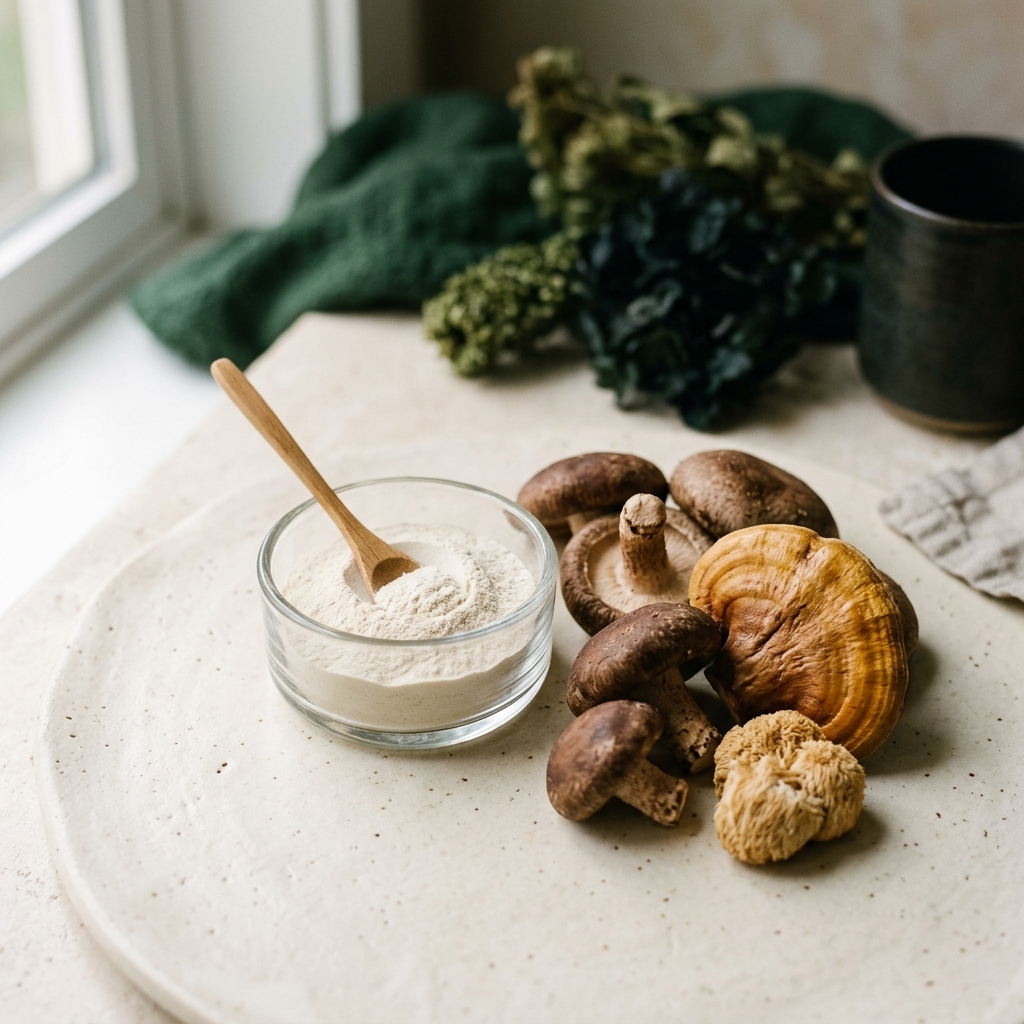
If you have shopped for a mushroom blend lately, you have probably seen "gut health" stamped on the front and quietly assumed the mushrooms were doing probiotic work. It is an easy assumption to make, and it is wrong. As a pharmacist, this is one of the most common gut questions I get, so let me give you the honest, unglamorous answer up front: mushrooms are not probiotics. They contain no live bacteria. What they do is feed the bacteria you already carry — which makes them prebiotic, not probiotic. That distinction is small in wording and large in meaning, and it changes how you should read every gut-health label on the shelf.
The short version: no, and here is why
A probiotic, by definition, is a live beneficial microorganism. Mushrooms are not alive by the time they reach your cup — they are dual-extracted, dried, and milled — and they were never bacteria to begin with. So they cannot be a probiotic in any literal sense.
What functional mushrooms are rich in is beta-glucans: a class of fiber-like compounds that your own gut bacteria can use as fuel. In other words, mushrooms behave like food for your microbiome rather than an addition to it. That is the textbook definition of a prebiotic. So the accurate sentence is: mushrooms are prebiotic-acting, not probiotic. Same goal — a healthier gut — by a completely different route.
Prebiotic vs. probiotic vs. postbiotic, in plain language
These three words get used interchangeably in marketing, which is exactly why nobody can keep them straight. They are not synonyms; they are three links in one chain.
- Prebiotic — the food. Fibers and fiber-like compounds (including mushroom beta-glucans and acacia fiber) that feed the beneficial bacteria you already have. They are not alive. They are lunch for the microbes that are.
- Probiotic — the bacteria. Live beneficial microorganisms you take in to add to your existing population.
- Postbiotic — the output. The beneficial compounds those bacteria produce, often delivered in a heat-treated, shelf-stable form so you get the useful end-product without needing the cells to stay alive.
The simplest way to hold it in your head: prebiotics feed the bacteria, probiotics add to the bacteria, postbiotics are what the bacteria make. If you want to see why this chain matters in the first place — how a well-fed gut becomes the root of steady energy and focus — that is the bigger picture in how your gut quietly fuels real energy and focus. This post stays mushroom-first.
Where mushrooms actually fit: the prebiotic slot
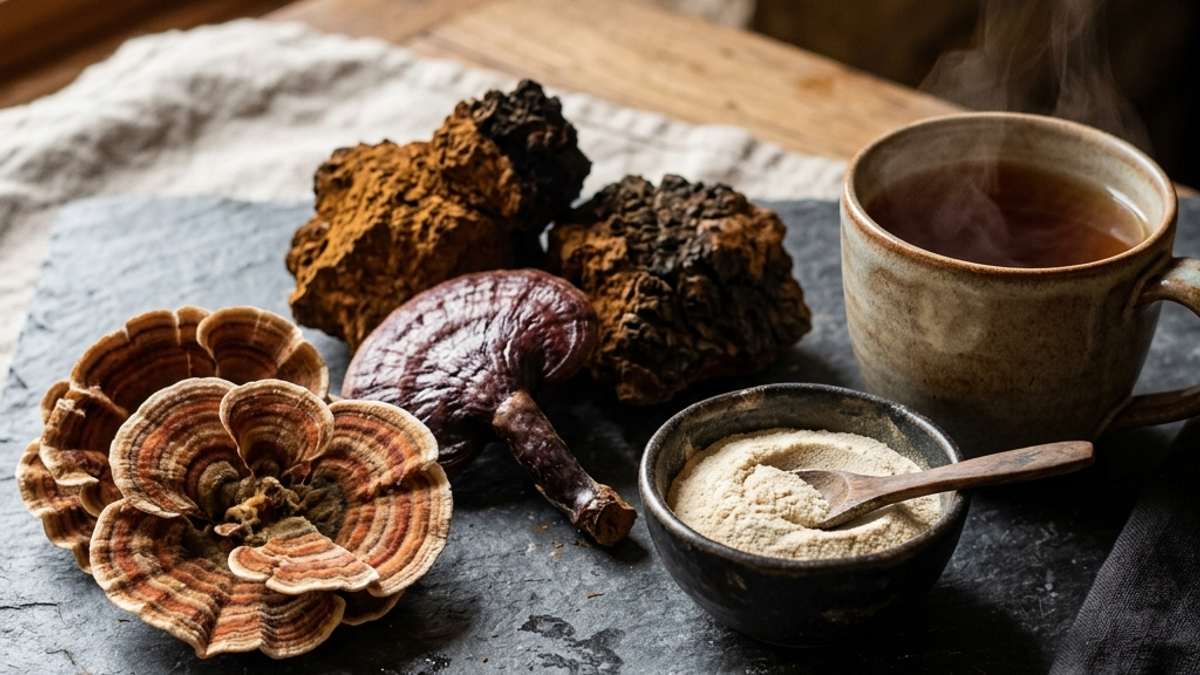
Several of the mushrooms in our blend — turkey tail, reishi, and chaga among them — are notably high in beta-glucans. A review of how beta-glucans interact with immune-cell receptors (opens in new tab) describes them as biologic response modifiers that bind receptors such as Dectin-1 and CR3, and that same fiber-like fraction is what your gut bacteria can ferment. So beta-glucans do double duty: they are the immune-interesting part of a mushroom and the prebiotic-acting part. In a gut-health frame, the honest claim is the prebiotic one — they are material your existing microbiome can use, not organisms you are introducing.
To be clear about compliance, because this is a health topic: this is structure/function support, not treatment of anything. Turkey tail, for example, supports immune function and gut flora — full stop. It does not treat disease, and we keep mushroom claims to "supports" and "helps maintain." Feeding your microbiome is a real contribution, but it is a foundational one, not a cure.
How a complete gut formula covers all three
Here is where most mushroom blends stop — at the prebiotic step — and call it "gut health." We did not want to leave two-thirds of the chain to chance, so the Shroombiosis blend is built to cover prebiotic, probiotic, and postbiotic deliberately.
Prebiotic — acacia fiber + mushroom beta-glucans. Alongside the beta-glucans from the mushrooms, the blend includes acacia fiber (gum arabic) as a dedicated prebiotic. A 12-week fiber-supplement RCT in healthy adults (opens in new tab) found it shifted the composition of the gut microbiome, though the metabolic and inflammatory resilience markers were unchanged. One honest caveat: that study used acacia gum combined with carrot powder, so we credit the fiber supplement as tested rather than acacia in pure isolation.
Probiotic — Bacillus subtilis DE111®. This is the live part, and it is the piece mushrooms cannot supply. DE111® is a heat-stable, spore-forming strain, which is why it can ride along in a warm drink. In a pilot clinical trial of DE111® in healthy adults (opens in new tab), the researchers reported that "we observed an increase in anti-inflammatory immune cell populations in response to ex vivo LPS stimulation of PBMCs in the DE111 intervention group." I am quoting that verbatim on purpose, and I am going to quote the caveat verbatim too, because the same paper is admirably honest: "Overall perceived gastrointestinal health, microbiota, and circulating and fecal markers of inflammation (Il-6, sIgA) and gut barrier function (plasma zonulin) were largely unaffected by DE111 intervention, although the study may have been underpowered to detect these differences." So we frame DE111® as an immune-signal in a small pilot — maintenance and support — not as a proven digestion or regularity fix.
Postbiotic — Bifidobacterium animalis subsp. lactis CECT 8145 (BPL1® HT). The "HT" means heat-treated: a postbiotic form, not a live probiotic. The strain's research comes from a trial of the live and heat-killed cells, which reported that "in abdominally obese individuals, consumption of Ba8145, both as viable and mainly as heat-killed cells, improves anthropometric adiposity biomarkers, particularly in women." That is the heat-killed form — the same idea as our HT postbiotic — and we cite it as gut and metabolic structure/function support, not a weight-loss claim. The trial ran in a specific population, and our ingredient is the postbiotic form, so we are precise about both.
Put together, that is the full chain in one scoop: prebiotic fiber to feed your bacteria, an actual probiotic to add to them, and a postbiotic for the useful output — with every dose printed on the label so you can verify it yourself rather than trust a "gut health" badge.
Why this matters when you read a label
The reason the prebiotic-versus-probiotic distinction is worth your attention is that the gut sits underneath almost everything else people want from these products. A 2012 review in Nature Reviews Neuroscience (opens in new tab) mapped out the gut–brain axis — the two-way signaling between your microbiome and your brain — and it is the reason a well-fed gut connects to mood, calm, and how clearly you think. If a blend's only gut credential is "contains mushrooms," it is offering you the prebiotic link and quietly skipping the other two.
So the practical takeaway when you are comparing products: look for whether a blend names a real probiotic strain (not just "probiotics"), whether it discloses the form (live vs. heat-treated postbiotic), and whether it prints amounts rather than hiding behind a proprietary blend. That is the same label-literacy habit I walk through in how to read a mushroom supplement label, and it is the difference between a product that says gut health and one that is actually built for it.
The bottom line
Mushrooms are not probiotics — they are prebiotic-acting, feeding the bacteria you already have through their beta-glucans and fibers. That is a genuine contribution to gut health, but it is one link in a three-link chain, which is why a complete formula adds a real probiotic and a postbiotic on top. If you want the wider view of how these ingredients fit daily energy and focus, see five ways mushrooms support gut health, focus, and energy, the pharmacology deep-dive in the full lion's mane breakdown, and our complete guide to gut health — the pillar this post belongs to — alongside the broader functional mushrooms guide. If the question is how a live probiotic survives a drink you make with hot water, that has its own answer. A balanced gut is the foundation; mushrooms help feed it, and we built the rest of the chain in on purpose.
References
Akramiene D, Kondrotas A, Didziapetriene J, Kevelaitis E. Effects of beta-glucans on the immune system. Medicina (Kaunas). 2007;43(8):597–606. PMID: 17895634 (opens in new tab)
Eveleens Maarse BC, Eggink HM, Warnke I, et al. Impact of fibre supplementation on microbiome and resilience in healthy participants: a randomized, placebo-controlled clinical trial. Nutrition, Metabolism & Cardiovascular Diseases. 2024;34(6):1416–1426. PMID: 38499450 (opens in new tab) · doi:10.1016/j.numecd.2024.01.028 (opens in new tab)
Freedman KE, Hill JL, Wei Y, et al. Examining the gastrointestinal and immunomodulatory effects of the novel probiotic Bacillus subtilis DE111. International Journal of Molecular Sciences. 2021;22(5):2453. PMID: 33671071 (opens in new tab) · doi:10.3390/ijms22052453 (opens in new tab)
Pedret A, Valls RM, Calderón-Pérez L, et al. Effects of daily consumption of the probiotic Bifidobacterium animalis subsp. lactis CECT 8145 on anthropometric adiposity biomarkers in abdominally obese subjects: a randomized controlled trial. International Journal of Obesity (Lond). 2019. PMID: 30262813 (opens in new tab)
Cryan JF, Dinan TG. Mind-altering microorganisms: the impact of the gut microbiota on brain and behaviour. Nature Reviews Neuroscience. 2012;13(10):701–712. PMID: 22968153 (opens in new tab) · doi:10.1038/nrn3346 (opens in new tab)